Clinical Knowledge › Internal medicine › Cardiology and angiology › Relevant pharmacology
Angiotensin receptor–neprilysin inhibitors and SGLT2 inhibitors in heart failure
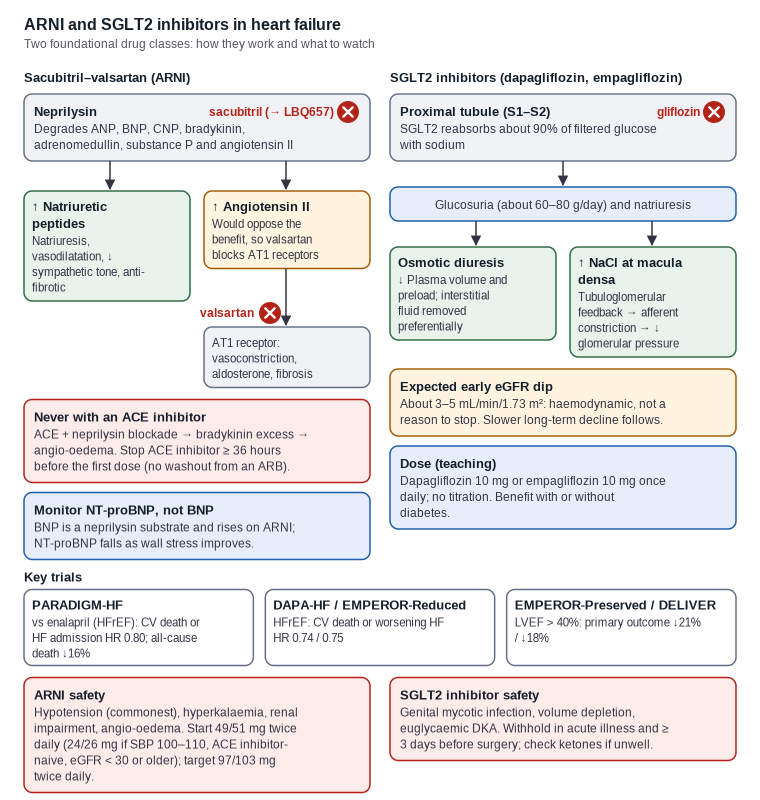
Sacubitril–valsartan, the angiotensin receptor–neprilysin inhibitor (ARNI), and the SGLT2 inhibitors dapagliflozin and empagliflozin are two of the newest pillars of heart failure therapy. Sacubitril blocks neprilysin, raising natriuretic peptides and other vasodilator peptides, while valsartan blocks the angiotensin II receptor; in PARADIGM-HF it reduced cardiovascular death or HF admission by 20% and all-cause death by 16% compared with enalapril. SGLT2 inhibitors block glucose and sodium reabsorption in the proximal tubule, causing natriuresis and osmotic diuresis and protecting the kidney; DAPA-HF and EMPEROR-Reduced showed about a 25% reduction in cardiovascular death or worsening HF, with or without diabetes, and EMPEROR-Preserved and DELIVER extended benefit to LVEF above 40%. The 2026 ESC guideline lists an ACE inhibitor or ARNI and an SGLT2 inhibitor among foundational therapy for HFrEF, and SGLT2 inhibitors for HFpEF. Key safety points are a 36-hour ACE inhibitor washout before ARNI (angio-oedema), hypotension, hyperkalaemia, genital infections and euglycaemic ketoacidosis.
Patient case, mechanism, investigations, management, flashcards and exam-style questions.Open the lesson →
Key facts
- Sacubitril (a prodrug) inhibits neprilysin, the enzyme that degrades natriuretic peptides, bradykinin and adrenomedullin; valsartan blocks AT1 receptors to oppose the angiotensin II rise
- PARADIGM-HF: sacubitril–valsartan reduced cardiovascular death or HF admission by 20% and all-cause death by 16% versus enalapril in HFrEF
- Stop ACE inhibitors at least 36 hours before starting ARNI, and never combine them: angio-oedema risk from bradykinin accumulation
- On ARNI, BNP rises as a neprilysin substrate; use NT-proBNP to monitor heart failure
- SGLT2 inhibitors (dapagliflozin 10 mg, empagliflozin 10 mg daily, no titration) reduce cardiovascular death or worsening HF by about 25% in HFrEF regardless of diabetes
- EMPEROR-Preserved and DELIVER showed about a 20% reduction in the primary outcome in LVEF above 40%, mainly fewer HF admissions
- SGLT2 inhibitors cause an early eGFR dip of about 3–5 mL/min/1.73 m² that reflects lower intraglomerular pressure and is not a reason to stop
- Main SGLT2 inhibitor hazards: genital mycotic infection, volume depletion and euglycaemic diabetic ketoacidosis; withhold during acute illness and 3 days before surgery
Differential diagnosis
| Condition | Clues | Key test |
|---|---|---|
| Sacubitril–valsartan (ARNI) | HFrEF in place of ACE inhibitor/ARB; can start in hospital after stabilisation | BP, potassium, creatinine |
| ACE inhibitor (ramipril, enalapril) | Foundational RAS blocker; cheaper; ESC 2026 accepts ACE inhibitor or ARNI | Potassium, creatinine, cough |
| ARB (candesartan, valsartan) | If ACE inhibitor and ARNI not tolerated (cough, not angio-oedema) | Potassium, creatinine |
| Dapagliflozin | 10 mg daily in HF of any LVEF; also CKD and type 2 diabetes | eGFR, volume status |
| Empagliflozin | 10 mg daily in HF of any LVEF; in-hospital start (EMPULSE) | eGFR, volume status |
| Sotagliflozin (SGLT1/2 inhibitor) | Studied after worsening HF in diabetes (SOLOIST); licensed in some countries | Diarrhoea, eGFR |
| Mineralocorticoid receptor antagonist | Foundational in HFrEF and HFpEF; adds to ARNI and SGLT2 inhibitor | Potassium, creatinine |
Exam pearls
Guideline
2026 ESC Guidelines for the management of heart failure (with the 2023 ESC focused update) and 2022 AHA/ACC/HFSA heart failure guideline
References
- Køber L, Adamo M, Ruwald AC, et al.. 2026 ESC Guidelines for the management of heart failure. Eur Heart J 2026.
- Heidenreich PA, Bozkurt B, Aguilar D, et al.. 2022 AHA/ACC/HFSA Guideline for the Management of Heart Failure. Circulation 2022.
- McDonagh TA, Metra M, Adamo M, et al.. 2023 Focused Update of the 2021 ESC Guidelines for the diagnosis and treatment of acute and chronic heart failure. Eur Heart J 2023.
- McMurray JJV, Packer M, Desai AS, et al.. Angiotensin-neprilysin inhibition versus enalapril in heart failure. N Engl J Med 2014.
- McMurray JJV, Solomon SD, Inzucchi SE, et al.. Dapagliflozin in patients with heart failure and reduced ejection fraction. N Engl J Med 2019.
- Packer M, Anker SD, Butler J, et al.. Cardiovascular and renal outcomes with empagliflozin in heart failure. N Engl J Med 2020.
Related topics
By Dr Khalid Seidi (B.Sc., M.D.) · MedEd World Clinical Knowledge library. Original teaching content checked against current guidelines (November 2026); confirm the latest local guidance before clinical use. Not a substitute for clinical judgement.