Clinical Knowledge › Internal medicine › Cardiology and angiology › Relevant pharmacology
Lipid-lowering drugs
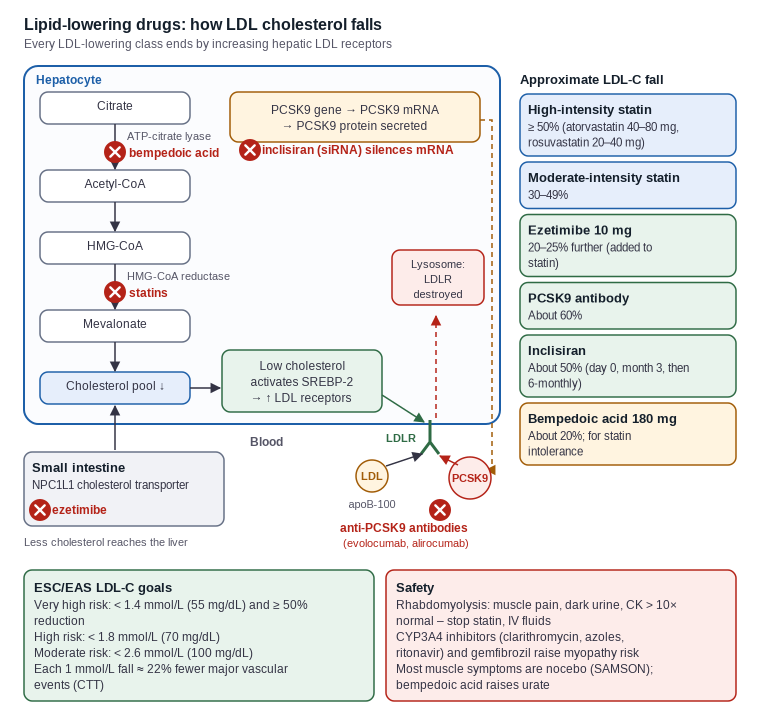
Lowering LDL cholesterol prevents atherosclerotic cardiovascular events in proportion to the absolute LDL reduction and its duration: each 1 mmol/L fall cuts major vascular events by about a fifth. Statins inhibit HMG-CoA reductase, up-regulate hepatic LDL receptors and are the foundation of therapy, with high-intensity atorvastatin or rosuvastatin lowering LDL by half. Ezetimibe blocks intestinal cholesterol absorption; PCSK9 monoclonal antibodies (evolocumab, alirocumab) and the siRNA inclisiran preserve LDL receptors; bempedoic acid inhibits ATP-citrate lyase and suits statin-intolerant patients. Triglyceride drugs include fibrates and icosapent ethyl. Current ESC/EAS and ACC/AHA guidelines set LDL goals by risk (below 1.4 mmol/L or 55 mg/dL for very-high-risk patients), favour early combination therapy after acute coronary syndrome and recommend measuring Lp(a) once. Muscle symptoms are common but usually not caused by the statin; true myopathy, rhabdomyolysis, CYP3A4 interactions and a small rise in diabetes risk need attention.
Patient case, mechanism, investigations, management, flashcards and exam-style questions.Open the lesson →
Key facts
- Statins inhibit HMG-CoA reductase (rate-limiting step of cholesterol synthesis), activating SREBP-2 and increasing hepatic LDL receptors
- Each 1 mmol/L (about 39 mg/dL) reduction in LDL-C lowers major vascular events by about 22% (CTT meta-analysis)
- High-intensity statin (atorvastatin 40–80 mg, rosuvastatin 20–40 mg) lowers LDL-C by 50% or more; moderate intensity by 30–49%
- ESC/EAS targets: very high risk LDL-C below 1.4 mmol/L (55 mg/dL) and at least 50% reduction; high risk below 1.8 mmol/L (70 mg/dL); moderate below 2.6 mmol/L (100 mg/dL)
- Add-on order: ezetimibe (about 20–25% further LDL fall), then a PCSK9 inhibitor (about 60%) or inclisiran; bempedoic acid (about 20%) for statin intolerance (CLEAR Outcomes)
- Statin-associated muscle symptoms are common, but most are nocebo effects (SAMSON); rhabdomyolysis (CK above 10 times normal, myoglobinuria) is rare
- CYP3A4 interactions (clarithromycin, azoles, ritonavir, grapefruit) and gemfibrozil raise simvastatin and atorvastatin levels and myopathy risk; rosuvastatin and pravastatin are less affected
- Measure Lp(a) once in every adult; above about 50 mg/dL (105 nmol/L) is a risk enhancer, but no Lp(a)-specific drug has yet proven outcome benefit
Differential diagnosis
| Condition | Clues | Key test |
|---|---|---|
| Statins (atorvastatin, rosuvastatin, simvastatin, pravastatin) | First-line; largest outcome evidence; dose sets intensity | Lipids at 4–12 weeks; ALT baseline |
| Ezetimibe | NPC1L1 inhibitor; oral add-on; IMPROVE-IT benefit after ACS | Lipids |
| PCSK9 monoclonal antibodies (evolocumab, alirocumab) | SC every 2–4 weeks; about 60% LDL fall; FOURIER and ODYSSEY | Lipids |
| Inclisiran | siRNA blocking hepatic PCSK9 synthesis; SC at 0, 3 months then 6-monthly | Lipids |
| Bempedoic acid | ATP-citrate lyase inhibitor activated only in liver; for statin intolerance | Urate, LFTs |
| Fibrates (fenofibrate) | PPAR-alpha agonist; lowers triglycerides; pancreatitis prevention | Creatinine, CK, LFTs |
| Icosapent ethyl | Purified EPA 2 g twice daily; residual hypertriglyceridaemia on statin (REDUCE-IT) | Triglycerides, AF symptoms, bleeding |
| Bile acid sequestrants (colestyramine, colesevelam) | Non-absorbed; safe in pregnancy; raise triglycerides and bind other drugs | Lipids, drug timing |
Exam pearls
Guideline
2019 ESC/EAS dyslipidaemia guideline with its 2025 focused update, and the 2026 ACC/AHA multisociety dyslipidemia guideline
References
- Mach F, Baigent C, Catapano AL, et al.. 2019 ESC/EAS Guidelines for the management of dyslipidaemias: lipid modification to reduce cardiovascular risk. Eur Heart J 2020.
- Mach F, Koskinas KC, Roeters van Lennep JE, et al.. 2025 Focused Update of the 2019 ESC/EAS Guidelines for the management of dyslipidaemias. Eur Heart J 2025.
- Blumenthal RS, Morris PB, Gaudino M, et al.. 2026 ACC/AHA/AACVPR/ABC/ACPM/ADA/AGS/APhA/ASPC/NLA/PCNA Guideline on the Management of Dyslipidemia. J Am Coll Cardiol 2026.
- Cholesterol Treatment Trialists' (CTT) Collaboration; Baigent C, Blackwell L, et al.. Efficacy and safety of more intensive lowering of LDL cholesterol: a meta-analysis of data from 170,000 participants in 26 randomised trials. Lancet 2010.
- Cannon CP, Blazing MA, Giugliano RP, et al.. Ezetimibe Added to Statin Therapy after Acute Coronary Syndromes. N Engl J Med 2015.
- Sabatine MS, Giugliano RP, Keech AC, et al.. Evolocumab and Clinical Outcomes in Patients with Cardiovascular Disease. N Engl J Med 2017.
Related topics
By Dr Khalid Seidi (B.Sc., M.D.) · MedEd World Clinical Knowledge library. Original teaching content checked against current guidelines (November 2026); confirm the latest local guidance before clinical use. Not a substitute for clinical judgement.