Clinical Knowledge › Internal medicine › Haematology and oncology › Anaemias
Aplastic anaemia
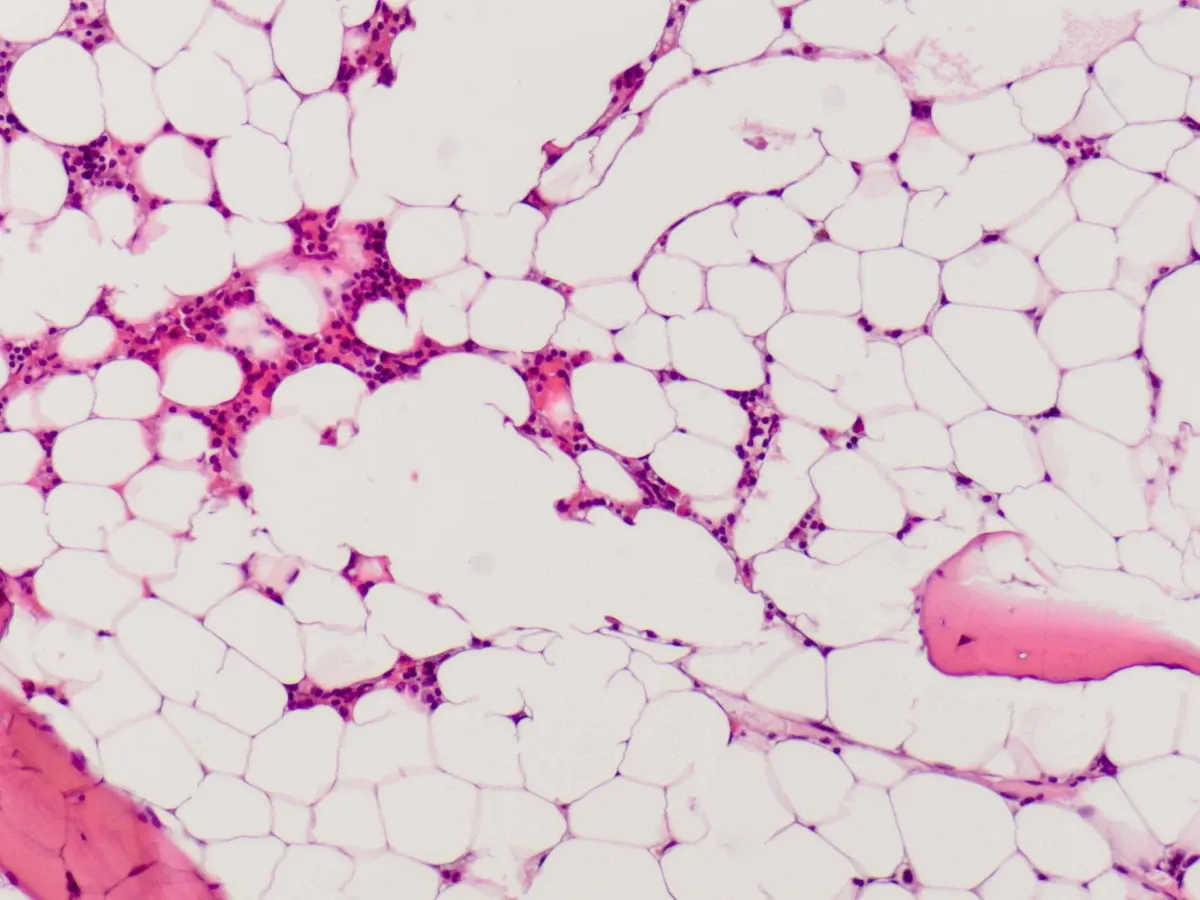
Aplastic anaemia is bone marrow failure with pancytopenia and a hypocellular marrow, without abnormal infiltration or fibrosis. Most acquired cases are immune-mediated: cytotoxic T cells destroy haematopoietic stem cells. Other causes include drugs, chemicals, seronegative hepatitis and pregnancy, and inherited marrow failure (Fanconi anaemia, telomere disorders) must be excluded because it changes treatment. Patients present with anaemia, bleeding and infection; splenomegaly or lymphadenopathy suggest another diagnosis. Diagnosis needs FBC with reticulocytes, film, bone marrow aspirate and trephine, cytogenetics, PNH flow cytometry and tests for inherited and viral causes. Severity follows the Camitta criteria. Severe disease is treated with matched sibling stem cell transplantation in younger patients, or horse antithymocyte globulin with ciclosporin and eltrombopag, alongside transfusion, infection prophylaxis and urgent treatment of neutropenic fever.
Patient case, mechanism, investigations, management, flashcards and exam-style questions.Open the lesson →
Key facts
- Definition: pancytopenia with a hypocellular marrow (usually below 25–30% cellularity) and no abnormal infiltrate or marrow fibrosis
- Incidence about 2–3 per million per year in Europe and North America, two to three times higher in East Asia; peaks at 10–25 and over 60 years
- About 70–80% of acquired cases are idiopathic and immune-mediated (T-cell attack on stem cells)
- Severe aplastic anaemia (Camitta): cellularity <25% (or 25–50% with <30% residual haematopoietic cells) plus ≥2 of neutrophils <0.5, platelets <20, reticulocytes <20 ×10⁹/L (automated count <60 ×10⁹/L)
- Very severe: as severe, with neutrophils <0.2 ×10⁹/L
- Small PNH clones are found in about half of patients; screen all with flow cytometry
- Severe disease: HLA-matched sibling transplant for younger fit patients; otherwise horse ATG + ciclosporin + eltrombopag
- Splenomegaly or lymphadenopathy argues against aplastic anaemia
Differential diagnosis
| Condition | Clues | Key test |
|---|---|---|
| Hypoplastic myelodysplastic syndrome | Dysplasia, abnormal karyotype (for example −7), high-risk mutations | Marrow morphology, cytogenetics, NGS |
| Hypocellular acute leukaemia | Blasts on film or marrow | Marrow, flow cytometry |
| Hairy cell leukaemia | Pancytopenia with monocytopenia, splenomegaly, 'dry tap' | Flow cytometry (CD103, CD25, CD11c), BRAF V600E |
| Paroxysmal nocturnal haemoglobinuria | Haemolysis, haemoglobinuria, thrombosis; often overlaps with AA | Flow cytometry (FLAER, CD59) |
| Inherited bone marrow failure (Fanconi anaemia, telomere disorders) | Young age, short stature, thumb or skin anomalies, nail dystrophy, family history | Chromosome breakage (DEB/MMC), telomere length, genetic panel |
| Megaloblastic anaemia | Pancytopenia with macrocytosis and hypercellular marrow | B12, folate |
| Overwhelming infection or drugs | Sepsis, TB, HIV, recent chemotherapy | Cultures, serology, drug history |
| Anorexia nervosa | Gelatinous marrow transformation; low BMI | History, marrow |
Exam pearls
Guideline
BSH Guidelines for the diagnosis and management of adult aplastic anaemia (2024)
References
- Kulasekararaj A, Cavenagh J, Dokal I, et al.. Guidelines for the diagnosis and management of adult aplastic anaemia: A British Society for Haematology Guideline. Br J Haematol 2024.
- Young NS.. Aplastic anemia. N Engl J Med 2018.
- Peffault de Latour R, Kulasekararaj A, Iacobelli S, et al.. Eltrombopag added to immunosuppression in severe aplastic anemia. N Engl J Med 2022.
- Townsley DM, Scheinberg P, Winkler T, et al.. Eltrombopag added to standard immunosuppression for aplastic anemia. N Engl J Med 2017.
- Scheinberg P, Finelli C, Montaño-Figueroa EH, et al.. Activity and safety of eltrombopag in combination with cyclosporin A as first-line treatment of adults with severe aplastic anaemia (SOAR): a phase 2, single-arm study. Lancet Haematol 2024.
- Scheinberg P, Nunez O, Weinstein B, et al.. Horse versus rabbit antithymocyte globulin in acquired aplastic anemia. N Engl J Med 2011.
Related topics
By Dr Khalid Seidi (B.Sc., M.D.) · MedEd World Clinical Knowledge library. Original teaching content checked against current guidelines (November 2026); confirm the latest local guidance before clinical use. Not a substitute for clinical judgement.