Clinical Knowledge › Internal medicine › Haematology and oncology › Anaemias
Sideroblastic anaemia
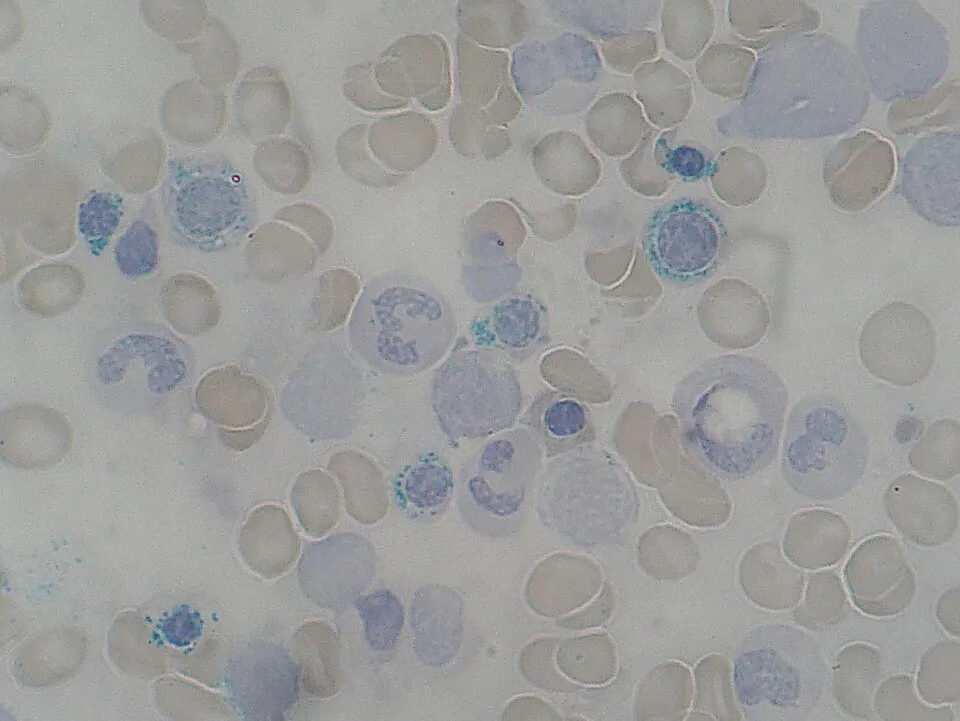
Sideroblastic anaemias are inherited or acquired disorders in which erythroblasts cannot use iron to make haem, so iron accumulates in mitochondria around the nucleus, forming ring sideroblasts on Perls' stain of the marrow. Ineffective erythropoiesis suppresses hepcidin, so iron overload develops even without transfusion. The commonest acquired form is clonal: myelodysplastic syndrome with SF3B1 mutation in older adults. Reversible causes include alcohol, isoniazid, linezolid, chloramphenicol, copper deficiency (often from zinc excess or bariatric surgery) and lead. The commonest congenital form is X-linked sideroblastic anaemia (ALAS2), a microcytic anaemia in young men that often responds to pyridoxine. Clues are a dimorphic film, Pappenheimer bodies and high ferritin and transferrin saturation. Treatment removes the cause, tries pyridoxine, supports with transfusion and chelation, and in MDS uses erythropoiesis-stimulating agents or luspatercept. Iron must never be given.
Patient case, mechanism, investigations, management, flashcards and exam-style questions.Open the lesson →
Key facts
- Ring sideroblast: an erythroblast with ≥5 iron granules encircling at least one third of the nucleus on Perls' stain
- Mechanism: defective haem synthesis or mitochondrial iron use; iron is trapped in erythroblast mitochondria
- Iron studies show high ferritin and transferrin saturation; iron overload occurs even without transfusion
- Commonest congenital form: X-linked sideroblastic anaemia (ALAS2), microcytic, often pyridoxine-responsive
- Commonest acquired clonal form: MDS with low blasts and SF3B1 mutation (WHO 2022), usually macrocytic or normocytic
- Reversible causes: alcohol, isoniazid, linezolid, chloramphenicol, copper deficiency (zinc excess), lead poisoning, hypothermia
- Blood film: dimorphic red cells and Pappenheimer bodies (siderocytes); basophilic stippling suggests lead
- Luspatercept reduces transfusion needs in lower-risk MDS with ring sideroblasts (MEDALIST 2020; COMMANDS 2023)
Differential diagnosis
| Condition | Clues | Key test |
|---|---|---|
| Iron deficiency anaemia | Microcytic, but ferritin and transferrin saturation low | Ferritin, transferrin saturation |
| β-thalassaemia trait | Microcytosis out of proportion to anaemia, high red-cell count | HbA2 by HPLC or electrophoresis |
| Anaemia of chronic disease | Normocytic or microcytic, ferritin high but transferrin saturation low | CRP, transferrin saturation |
| Lead poisoning | Microcytic anaemia, basophilic stippling, abdominal pain, neuropathy | Blood lead level, zinc protoporphyrin |
| Copper deficiency | Anaemia with neutropenia and myeloneuropathy; zinc supplements or bariatric surgery | Serum copper, caeruloplasmin, zinc |
| Megaloblastic anaemia | Macrocytic with hypersegmented neutrophils | B12 and folate |
| Other MDS subtypes | Cytopenias with dysplasia, excess blasts or adverse cytogenetics | Bone marrow, cytogenetics, myeloid NGS panel |
Exam pearls
Guideline
WHO 5th edition (2022) and International Consensus Classification (ICC, 2022) of myeloid neoplasms, BSH guideline for the diagnosis and management of adult myelodysplastic syndromes (2021) and ESMO MDS Clinical Practice Guidelines (2021)
References
- Khoury JD, Solary E, Abla O, et al.. The 5th edition of the World Health Organization Classification of Haematolymphoid Tumours: Myeloid and Histiocytic/Dendritic Neoplasms. Leukemia 2022.
- Arber DA, Orazi A, Hasserjian RP, et al.. International Consensus Classification of Myeloid Neoplasms and Acute Leukemias: integrating morphologic, clinical, and genomic data. Blood 2022.
- Bottomley SS, Fleming MD.. Sideroblastic anemia: diagnosis and management. Hematol Oncol Clin North Am 2014.
- Ducamp S, Fleming MD.. The molecular genetics of sideroblastic anemia. Blood 2019.
- Fenaux P, Platzbecker U, Mufti GJ, et al.. Luspatercept in patients with lower-risk myelodysplastic syndromes. N Engl J Med 2020.
- Platzbecker U, Della Porta MG, Santini V, et al.. Efficacy and safety of luspatercept versus epoetin alfa in erythropoiesis-stimulating agent-naive, transfusion-dependent, lower-risk myelodysplastic syndromes (COMMANDS): interim analysis of a phase 3, open-label, randomised controlled trial. Lancet 2023.
Related topics
By Dr Khalid Seidi (B.Sc., M.D.) · MedEd World Clinical Knowledge library. Original teaching content checked against current guidelines (November 2026); confirm the latest local guidance before clinical use. Not a substitute for clinical judgement.