Clinical Knowledge › Surgery › Upper gastrointestinal surgery
Bariatric surgery
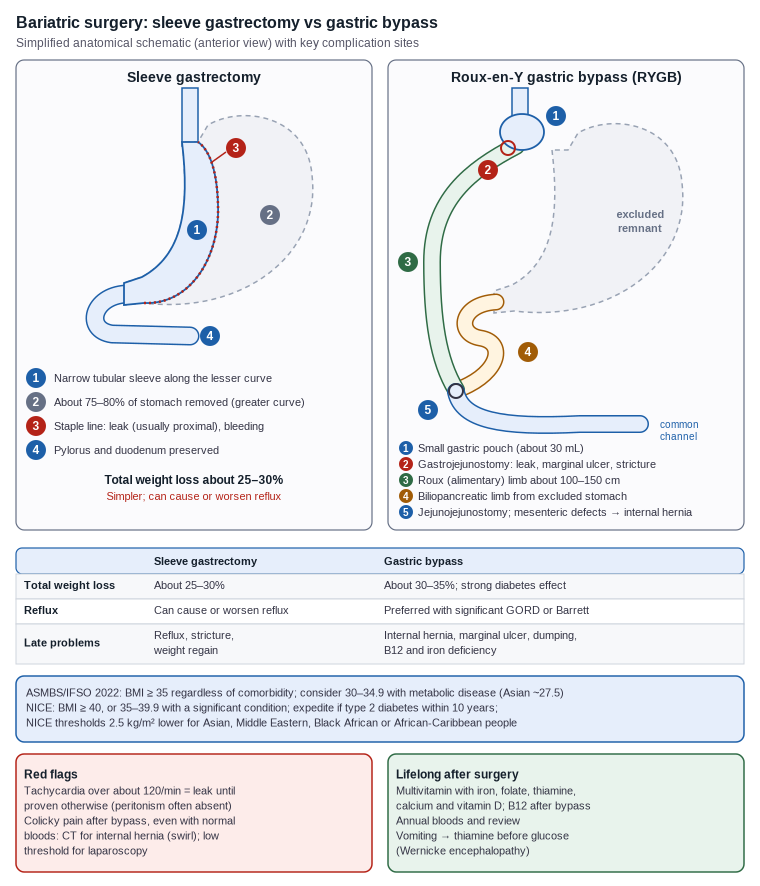
Bariatric (metabolic) surgery is the most effective long-term treatment for severe obesity and its complications, producing sustained loss of 25–35% of body weight, frequent diabetes remission and lower mortality. Current ASMBS/IFSO criteria support surgery at BMI 35 kg/m² or more regardless of comorbidity and at 30–34.9 with metabolic disease, with lower thresholds in Asian populations; NICE uses BMI 40, or 35 with a significant condition, and expedites assessment for recent-onset type 2 diabetes. The commonest operations are laparoscopic sleeve gastrectomy and Roux-en-Y gastric bypass. Work-up is multidisciplinary, with screening for sleep apnoea and reflux. Early complications include staple-line or anastomotic leak (tachycardia is the earliest sign), bleeding and VTE; late problems include internal hernia, marginal ulcer, stricture, dumping, reflux after sleeve, gallstones and micronutrient deficiency. Lifelong supplements and annual review are essential.
Patient case, mechanism, investigations, management, flashcards and exam-style questions.Open the lesson →
Key facts
- ASMBS/IFSO 2022: surgery recommended for BMI 35 or more regardless of comorbidity, and considered for BMI 30–34.9 with metabolic disease; Asian thresholds about 27.5
- NICE: refer for assessment at BMI 40 or more, or 35–39.9 with a significant condition; expedite for type 2 diabetes diagnosed within 10 years; lower thresholds by 2.5 for people of Asian, Middle Eastern, Black African or African-Caribbean background
- Sleeve gastrectomy removes about 75–80% of the stomach along the greater curve; Roux-en-Y gastric bypass creates a small pouch with a Roux limb and biliopancreatic limb
- Unexplained tachycardia over about 120/min after bariatric surgery is a leak until proven otherwise
- Colicky abdominal pain after gastric bypass, even with normal bloods, may be an internal hernia: CT (mesenteric swirl) and low threshold for laparoscopy
- Sleeve gastrectomy can cause or worsen reflux; gastric bypass is preferred in patients with significant GORD or Barrett
- Lifelong supplements (multivitamin with iron, folate, thiamine, vitamin D and calcium, and vitamin B12 after bypass) and annual blood tests are required
- Vomiting after surgery can cause thiamine deficiency and Wernicke encephalopathy: give thiamine before glucose
Differential diagnosis
| Condition | Clues | Key test |
|---|---|---|
| Anastomotic or staple-line leak | Tachycardia, fever, left shoulder or abdominal pain, days 1–10 | CT with oral contrast; return to theatre |
| Pulmonary embolism | Tachycardia, hypoxia, pleuritic pain | CT pulmonary angiography |
| Internal hernia | Colicky pain months to years after bypass, often after weight loss | CT (swirl sign); diagnostic laparoscopy |
| Marginal ulcer | Epigastric pain, bleeding; smokers and NSAID users after bypass | Endoscopy |
| Anastomotic or sleeve stricture | Progressive dysphagia, vomiting weeks after surgery | Contrast study and endoscopy |
| Dumping syndrome | Palpitations, sweating, diarrhoea after sugary meals | Clinical; food diary |
| Post-bariatric hypoglycaemia | Neuroglycopenia 1–3 hours after meals, often a year or more after bypass | Glucose during symptoms; mixed-meal test |
| Biliary colic or cholecystitis | Right upper quadrant pain during rapid weight loss | Ultrasound |
Exam pearls
Guideline
ASMBS/IFSO Indications for metabolic and bariatric surgery (2022), NICE NG246 Overweight and obesity management (2025; surgery recommendations from 2014 and 2023), ERAS Society bariatric guideline (2021 update) and ASMBS/AACE/TOS perioperative nutrition guidelines (2019 update)
References
- Eisenberg D, Shikora SA, Aarts E, et al.. 2022 American Society for Metabolic and Bariatric Surgery (ASMBS) and International Federation for the Surgery of Obesity and Metabolic Disorders (IFSO): indications for metabolic and bariatric surgery. Surg Obes Relat Dis 2022.
- National Institute for Health and Care Excellence. Overweight and obesity management (NG246). NICE 2025.
- Stenberg E, Dos Reis Falcão LF, O'Kane M, et al.. Guidelines for perioperative care in bariatric surgery: Enhanced Recovery After Surgery (ERAS) Society recommendations: a 2021 update. World J Surg 2022.
- Sjöström L, Narbro K, Sjöström CD, et al.. Effects of bariatric surgery on mortality in Swedish obese subjects. N Engl J Med 2007.
- Schauer PR, Bhatt DL, Kirwan JP, et al.. Bariatric surgery versus intensive medical therapy for diabetes - 5-year outcomes. N Engl J Med 2017.
- Society of American Gastrointestinal and Endoscopic Surgeons. SAGES guidelines for the management of comorbidities relevant to metabolic and bariatric surgery. Surg Endosc 2025.
Related topics
By Dr Khalid Seidi (B.Sc., M.D.) · MedEd World Clinical Knowledge library. Original teaching content checked against current guidelines (November 2026); confirm the latest local guidance before clinical use. Not a substitute for clinical judgement.