Clinical Knowledge › Surgery › Upper gastrointestinal surgery
Perforated peptic ulcer
Perforated peptic ulcer is a full-thickness defect in a gastric or duodenal ulcer that releases acid, food and later bacteria into the peritoneal cavity. Mortality ranges from under 5% in young fit patients to 30% or more in frail older adults with delayed presentation. The main risk factors are NSAIDs and aspirin, Helicobacter pylori, smoking, corticosteroids, older age and crack cocaine. Patients describe sudden, severe epigastric pain that becomes generalised, with shoulder-tip pain, board-like rigidity and shock, though older or immunosuppressed patients may have few signs. An erect chest radiograph shows free subdiaphragmatic gas in most cases, and CT is the most sensitive test. Treatment follows sepsis principles: resuscitation, nil by mouth, nasogastric drainage, intravenous PPI and broad-spectrum antibiotics, then source control, usually laparoscopic or open omental patch repair with peritoneal lavage. Selected stable patients with sealed perforations can be managed non-operatively. Afterwards, test and eradicate H. pylori, stop NSAIDs and re-scope gastric ulcers to exclude cancer.
Patient case, mechanism, investigations, management, flashcards and exam-style questions.Open the lesson →
Key facts
- Sudden severe epigastric pain progressing to generalised peritonitis with board-like rigidity is the classic presentation; older and steroid-treated patients may have few signs
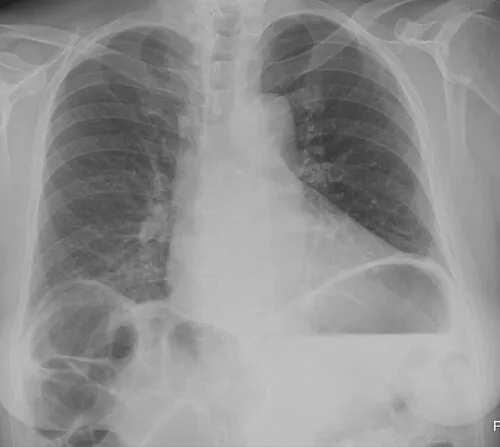
- Erect chest X-ray shows free gas under the diaphragm in about 75–85% of cases; CT is the most sensitive test and also excludes other causes
- Anterior duodenal ulcers perforate; posterior duodenal ulcers erode the gastroduodenal artery and bleed
- Delay to surgery increases mortality: source control should not be postponed once the patient is resuscitated
- Boey score: shock on admission, major medical illness and delay over 24 hours (0–3 points) predicts mortality; PULP and ASA scores are also used
- Omental patch repair (Graham or Cellan-Jones) with thorough peritoneal lavage is the standard operation; laparoscopy is preferred in stable patients when expertise is available
- Gastric ulcer perforations must be biopsied or excised, and every gastric ulcer needs repeat endoscopy to exclude carcinoma
- Test for H. pylori and eradicate if positive; stop NSAIDs; continue PPI for at least 6–8 weeks
Differential diagnosis
| Condition | Clues | Key test |
|---|---|---|
| Acute pancreatitis | Epigastric pain radiating to back, vomiting, alcohol or gallstones | Lipase or amylase over 3 times upper limit; CT |
| Ruptured abdominal aortic aneurysm | Older smoker, back pain, shock, pulsatile mass | Bedside ultrasound or CT angiography |
| Acute mesenteric ischaemia | Pain out of proportion, AF, high lactate | CT angiography |
| Perforated colonic diverticulum or appendix | Lower abdominal origin of pain and tenderness | CT abdomen and pelvis |
| Boerhaave syndrome | Chest pain after forceful vomiting, surgical emphysema | CT with oral contrast; pneumomediastinum |
| Inferior myocardial infarction | Epigastric pain, ECG changes, no peritonism | ECG and troponin |
| Acute cholecystitis | Right upper quadrant pain, Murphy sign, fever | Ultrasound |
| Pneumoperitoneum without perforation | Recent laparotomy, laparoscopy or peritoneal dialysis; soft abdomen | Clinical context; CT |
Exam pearls
Guideline
WSES guidelines on perforated and bleeding peptic ulcer (2020), Surviving Sepsis Campaign international guidelines (2021) and Maastricht VI/Florence H. pylori consensus (2022)
References
- Tarasconi A, Coccolini F, Biffl WL, et al.. Perforated and bleeding peptic ulcer: WSES guidelines. World J Emerg Surg 2020.
- Søreide K, Thorsen K, Harrison EM, et al.. Perforated peptic ulcer. Lancet 2015.
- Crofts TJ, Park KG, Steele RJ, Chung SS, Li AK. A randomized trial of nonoperative treatment for perforated peptic ulcer. N Engl J Med 1989.
- Evans L, Rhodes A, Alhazzani W, et al.. Surviving sepsis campaign: international guidelines for management of sepsis and septic shock 2021. Intensive Care Med 2021.
- Boey J, Choi SK, Poon A, Alagaratnam TT. Risk stratification in perforated duodenal ulcers. A prospective validation of predictive factors. Ann Surg 1987.
- Malfertheiner P, Megraud F, Rokkas T, et al.. Management of Helicobacter pylori infection: the Maastricht VI/Florence consensus report. Gut 2022.
Related topics
By Dr Khalid Seidi (B.Sc., M.D.) · MedEd World Clinical Knowledge library. Original teaching content checked against current guidelines (November 2026); confirm the latest local guidance before clinical use. Not a substitute for clinical judgement.