Clinical Knowledge › Internal medicine › Cardiology and angiology › Congenital heart disease
Bicuspid aortic valve
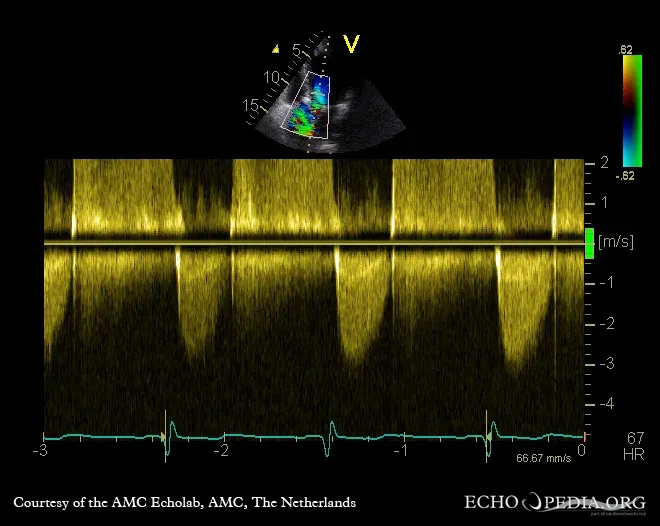
Bicuspid aortic valve (BAV) is the commonest congenital heart abnormality, affecting about 1–2% of people, with a male predominance of roughly 3:1. Two of the three cusps are fused (most often the right and left coronary cusps, frequently with a raphe), so the valve opens with an elliptical orifice and leaflets experience abnormal stress. It is a disease of both valve and aorta: an abnormal aortic media and altered flow cause dilatation of the ascending aorta or root in up to half of patients. Complications include aortic stenosis presenting one to two decades earlier than tricuspid calcific disease, aortic regurgitation, infective endocarditis, aneurysm formation and, less commonly, aortic dissection. BAV is associated with coarctation, Turner syndrome and familial clustering (NOTCH1), so first-degree relatives should be screened. Echocardiography shows a 'fish-mouth' systolic opening and assesses valve function; CT or MRI images the whole aorta. Management is surveillance, BP control and valve or aortic surgery at guideline thresholds.
Patient case, mechanism, investigations, management, flashcards and exam-style questions.Open the lesson →
Key facts
- Commonest congenital heart abnormality: about 1–2% of the population, male to female about 3:1
- Usual phenotype: fusion of right and left coronary cusps with a raphe (Sievers type 1)
- Aortopathy (ascending aorta or root dilatation) occurs in up to half and is independent of valve function
- Aortic stenosis presents earlier (around 40–60 years) than tricuspid calcific AS
- Associations: coarctation of the aorta, Turner syndrome, Shone complex, familial forms (NOTCH1)
- Classic signs: ejection click followed by an ejection systolic murmur; early diastolic murmur if regurgitant
- Ascending aortic surgery at ≥55 mm, ≥50 mm with risk factors, or ≥45 mm when the valve is being operated on
- Screen first-degree relatives with echocardiography and image the whole aorta in every patient
Differential diagnosis
| Condition | Clues | Key test |
|---|---|---|
| Tricuspid calcific aortic stenosis | Older age (over 70), no click, no aortopathy | Echo or CT showing three cusps |
| Hypertrophic cardiomyopathy with LVOT obstruction | Murmur increases with Valsalva, no click | Echo: septal hypertrophy, dynamic gradient |
| Subvalvular or supravalvular aortic stenosis | Murmur location differs; Williams syndrome for supravalvular | Echo and MRI of LVOT and aorta |
| Pulmonary stenosis | Click varies with respiration, murmur at left upper sternal edge | Echocardiography |
| Marfan syndrome or other heritable aortopathy | Root dilatation with systemic features (tall, lens dislocation) | Ghent criteria, genetic testing |
| Innocent flow murmur | Soft, midsystolic, no click, normal S2 | Normal echocardiogram |
Exam pearls
Guideline
2025 ESC/EACTS Guidelines for valvular heart disease, 2024 ESC peripheral arterial and aortic diseases guideline, 2020 ACC/AHA valvular and 2022 ACC/AHA aortic disease guidelines, with the 2021 international BAV nomenclature consensus
References
- Praz F, Borger MA, Lanz J, et al.. 2025 ESC/EACTS Guidelines for the management of valvular heart disease. Eur Heart J 2025.
- Otto CM, Nishimura RA, Bonow RO, et al.. 2020 ACC/AHA Guideline for the Management of Patients With Valvular Heart Disease. Circulation 2021.
- Mazzolai L, Teixido-Tura G, Lanzi S, et al.. 2024 ESC Guidelines for the management of peripheral arterial and aortic diseases. Eur Heart J 2024.
- Isselbacher EM, Preventza O, Hamilton Black J 3rd, et al.. 2022 ACC/AHA Guideline for the Diagnosis and Management of Aortic Disease. Circulation 2022.
- Michelena HI, Della Corte A, Evangelista A, et al.. International consensus statement on nomenclature and classification of the congenital bicuspid aortic valve and its aortopathy, for clinical, surgical, interventional and research purposes. Eur J Cardiothorac Surg 2021.
- Michelena HI, Khanna AD, Mahoney D, et al.. Incidence of aortic complications in patients with bicuspid aortic valves. JAMA 2011.
Related topics
By Dr Khalid Seidi (B.Sc., M.D.) · MedEd World Clinical Knowledge library. Original teaching content checked against current guidelines (November 2026); confirm the latest local guidance before clinical use. Not a substitute for clinical judgement.