Clinical Knowledge › Internal medicine › Cardiology and angiology › Congenital heart disease
Truncus arteriosus
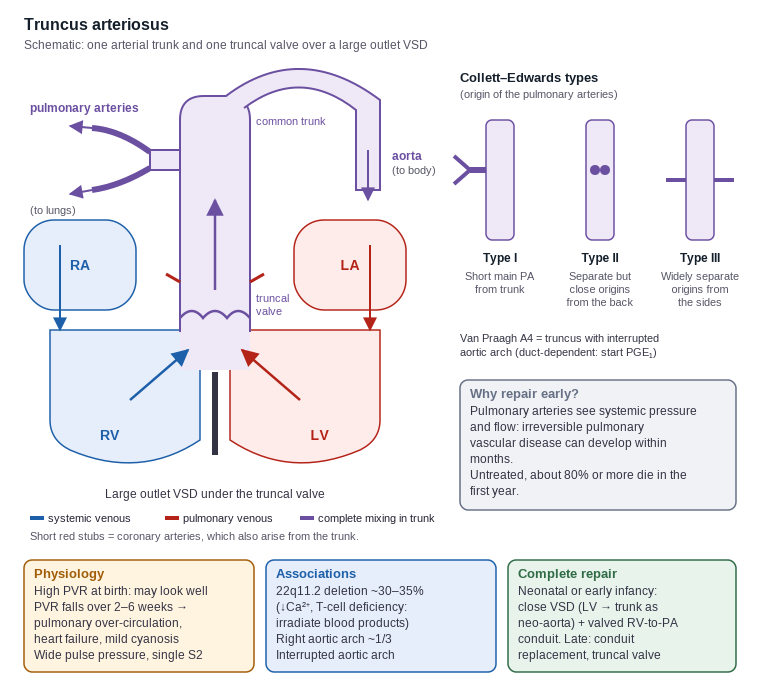
Truncus arteriosus (common arterial trunk) is a conotruncal defect in which a single great artery leaves the heart above a large outlet ventricular septal defect and gives rise to the coronary, systemic and pulmonary arteries. It results from failure of the truncal and conal ridges to form the aorticopulmonary septum. Because both ventricles eject into one vessel, systemic saturation is only mildly reduced, but as pulmonary vascular resistance falls in the first weeks torrential pulmonary blood flow causes heart failure, bounding pulses and failure to thrive. The truncal valve is often abnormal and may leak or obstruct. About a third of patients have 22q11.2 deletion, and interrupted aortic arch or a right-sided arch may coexist. Echocardiography is diagnostic. Without surgery most infants die in the first year, and survivors develop irreversible pulmonary vascular disease. Repair in the neonatal period or early infancy closes the VSD, detaches the pulmonary arteries and connects them to the right ventricle with a valved conduit. Conduits need replacement as the child grows.
Patient case, mechanism, investigations, management, flashcards and exam-style questions.Open the lesson →
Key facts
- Single arterial trunk over a large outlet VSD supplies coronary, systemic and pulmonary circulations
- Failure of septation of the truncus arteriosus by the neural-crest-derived aorticopulmonary septum
- About a third have 22q11.2 deletion; right aortic arch in about a third; interrupted aortic arch in some
- Mild cyanosis with heart failure in the first weeks as pulmonary resistance falls
- Bounding pulses, wide pulse pressure, single S2, ejection click; diastolic murmur if truncal regurgitation
- Collett–Edwards types I–III by pulmonary artery origin; Van Praagh A1–A4 (A4 with interrupted arch)
- Complete repair in the neonatal period or early infancy: VSD closure and RV-to-pulmonary artery valved conduit
- Late problems: conduit stenosis and regurgitation needing replacement, truncal valve regurgitation, branch pulmonary stenosis
Differential diagnosis
| Condition | Clues | Key test |
|---|---|---|
| Large VSD | Heart failure at 4–8 weeks, two separate great arteries, normal saturations | Echocardiography |
| Tetralogy of Fallot with pulmonary atresia | Single outlet from aorta but pulmonary flow from duct or collaterals; oligaemic lungs | Echocardiography, CT angiography |
| Aortopulmonary window | Communication between two separate great arteries with two semilunar valves | Echocardiography |
| Transposition of the great arteries | Profound early cyanosis rather than heart failure | Echocardiography |
| Patent ductus arteriosus (large) | Bounding pulses and continuous murmur, normal saturations | Echocardiography |
| Total anomalous pulmonary venous return (unobstructed) | Mild cyanosis with heart failure; RV volume overload | Echocardiography |
Exam pearls
Guideline
2020 ESC Guidelines for adult congenital heart disease (no newer ESC edition by November 2026), 2025 ACC/AHA/HRS/ISACHD/SCAI ACHD Guideline and 2023 ESC Guidelines for endocarditis
References
- Baumgartner H, De Backer J, Babu-Narayan SV, et al.. 2020 ESC Guidelines for the management of adult congenital heart disease. Eur Heart J 2021.
- Gurvitz M, Krieger EV, Fuller S, et al.. 2025 ACC/AHA/HRS/ISACHD/SCAI Guideline for the Management of Adults With Congenital Heart Disease: A Report of the American College of Cardiology/American Heart Association Joint Committee on Clinical Practice Guidelines. Circulation 2025.
- Naimo PS, Bell D, Fricke TA, et al.. Truncus arteriosus repair: A 40-year multicenter perspective. J Thorac Cardiovasc Surg 2020.
- O'Connor M, Hoyos ME, Stauber CE, et al.. The Fate of the Truncal Valve: Multi-Institutional Insights Into Reintervention After Truncus Arteriosus Repair. Ann Thorac Surg 2025.
- Hickey EJ, McCrindle BW, Blackstone EH, et al.. Jugular venous valved conduit (Contegra) matches allograft performance in infant truncus arteriosus repair. Eur J Cardiothorac Surg 2008.
- Martin GR, Ewer AK, Gaviglio A, et al.. Updated Strategies for Pulse Oximetry Screening for Critical Congenital Heart Disease. Pediatrics 2020.
Related topics
By Dr Khalid Seidi (B.Sc., M.D.) · MedEd World Clinical Knowledge library. Original teaching content checked against current guidelines (November 2026); confirm the latest local guidance before clinical use. Not a substitute for clinical judgement.