Clinical Knowledge › Internal medicine › Cardiology and angiology › Congenital heart disease
Patent ductus arteriosus
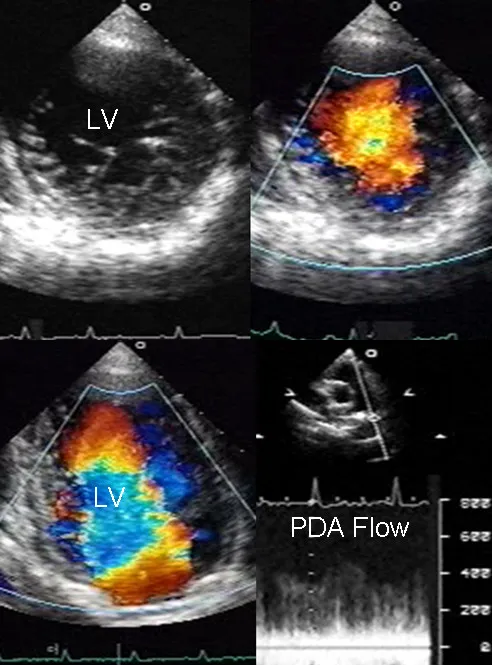
The ductus arteriosus is a fetal vessel joining the pulmonary trunk to the descending aorta just beyond the left subclavian artery. It normally closes within days of birth as oxygen tension rises and prostaglandin E2 falls; persistence is patent ductus arteriosus (PDA). PDA is common in preterm infants, where it can worsen respiratory disease, and less common at term, where it is more often found in girls and after maternal rubella. Blood flows from aorta to pulmonary artery throughout the cardiac cycle, causing a continuous 'machinery' murmur below the left clavicle, bounding pulses with a wide pulse pressure, and left atrial and ventricular volume overload. A large duct can cause heart failure and, if left, Eisenmenger syndrome with differential cyanosis of the lower limbs. Echocardiography confirms the diagnosis. In preterm infants recent trials favour expectant management for most, with ibuprofen, paracetamol or closure for selected cases; in older children and adults, a duct causing left heart overload with low pulmonary resistance is closed, usually by catheter device.
Patient case, mechanism, investigations, management, flashcards and exam-style questions.Open the lesson →
Key facts
- The ductus links the pulmonary trunk to the descending aorta and is derived from the left sixth aortic arch
- Prostaglandin E2 and low oxygen keep the duct open in utero; functional closure normally occurs within 12–72 hours of birth at term
- Classic signs: continuous machinery murmur below the left clavicle, bounding pulses and wide pulse pressure
- PDA is common in preterm infants; risk rises as gestation falls
- Expectant management is reasonable for most preterm infants (BeNeDuctus, Baby-OSCAR); NSAIDs or paracetamol are reserved for selected haemodynamically significant ducts
- Prostaglandin E1 (alprostadil) keeps the duct open in duct-dependent lesions; apnoea is its key adverse effect
- In adults, close a PDA with LV volume overload and PVR below 3 WU, usually by device; do not close in Eisenmenger syndrome
- Eisenmenger PDA gives differential cyanosis: blue clubbed toes with pink fingers
Differential diagnosis
| Condition | Clues | Key test |
|---|---|---|
| Venous hum | Continuous murmur in the neck that disappears on lying flat or compressing the jugular vein | Clinical manoeuvres |
| Ventricular septal defect with aortic regurgitation | To-and-fro pansystolic and early diastolic murmur, not truly continuous | Echocardiography |
| Aortopulmonary window | Large shunt with early pulmonary hypertension; murmur often not continuous | Echo, CT or MRI |
| Ruptured sinus of Valsalva aneurysm | Sudden continuous murmur and heart failure in a young adult | Echocardiography |
| Coronary arteriovenous fistula | Continuous murmur heard lower on the chest | Echo, CT coronary angiography |
| Aortic regurgitation | Collapsing pulse and wide pulse pressure but an early diastolic murmur only | Echocardiography |
Exam pearls
Guideline
2020 ESC Guidelines for adult congenital heart disease, 2025 ACC/AHA/HRS/ISACHD/SCAI ACHD Guideline, and American Academy of Pediatrics clinical report on PDA in preterm infants (2020), informed by the BeNeDuctus (2023) and Baby-OSCAR (2024) trials
References
- Baumgartner H, De Backer J, Babu-Narayan SV, et al.. 2020 ESC Guidelines for the management of adult congenital heart disease. Eur Heart J 2021.
- Gurvitz M, Krieger EV, Fuller S, et al.. 2025 ACC/AHA/HRS/ISACHD/SCAI Guideline for the Management of Adults With Congenital Heart Disease: A Report of the American College of Cardiology/American Heart Association Joint Committee on Clinical Practice Guidelines. Circulation 2025.
- Schneider DJ, Moore JW.. Patent ductus arteriosus. Circulation 2006.
- Hamrick SEG, Sallmon H, Rose AT, et al.. Patent Ductus Arteriosus of the Preterm Infant. Pediatrics 2020.
- Hundscheid T, Onland W, Kooi EMW, et al.. Expectant Management or Early Ibuprofen for Patent Ductus Arteriosus. N Engl J Med 2023.
- Gupta S, Subhedar NV, Bell JL, et al.. Trial of Selective Early Treatment of Patent Ductus Arteriosus with Ibuprofen. N Engl J Med 2024.
Related topics
By Dr Khalid Seidi (B.Sc., M.D.) · MedEd World Clinical Knowledge library. Original teaching content checked against current guidelines (November 2026); confirm the latest local guidance before clinical use. Not a substitute for clinical judgement.