Clinical Knowledge › Internal medicine › Rheumatology and immunology › Crystal and infectious arthritis
Calcium pyrophosphate deposition disease (pseudogout)
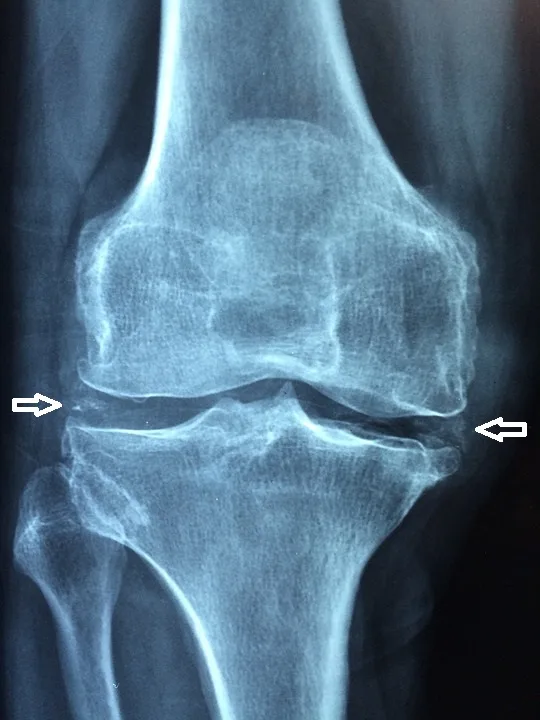
Calcium pyrophosphate deposition (CPPD) disease is caused by calcium pyrophosphate crystals forming in cartilage, mainly in older people with osteoarthritis. Most deposition is asymptomatic and seen as chondrocalcinosis on X-ray of the knee menisci, wrist triangular fibrocartilage or symphysis pubis. Acute CPP crystal arthritis (pseudogout) presents as a sudden hot swollen knee or wrist, often after surgery or acute illness, and can mimic gout or septic arthritis. Other forms are osteoarthritis with CPPD in unusual joints, a chronic polyarthritis that mimics rheumatoid arthritis, and crowned dens syndrome with acute neck pain. Diagnosis rests on finding rhomboid, weakly positively birefringent crystals in joint fluid, with culture to exclude sepsis; ultrasound and CT support it. Patients under 60 need screening for haemochromatosis, hyperparathyroidism, hypomagnesaemia and hypophosphatasia. Acute attacks are treated with aspiration and intra-articular steroid, colchicine, NSAIDs or a short oral steroid course; there is no crystal-dissolving therapy.
Patient case, mechanism, investigations, management, flashcards and exam-style questions.Open the lesson →
Key facts
- CPP crystals are rhomboid or rod-shaped and weakly positively birefringent (blue when parallel to the compensator)
- Acute CPP crystal arthritis typically affects the knee, then the wrist, in older people, often after surgery or illness
- Chondrocalcinosis: knee menisci, wrist triangular fibrocartilage and symphysis pubis
- Screen for haemochromatosis, hyperparathyroidism, hypomagnesaemia and hypophosphatasia if under 60
- Crowned dens syndrome: acute neck pain, fever and high CRP with calcification around the odontoid on CT
- Chronic forms mimic osteoarthritis (unusual joints) or rheumatoid arthritis
- 2023 ACR/EULAR classification: entry criterion, sufficient criteria, weighted score above 56
- Treatment: aspiration with intra-articular steroid, colchicine, NSAID or short oral steroid; no urate-lowering equivalent
Differential diagnosis
| Condition | Clues | Key test |
|---|---|---|
| Septic arthritis | Fever, rigors, very high fluid white cells; may coexist | Gram stain and culture of synovial fluid |
| Gout | First MTP, younger men, tophi | Needle-shaped negatively birefringent crystals |
| Rheumatoid arthritis | Symmetric small-joint synovitis, erosions | RF and anti-CCP; no crystals |
| Osteoarthritis | Mechanical pain, bony swelling, typical sites | Non-inflammatory fluid; no chondrocalcinosis |
| Polymyalgia rheumatica | Shoulder and hip girdle pain, morning stiffness, high ESR | Ultrasound bursitis; response to low-dose steroid |
| Meningitis (vs crowned dens) | Neck stiffness and fever | CT odontoid calcification; CSF normal |
Exam pearls
Guideline
2023 ACR/EULAR CPPD classification criteria and EULAR 2011 CPPD recommendations (terminology, diagnosis and management)
References
- Abhishek A, Tedeschi SK, Pascart T, et al.. The 2023 ACR/EULAR classification criteria for calcium pyrophosphate deposition disease. Ann Rheum Dis 2023.
- Zhang W, Doherty M, Bardin T, et al.. European League Against Rheumatism recommendations for calcium pyrophosphate deposition. Part I: terminology and diagnosis. Ann Rheum Dis 2011.
- Zhang W, Doherty M, Pascual E, et al.. EULAR recommendations for calcium pyrophosphate deposition. Part II: management. Ann Rheum Dis 2011.
- Rosenthal AK, Ryan LM.. Calcium pyrophosphate deposition disease. N Engl J Med 2016.
- Dalbeth N, Gosling AL, Gaffo A, Abhishek A.. Gout. Lancet 2021.
- Penman ID, Ralston SH, Strachan MWJ, Hobson RP, eds.. Davidson's Principles and Practice of Medicine. 2022.
Related topics
By Dr Khalid Seidi (B.Sc., M.D.) · MedEd World Clinical Knowledge library. Original teaching content checked against current guidelines (November 2026); confirm the latest local guidance before clinical use. Not a substitute for clinical judgement.