Clinical Knowledge › Internal medicine › Rheumatology and immunology › Crystal and infectious arthritis
Disseminated gonococcal infection
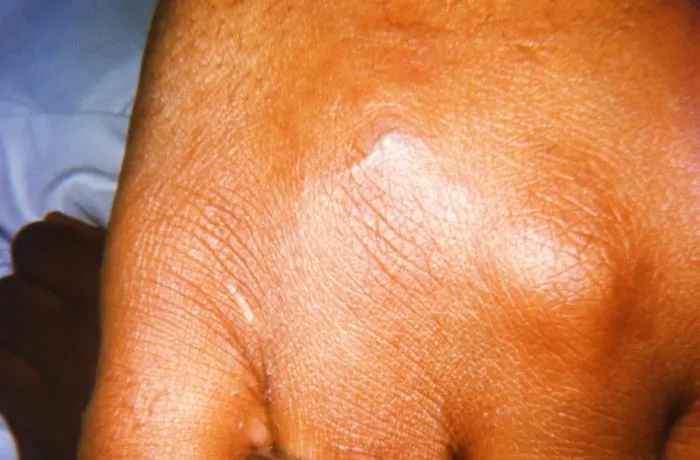
Disseminated gonococcal infection (DGI) follows bloodstream spread of Neisseria gonorrhoeae from an often asymptomatic mucosal infection of the cervix, urethra, rectum or pharynx. It is the commonest cause of acute infective arthritis in sexually active young adults in many settings. Two overlapping syndromes occur: the arthritis–dermatitis syndrome, with fever, migratory polyarthralgia, tenosynovitis of the wrists, hands or ankles and a few painless pustules on the limbs; and a purulent monoarthritis or oligoarthritis, usually of the knee, wrist or ankle, without skin lesions. Women (especially around menstruation, pregnancy and the postpartum period), men who have sex with men and people with terminal complement deficiency or taking eculizumab are at higher risk. Blood and synovial cultures are often negative, so nucleic acid amplification tests from every exposed mucosal site are essential. Treatment is ceftriaxone 1 g IV or IM daily for at least 7 days, with joint drainage, testing for other STIs and partner notification. Most patients recover fully.
Patient case, mechanism, investigations, management, flashcards and exam-style questions.Open the lesson →
Key facts
- DGI complicates about 0.5–3% of untreated mucosal gonococcal infections, and the mucosal infection is often asymptomatic
- Arthritis–dermatitis syndrome: fever, tenosynovitis, migratory polyarthralgia and a few acral pustules
- Purulent arthritis form: knee, wrist or ankle; synovial fluid often 50 × 10⁹/L white cells or more but culture positive in under half
- Mucosal NAAT (urethra or cervix, rectum, pharynx) is positive far more often than blood or joint cultures
- Risk factors: female sex (menses, pregnancy, postpartum), MSM, terminal complement (C5–C9) deficiency, eculizumab or ravulizumab, SLE
- Treatment: ceftriaxone 1 g IV or IM every 24 hours, total at least 7 days; longer for meningitis (10–14 days) or endocarditis (at least 4 weeks)
- Test for chlamydia, syphilis and HIV, offer a pregnancy test and arrange partner notification
- Recurrent neisserial bacteraemia should prompt complement testing (CH50/AH50)
Differential diagnosis
| Condition | Clues | Key test |
|---|---|---|
| Staphylococcal septic arthritis | Single hot joint, older or with joint disease, no tenosynovitis or pustules | Synovial Gram stain shows Gram-positive cocci; cultures usually positive |
| Reactive arthritis | Sterile lower-limb oligoarthritis 1–4 weeks after urethritis or dysentery; conjunctivitis, enthesitis | Joint fluid sterile; no fever-bacteraemia picture; NAAT for chlamydia |
| Meningococcaemia | Rapid shock with spreading petechial or purpuric rash | Blood culture and PCR for Neisseria meningitidis |
| Infective endocarditis | Murmur, embolic lesions, persistent bacteraemia | Serial blood cultures and echocardiography |
| Secondary syphilis | Generalised rash including palms and soles, lymphadenopathy, arthralgia | Treponemal and non-treponemal serology |
| Acute viral arthritis (parvovirus B19, rubella, hepatitis B, HIV seroconversion) | Symmetrical small-joint arthralgia with rash | Viral serology or PCR; HIV antigen/antibody test |
| Gout or CPPD arthritis | Older patient, rapid onset, history of attacks | Synovial fluid crystals on polarised microscopy |
| Löfgren syndrome | Ankle periarthritis, erythema nodosum, bilateral hilar lymphadenopathy | Chest X-ray; serum ACE |
Exam pearls
Guideline
CDC Sexually Transmitted Infections Treatment Guidelines (2021, incorporating the 2020 gonococcal update), BASHH UK national guideline for Neisseria gonorrhoeae (2025) and WHO gonorrhoea treatment recommendations (2024)
References
- Workowski KA, Bachmann LH, Chan PA, et al.. Sexually transmitted infections treatment guidelines, 2021. MMWR Recomm Rep 2021.
- St Cyr S, Barbee L, Workowski KA, et al.. Update to CDC's treatment guidelines for gonococcal infection, 2020. MMWR Morb Mortal Wkly Rep 2020.
- Fifer H, Ismail MA, Soni S, et al.. British Association of Sexual Health and HIV UK national guideline for the management of infection with Neisseria gonorrhoeae, 2025. Int J STD AIDS 2025.
- World Health Organization. Updated recommendations for the treatment of Neisseria gonorrhoeae, Chlamydia trachomatis and Treponema pallidum (syphilis), and new recommendations on syphilis testing and partner services. WHO, Geneva 2024.
- Rice PA. Gonococcal arthritis (disseminated gonococcal infection). Infect Dis Clin North Am 2005.
- Crew PE, Abara WE, McCulley L, et al.. Disseminated gonococcal infections in patients receiving eculizumab: a case series. Clin Infect Dis 2019.
Related topics
By Dr Khalid Seidi (B.Sc., M.D.) · MedEd World Clinical Knowledge library. Original teaching content checked against current guidelines (November 2026); confirm the latest local guidance before clinical use. Not a substitute for clinical judgement.