Clinical Knowledge › Internal medicine › Pulmonology › Sleep and ventilatory disorders
Central sleep apnoea
Central sleep apnoea (CSA) is a sleep-related breathing disorder in which airflow stops because the brainstem briefly stops signalling the respiratory muscles, so there is no breathing effort, unlike obstructive apnoea where effort continues against a closed airway. It is less common than obstructive sleep apnoea but frequent in heart failure, atrial fibrillation, after stroke, with long-term opioid use, at high altitude, and when CPAP is started for OSA. Most cases arise from unstable ventilatory control (high loop gain) around the apnoeic CO2 threshold, producing Cheyne–Stokes breathing in heart failure; a smaller group results from reduced drive or weak muscles with daytime hypercapnia. Symptoms include broken sleep, insomnia, witnessed pauses, fatigue and nocturnal breathlessness. Diagnosis needs polysomnography showing predominantly central events. Treatment starts with the cause: optimise heart failure therapy and reduce opioids. Then CPAP, adaptive servo-ventilation (avoided in reduced ejection fraction), oxygen, acetazolamide or phrenic nerve stimulation are chosen by cause.
Patient case, mechanism, investigations, management, flashcards and exam-style questions.Open the lesson →
Key facts
- Central apnoea = no airflow and no respiratory effort for at least 10 seconds; obstructive apnoea has continuing effort
- Diagnosis: polysomnography with central events making up most of the AHI (central apnoeas and hypopnoeas at least 5/h and over 50% of events)
- Commonest causes: heart failure (Cheyne–Stokes breathing), stroke, atrial fibrillation, opioids, high altitude and treatment-emergent CSA on CPAP
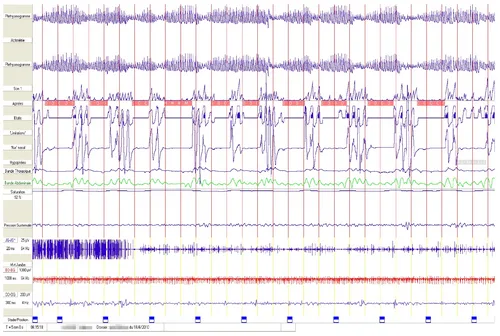
- Cheyne–Stokes breathing: crescendo–decrescendo ventilation alternating with central apnoeas, cycle length usually 40 seconds or more
- Most CSA is non-hypercapnic, from high loop gain and PaCO2 falling below the apnoeic threshold; hypercapnic CSA results from weak drive or muscles
- First step is to treat the cause: guideline-directed heart failure therapy, reduce opioids, descend from altitude
- SERVE-HF: minute-ventilation-targeted ASV increased mortality in HFrEF (LVEF 45% or less) with predominant CSA
- AASM 2025 guideline: CPAP, ASV (with HFrEF caveats), bilevel with backup rate, low-flow oxygen, acetazolamide and phrenic nerve stimulation by cause
Differential diagnosis
| Condition | Clues | Key test |
|---|---|---|
| Obstructive sleep apnoea | Snoring, obesity, continued thoracoabdominal effort during apnoeas | Polysomnography with effort belts |
| Obesity hypoventilation syndrome | BMI 30 or more, daytime hypercapnia, raised bicarbonate | Arterial blood gas, polysomnography |
| Neuromuscular respiratory failure | Weakness, orthopnoea, paradoxical breathing, low vital capacity | Supine and erect VC, MIP, EMG |
| Paroxysmal nocturnal dyspnoea from heart failure | Waking breathless, orthopnoea, oedema | Echocardiogram, BNP; PSG shows CSA if coexistent |
| Nocturnal panic attacks or insomnia | Awakenings without breathing pauses on monitoring | Polysomnography |
| Opioid toxicity | Slow irregular breathing, pinpoint pupils, sedation | Medication history, response to naloxone |
| Sleep-related laryngospasm or nocturnal seizures | Sudden choking awakenings, stereotyped events | Video polysomnography with EEG |
Exam pearls
Guideline
AASM clinical practice guideline on treatment of central sleep apnoea in adults (2025), ICSD-3-TR classification (2023) and ESC heart failure guidance on ASV in HFrEF
References
- Badr MS, Khayat RN, Allam JS, et al.. Treatment of central sleep apnea in adults: an American Academy of Sleep Medicine clinical practice guideline. J Clin Sleep Med 2025.
- Badr MS, Khayat RN, Allam JS, et al.. Treatment of central sleep apnea in adults: an American Academy of Sleep Medicine systematic review, meta-analysis, and GRADE assessment. J Clin Sleep Med 2025.
- Cowie MR, Woehrle H, Wegscheider K, et al.. Adaptive Servo-Ventilation for Central Sleep Apnea in Systolic Heart Failure. N Engl J Med 2015.
- Costanzo MR, Ponikowski P, Javaheri S, et al.. Transvenous neurostimulation for central sleep apnoea: a randomised controlled trial. Lancet 2016.
- Bradley TD, Logan AG, Floras JS.. Treating sleep disordered breathing for cardiovascular outcomes: observational and randomised trial evidence. Eur Respir J 2024.
- Yatsu S, Woo A, Horvath CM, et al.. LV Structure and Function in HFrEF With and Without Peak-Flow-Triggered Adaptive Servo-Ventilation-Treated Sleep-Disordered Breathing. JACC Heart Fail 2025.
Related topics
By Dr Khalid Seidi (B.Sc., M.D.) · MedEd World Clinical Knowledge library. Original teaching content checked against current guidelines (November 2026); confirm the latest local guidance before clinical use. Not a substitute for clinical judgement.