Clinical Knowledge › Internal medicine › Pulmonology › Sleep and ventilatory disorders
Obesity hypoventilation syndrome
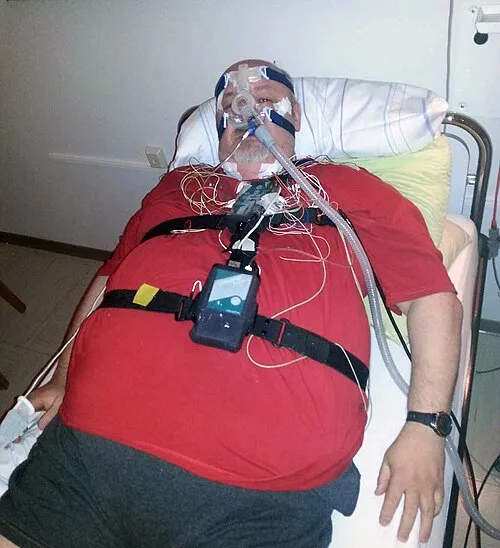
Obesity hypoventilation syndrome (OHS) is the combination of obesity (BMI 30 kg/m² or more) and daytime hypercapnia (PaCO2 45 mmHg, 6.0 kPa, or more) that is not explained by another lung, neuromuscular, chest wall or metabolic disorder. About nine in ten patients also have obstructive sleep apnoea, usually severe. Hypercapnia develops when a heavy chest and abdomen increase the work of breathing, upper airway obstruction and hypoventilation during sleep let CO2 rise, and a blunted respiratory drive, partly from leptin resistance, fails to correct it; the kidneys then retain bicarbonate, carrying the high CO2 into daytime. Patients present with sleepiness, morning headache, breathlessness, ankle oedema and cor pulmonale, or for the first time with acute-on-chronic hypercapnic respiratory failure, often mislabelled as COPD. Serum bicarbonate of 27 mmol/L or more should prompt an arterial blood gas. Treatment is positive airway pressure during sleep (CPAP when severe OSA coexists, otherwise NIV), sustained major weight loss, careful oxygen targets and avoidance of sedatives.
Patient case, mechanism, investigations, management, flashcards and exam-style questions.Open the lesson →
Key facts
- Diagnosis: BMI 30 or more plus awake PaCO2 45 mmHg (6.0 kPa) or more, after excluding other causes of hypoventilation
- About 90% have coexisting OSA, and about 70% have severe OSA (AHI 30 or more)
- Serum bicarbonate below 27 mmol/L makes OHS unlikely; at 27 or more, measure arterial blood gases
- Mechanisms: increased load from obesity, sleep-disordered breathing, blunted central drive (leptin resistance) and renal bicarbonate retention
- Untreated OHS carries high mortality, pulmonary hypertension and frequent hospitalisation; it is often missed until acute hypercapnic failure
- Stable patients with severe OSA: CPAP first (Pickwick trial); without severe OSA or failing CPAP: NIV
- Patients admitted with acute hypercapnic failure and suspected OHS should go home on NIV pending sleep studies within 2–3 months
- Sustained weight loss of 25–30% (usually bariatric surgery) is needed for resolution; avoid sedatives and high-flow oxygen without ventilatory support
Differential diagnosis
| Condition | Clues | Key test |
|---|---|---|
| COPD with hypercapnia | Smoking history, wheeze, airflow obstruction on spirometry | Post-bronchodilator spirometry (FEV1/FVC below LLN) |
| Obstructive sleep apnoea without OHS | Snoring, apnoeas, but normal awake PaCO2 and bicarbonate | ABG, polysomnography |
| Neuromuscular disease (ALS, myasthenia, Duchenne) | Weakness, orthopnoea, paradoxical abdomen | Vital capacity supine and erect, MIP/SNIP, EMG |
| Chest wall disease (kyphoscoliosis) | Spinal deformity, restrictive spirometry | Examination, spine imaging, spirometry |
| Hypothyroidism | Cold intolerance, weight gain, bradycardia | TSH and free T4 |
| Drug-induced hypoventilation | Opioids, benzodiazepines, gabapentinoids | Medication review, toxicology |
| Metabolic alkalosis with compensatory hypercapnia | Diuretics or vomiting, high bicarbonate with alkalaemia | ABG pH (alkalaemic), electrolytes, urine chloride |
Exam pearls
Guideline
ATS clinical practice guideline on evaluation and management of OHS (2019), NICE NG202 OSAHS and OHS in over 16s (2021), BTS/ICS acute NIV guidance and current obesity pharmacotherapy evidence (2024–2026)
References
- Mokhlesi B, Masa JF, Brozek JL, et al.. Evaluation and Management of Obesity Hypoventilation Syndrome. An Official American Thoracic Society Clinical Practice Guideline. Am J Respir Crit Care Med 2019.
- National Institute for Health and Care Excellence (NICE). Obstructive sleep apnoea/hypopnoea syndrome and obesity hypoventilation syndrome in over 16s (NICE guideline NG202). 2021.
- Masa JF, Mokhlesi B, Benítez I, et al.. Long-term clinical effectiveness of continuous positive airway pressure therapy versus non-invasive ventilation therapy in patients with obesity hypoventilation syndrome: a multicentre, open-label, randomised controlled trial. Lancet 2019.
- Afshar M, Brozek JL, Soghier I, et al.. The Role of Positive Airway Pressure Therapy in Adults with Obesity Hypoventilation Syndrome. A Systematic Review and Meta-Analysis. Ann Am Thorac Soc 2020.
- Malhotra A, Grunstein RR, Fietze I, et al.. Tirzepatide for the Treatment of Obstructive Sleep Apnea and Obesity. N Engl J Med 2024.
- Rochwerg B, Brochard L, Elliott MW, et al.. Official ERS/ATS clinical practice guidelines: noninvasive ventilation for acute respiratory failure. Eur Respir J 2017.
Related topics
By Dr Khalid Seidi (B.Sc., M.D.) · MedEd World Clinical Knowledge library. Original teaching content checked against current guidelines (November 2026); confirm the latest local guidance before clinical use. Not a substitute for clinical judgement.