Clinical Knowledge › Internal medicine › Pulmonology › Sleep and ventilatory disorders
Obstructive sleep apnoea
Obstructive sleep apnoea (OSA) is repeated partial or complete collapse of the pharyngeal airway during sleep, causing pauses in breathing, oxygen desaturation, surges in sympathetic activity and brief arousals that fragment sleep. It is common: close to a billion adults worldwide are estimated to have at least mild OSA, and obesity, male sex, older age and a crowded upper airway are the main risk factors. Patients present with loud snoring, witnessed apnoeas, unrefreshing sleep and daytime sleepiness. Untreated, it contributes to road collisions, resistant hypertension and atrial fibrillation. Diagnosis needs a sleep study: home respiratory polygraphy in uncomplicated cases, polysomnography when the picture is complex. Severity is graded by the apnoea–hypopnoea index (5–14 mild, 15–29 moderate, 30 or more severe). Continuous positive airway pressure is the main treatment for symptomatic disease, supported by weight loss, and alternatives include mandibular advancement devices, positional therapy, hypoglossal nerve stimulation and, in obesity, tirzepatide.
Patient case, mechanism, investigations, management, flashcards and exam-style questions.Open the lesson →
Key facts
- OSA = recurrent upper airway collapse in sleep causing apnoeas, hypopnoeas, desaturation and arousals
- Severity by apnoea–hypopnoea index (AHI): 5–14 mild, 15–29 moderate, 30 or more events per hour severe
- OSA syndrome (OSAHS) = AHI of 5 or more plus symptoms such as daytime sleepiness, or AHI of 15 or more regardless of symptoms
- Obesity is the strongest modifiable risk factor; neck circumference, retrognathia and large tonsils also narrow the airway
- Screening tools (STOP-Bang, Epworth Sleepiness Scale) support but never replace a sleep study
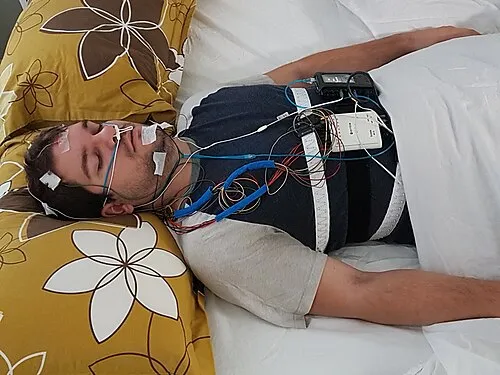
- Home respiratory polygraphy is enough for uncomplicated suspected moderate–severe OSA; use polysomnography if negative or complex
- CPAP is first-line for moderate–severe or symptomatic OSA; it improves sleepiness, quality of life and blood pressure
- Sleepy drivers with suspected OSA must be advised not to drive until treated, and to follow national licensing rules
Differential diagnosis
| Condition | Clues | Key test |
|---|---|---|
| Simple (primary) snoring | Snoring without apnoeas, desaturation or daytime sleepiness | Sleep study with AHI below 5 |
| Obesity hypoventilation syndrome | BMI 30 or more with daytime hypercapnia, often raised bicarbonate and oedema | Awake arterial blood gas: PaCO2 above 6 kPa (45 mmHg) |
| Central sleep apnoea | Heart failure, opioids or stroke; Cheyne–Stokes breathing without snoring | Polysomnography showing absent respiratory effort during apnoeas |
| Insufficient sleep or shift work disorder | Short habitual sleep, sleepiness improves with longer sleep | Sleep diary or actigraphy |
| Narcolepsy | Young patient, cataplexy, sleep paralysis, hypnagogic hallucinations | Polysomnography then multiple sleep latency test |
| Hypothyroidism | Weight gain, cold intolerance, fatigue, macroglossia | TSH and free T4 |
| Depression or medication-related sedation | Fatigue and low mood rather than sleep attacks; sedating drugs | Clinical assessment, PHQ-9, medication review |
Exam pearls
Guideline
AASM clinical practice guidelines for diagnostic testing (2017) and positive airway pressure treatment (2019), and NICE NG202 OSAHS and obesity hypoventilation syndrome in over 16s (2021)
References
- Kapur VK, Auckley DH, Chowdhuri S, et al.. Clinical Practice Guideline for Diagnostic Testing for Adult Obstructive Sleep Apnea: An American Academy of Sleep Medicine Clinical Practice Guideline. J Clin Sleep Med 2017.
- Patil SP, Ayappa IA, Caples SM, et al.. Treatment of Adult Obstructive Sleep Apnea with Positive Airway Pressure: An American Academy of Sleep Medicine Clinical Practice Guideline. J Clin Sleep Med 2019.
- National Institute for Health and Care Excellence (NICE). Obstructive sleep apnoea/hypopnoea syndrome and obesity hypoventilation syndrome in over 16s (NICE guideline NG202). 2021.
- Benjafield AV, Ayas NT, Eastwood PR, et al.. Estimation of the global prevalence and burden of obstructive sleep apnoea: a literature-based analysis. Lancet Respir Med 2019.
- Peppard PE, Young T, Barnet JH, Palta M, Hagen EW, Hla KM.. Increased prevalence of sleep-disordered breathing in adults. Am J Epidemiol 2013.
- McEvoy RD, Antic NA, Heeley E, et al.. CPAP for Prevention of Cardiovascular Events in Obstructive Sleep Apnea. N Engl J Med 2016.
Related topics
By Dr Khalid Seidi (B.Sc., M.D.) · MedEd World Clinical Knowledge library. Original teaching content checked against current guidelines (November 2026); confirm the latest local guidance before clinical use. Not a substitute for clinical judgement.