Clinical Knowledge › Internal medicine › Gastroenterology and hepatology › Diseases of the gallbladder and biliary tract
Cholangiocarcinoma
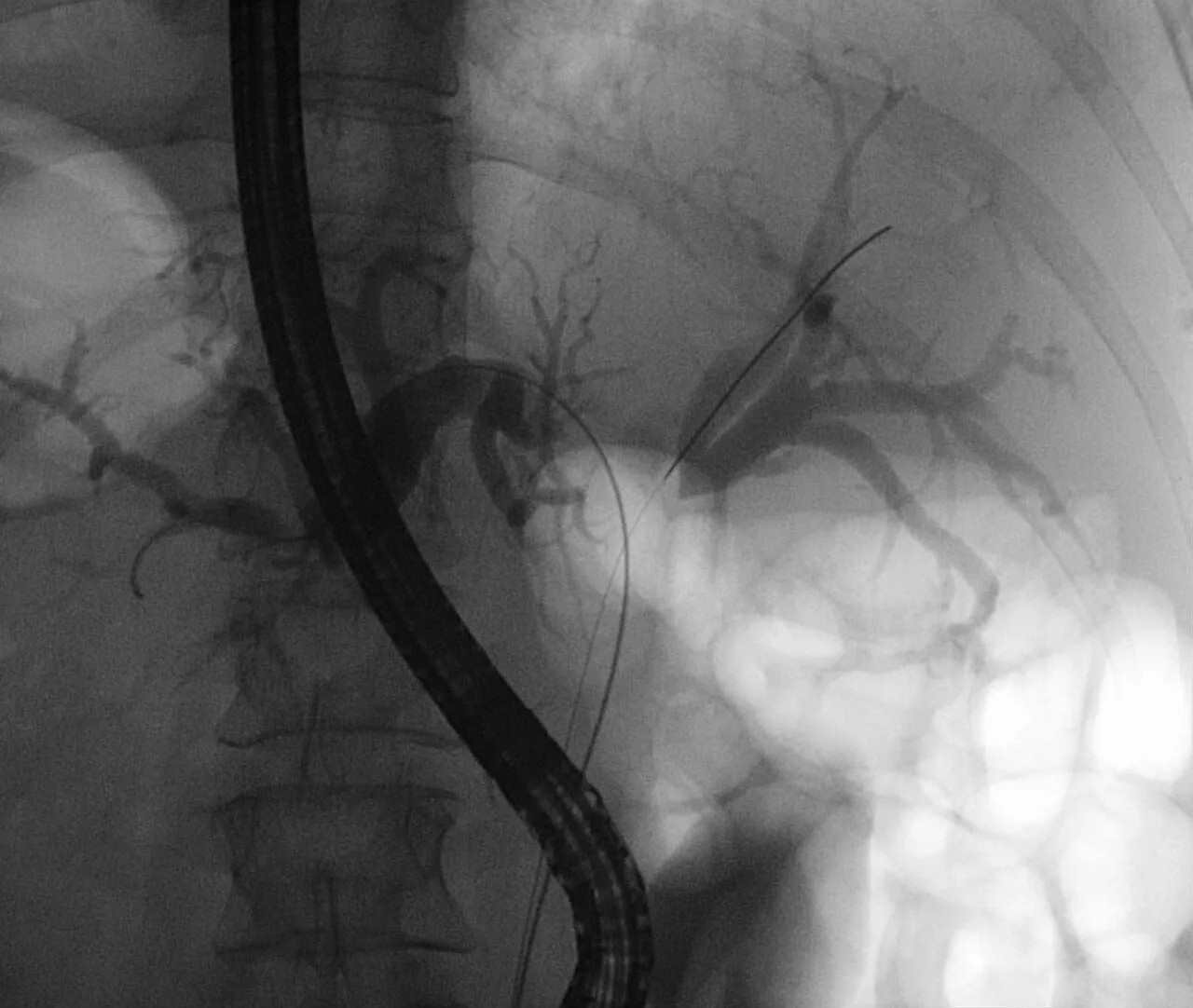
Cholangiocarcinoma is an adenocarcinoma of the bile duct epithelium and the second commonest primary liver cancer. It is classified by site as intrahepatic, perihilar (Klatskin tumour, the commonest) or distal. Risk factors include primary sclerosing cholangitis, liver flukes (Opisthorchis and Clonorchis, explaining very high rates in north-east Thailand), choledochal cysts, hepatolithiasis, cirrhosis and viral hepatitis. Perihilar and distal tumours present with painless obstructive jaundice and weight loss; intrahepatic tumours present as a liver mass. Diagnosis relies on CT and MRI with MRCP to define the level and extent of the stricture, with tissue from ERCP brushings, cholangioscopy or EUS; CA 19-9 supports but cannot confirm the diagnosis. Surgery is the only cure, followed by adjuvant capecitabine, and selected perihilar tumours are treated by liver transplantation. Advanced disease is treated with gemcitabine and cisplatin plus durvalumab or pembrolizumab, then targeted drugs chosen by molecular profiling (FGFR2, IDH1, HER2, BRAF).
Patient case, mechanism, investigations, management, flashcards and exam-style questions.Open the lesson →
Key facts
- Cholangiocarcinoma is classified as intrahepatic, perihilar (about half of cases) or distal
- Primary sclerosing cholangitis gives a lifetime risk of roughly 10–20%; liver flukes are the main cause in South-East Asia
- Perihilar tumours cause painless jaundice with a non-palpable gallbladder because the obstruction is above the cystic duct
- MRI with MRCP defines the level of obstruction (Bismuth–Corlette classification) before any stent is placed
- ERCP brushing cytology is specific but insensitive; FISH, cholangioscopy-guided biopsy and EUS improve the yield
- CA 19-9 rises in any cholestasis or cholangitis and is absent in Lewis antigen-negative people
- Resection is the only curative option; adjuvant capecitabine for 6 months follows (BILCAP)
- Advanced disease: gemcitabine–cisplatin plus durvalumab or pembrolizumab; molecular testing for FGFR2, IDH1, HER2, BRAF, NTRK and MSI
Differential diagnosis
| Condition | Clues | Key test |
|---|---|---|
| Pancreatic head adenocarcinoma | Distal obstruction, double duct sign, palpable gallbladder | Pancreatic-protocol CT and EUS biopsy |
| IgG4-related sclerosing cholangitis | Raised IgG4, autoimmune pancreatitis, other organ involvement, steroid response | Serum IgG4, imaging of pancreas, biopsy with IgG4 plasma cells |
| Dominant (high-grade) stricture in PSC | Known PSC; benign fibrotic stricture | Cholangioscopy-guided biopsy, brushings with FISH |
| Choledocholithiasis | Painful, fluctuating jaundice, fever | Ultrasound, MRCP or EUS showing stones |
| Gallbladder cancer invading the hilum | Gallbladder mass, gallstones, older women | CT/MRI showing gallbladder origin |
| Hepatocellular carcinoma | Cirrhosis, arterial enhancement with washout, raised AFP | Multiphase CT/MRI with LI-RADS; biopsy if atypical |
| Liver metastasis from colorectal cancer | Known primary, multiple lesions, CEA raised | Colonoscopy; biopsy with immunohistochemistry |
Exam pearls
Guideline
ESMO Clinical Practice Guideline on biliary tract cancer (2023) with interim update (2025), EASL–ILCA Clinical Practice Guidelines on intrahepatic cholangiocarcinoma (2023), AASLD guidance on PSC and cholangiocarcinoma (2023) and NCCN Guidelines: Biliary Tract Cancers (2026 versions)
References
- Vogel A, Bridgewater J, Edeline J, et al.. Biliary tract cancer: ESMO Clinical Practice Guideline for diagnosis, treatment and follow-up. Ann Oncol 2023.
- Vogel A, et al.. ESMO Clinical Practice Guideline interim update on the management of biliary tract cancer. ESMO Open 2025.
- European Association for the Study of the Liver and International Liver Cancer Association. EASL-ILCA Clinical Practice Guidelines on the management of intrahepatic cholangiocarcinoma. J Hepatol 2023.
- Bowlus CL, Arrivé L, Bergquist A, et al.. AASLD practice guidance on primary sclerosing cholangitis and cholangiocarcinoma. Hepatology 2023.
- Oh DY, He AR, Qin S, et al.. Durvalumab plus gemcitabine and cisplatin in advanced biliary tract cancer. NEJM Evid 2022.
- Kelley RK, Ueno M, Yoo C, et al.. Pembrolizumab in combination with gemcitabine and cisplatin compared with gemcitabine and cisplatin alone for patients with advanced biliary tract cancer (KEYNOTE-966): a randomised, double-blind, placebo-controlled, phase 3 trial. Lancet 2023.
Related topics
By Dr Khalid Seidi (B.Sc., M.D.) · MedEd World Clinical Knowledge library. Original teaching content checked against current guidelines (November 2026); confirm the latest local guidance before clinical use. Not a substitute for clinical judgement.