Clinical Knowledge › Internal medicine › Pulmonology › Pulmonary vascular diseases
Chronic thromboembolic pulmonary hypertension
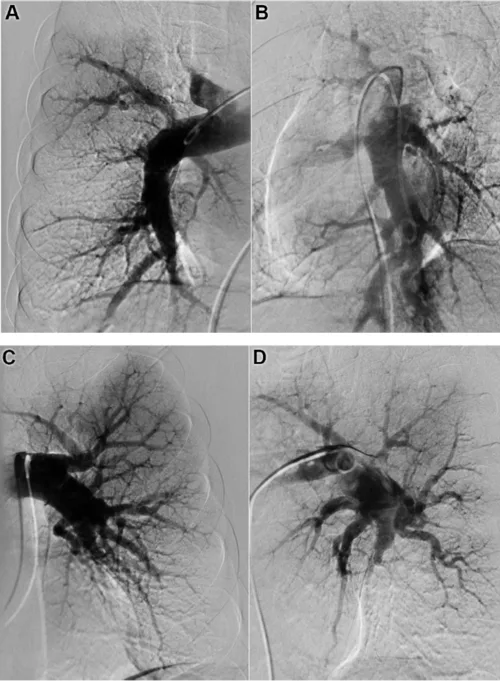
Chronic thromboembolic pulmonary hypertension (CTEPH, group 4 pulmonary hypertension) develops when pulmonary emboli fail to dissolve and are replaced by organised fibrotic material that narrows or occludes pulmonary arteries, with a secondary small-vessel arteriopathy. It complicates roughly 2–4% of survivors of acute pulmonary embolism but many recall no previous embolic event. It causes progressive exertional breathlessness and, later, right heart failure. The V/Q scan is the screening test of choice: a normal scan virtually excludes the diagnosis. Diagnosis is confirmed by right heart catheterisation (mean pulmonary arterial pressure above 20 mmHg, PAWP 15 mmHg or less, PVR above 2 Wood units) after at least 3 months of effective anticoagulation, with CT or catheter pulmonary angiography to map the lesions. CTEPH is the one form of pulmonary hypertension that is potentially curable: pulmonary endarterectomy for operable disease, balloon pulmonary angioplasty and riociguat for inoperable or residual disease, all with lifelong anticoagulation in an expert centre.
Patient case, mechanism, investigations, management, flashcards and exam-style questions.Open the lesson →
Key facts
- CTEPH follows unresolved, organised thromboemboli plus a microvasculopathy; it is group 4 pulmonary hypertension
- About 2–4% of patients develop CTEPH after acute PE; persistent breathlessness 3 months after PE should prompt screening
- V/Q scan is the best screening test: a normal perfusion scan essentially excludes CTEPH, whereas CTPA can miss chronic lesions
- Diagnosis needs right heart catheterisation (mPAP above 20 mmHg, PAWP 15 mmHg or less, PVR above 2 WU) after at least 3 months of anticoagulation
- Every patient should be assessed for operability by a multidisciplinary CTEPH team in an expert centre
- Pulmonary endarterectomy (PEA) is the treatment of choice and can be curative
- Balloon pulmonary angioplasty (BPA) and riociguat treat inoperable or persistent disease; RACE showed BPA lowers PVR more but has more complications
- Lifelong anticoagulation is required; vitamin K antagonists are preferred in antiphospholipid syndrome
Differential diagnosis
| Condition | Clues | Key test |
|---|---|---|
| Pulmonary arterial hypertension (group 1) | No mismatched perfusion defects; possible connective tissue disease, drugs or family history | V/Q scan, right heart catheterisation, autoimmune screen |
| PH due to left heart disease (group 2) | Orthopnoea, atrial fibrillation, LV or valve disease; raised PAWP | Echocardiogram, right heart catheter with PAWP above 15 mmHg |
| PH due to lung disease or hypoxia (group 3) | COPD or ILD, low DLCO, desaturation | Pulmonary function tests, HRCT |
| Pulmonary artery sarcoma | Weight loss, raised inflammatory markers, expansile filling defect that grows | CT/MR angiography, PET-CT |
| Large-vessel vasculitis (Takayasu) | Young woman, arm claudication, raised CRP, stenoses of aorta branches | CT/MR angiography, PET-CT |
| Fibrosing mediastinitis | Previous histoplasmosis or TB; mediastinal calcified tissue compressing vessels | Contrast CT |
| Post-PE syndrome without PH (deconditioning) | Breathless after PE but normal haemodynamics | Echo, cardiopulmonary exercise test, V/Q scan |
Exam pearls
Guideline
2022 ESC/ERS guidelines for pulmonary hypertension, 7th World Symposium on Pulmonary Hypertension (2024) CTEPD task force, ERS statement on CTEPH (2021) and 2026 AHA/ACC acute PE guideline (follow-up)
References
- Humbert M, Kovacs G, Hoeper MM, et al.. 2022 ESC/ERS Guidelines for the diagnosis and treatment of pulmonary hypertension. Eur Heart J 2022.
- Kim NH, D'Armini AM, Delcroix M, et al.. Chronic thromboembolic pulmonary disease. Eur Respir J 2024.
- Delcroix M, Torbicki A, Gopalan D, et al.. ERS statement on chronic thromboembolic pulmonary hypertension. Eur Respir J 2021.
- Ghofrani HA, D'Armini AM, Grimminger F, et al.. Riociguat for the treatment of chronic thromboembolic pulmonary hypertension. N Engl J Med 2013.
- Jaïs X, Brenot P, Bouvaist H, et al.. Balloon pulmonary angioplasty versus riociguat for the treatment of inoperable chronic thromboembolic pulmonary hypertension (RACE): a multicentre, phase 3, open-label, randomised controlled trial and ancillary follow-up study. Lancet Respir Med 2022.
- Ghofrani HA, Simonneau G, D'Armini AM, et al.. Macitentan for the treatment of inoperable chronic thromboembolic pulmonary hypertension (MERIT-1): results from the multicentre, phase 2, randomised, double-blind, placebo-controlled study. Lancet Respir Med 2017.
Related topics
By Dr Khalid Seidi (B.Sc., M.D.) · MedEd World Clinical Knowledge library. Original teaching content checked against current guidelines (November 2026); confirm the latest local guidance before clinical use. Not a substitute for clinical judgement.