Clinical Knowledge › Internal medicine › Rheumatology and immunology › Basics of rheumatology and immunology
Complement and immunoglobulin testing
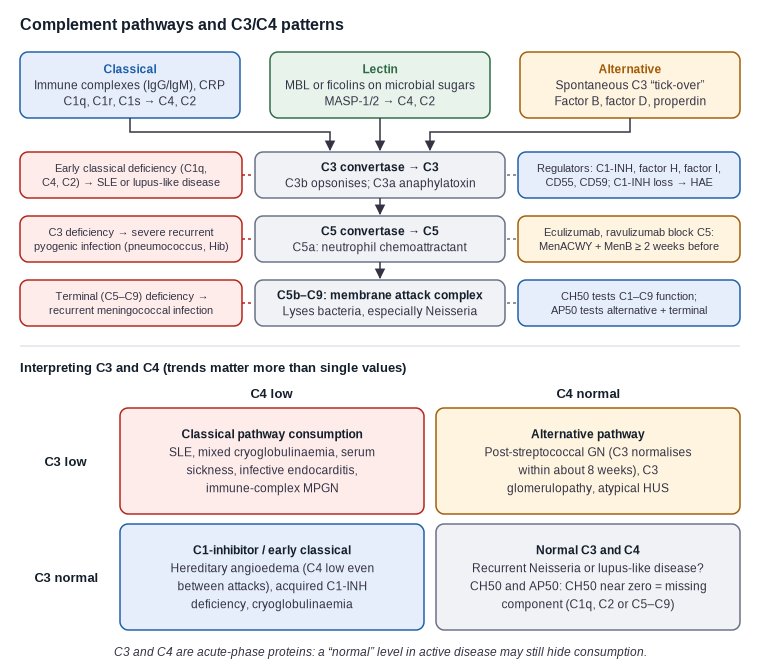
Complement and immunoglobulin tests answer two questions: is the immune system being consumed by disease, and is it working well enough to prevent infection? C3 and C4 are measured routinely; low C3 with low C4 points to classical-pathway activation by immune complexes (SLE, cryoglobulinaemia, serum sickness), low C3 alone to the alternative pathway (post-streptococcal glomerulonephritis, C3 glomerulopathy), and a persistently low C4 with normal C3 to hereditary angioedema or cryoglobulinaemia. Functional assays (CH50, AP50) detect inherited deficiencies: early classical components predispose to lupus, C3 to pyogenic infection and the terminal C5–C9 components to recurrent Neisseria infection. Serum immunoglobulins with protein electrophoresis, free light chains and vaccine responses detect antibody deficiency (common variable immunodeficiency, X-linked agammaglobulinaemia, secondary hypogammaglobulinaemia after rituximab or in CLL) and paraproteins (MGUS, myeloma). Patterns, trends and the clinical picture make these tests useful.
Patient case, mechanism, investigations, management, flashcards and exam-style questions.Open the lesson →
Key facts
- Low C3 and low C4: classical pathway consumption – SLE, mixed cryoglobulinaemia, serum sickness, endocarditis, immune-complex MPGN
- Low C3, normal C4: alternative pathway – post-streptococcal GN (normalises within about 8 weeks), C3 glomerulopathy, atypical HUS
- Low C4, normal C3: hereditary angioedema (C4 low even between attacks), cryoglobulinaemia, inherited C4 null alleles
- CH50 near zero with normal C3 and C4 suggests a deficiency of C1, C2 or a terminal component; C5–C9 deficiency causes recurrent meningococcal disease
- Eculizumab and ravulizumab block C5: give meningococcal vaccines (MenACWY and MenB) at least 2 weeks before and consider antibiotic prophylaxis
- Normal adult serum IgG is about 6–16 g/L; IgG below about 4 g/L with poor vaccine responses suggests significant antibody deficiency
- ESID 2019 CVID: low IgG and IgA (± IgM), poor vaccine responses or low switched memory B cells, onset after 4 years, secondary causes excluded
- Serum free light chain κ:λ ratio (about 0.26–1.65) and immunofixation detect monoclonal paraproteins in myeloma, AL amyloid and light-chain disease
Differential diagnosis
| Condition | Clues | Key test |
|---|---|---|
| Active SLE | Rash, arthritis, nephritis; low C3 and C4, anti-dsDNA positive | Anti-dsDNA, urine protein:creatinine ratio |
| Post-streptococcal glomerulonephritis | Nephritis 1–3 weeks after pharyngitis or 3–6 weeks after skin infection; low C3, normal C4 | ASO/anti-DNase B; repeat C3 at 8 weeks |
| Mixed cryoglobulinaemia | Purpura, arthralgia, neuropathy, HCV; very low C4, RF positive | Cryoglobulins (warm sample), HCV RNA |
| Hereditary angioedema | Recurrent non-itchy swelling and abdominal pain without urticaria; low C4 | C1-inhibitor level and function |
| Terminal complement deficiency | Recurrent or unusual-serogroup meningococcal infection | CH50 and AP50, individual components |
| Common variable immunodeficiency | Recurrent sinopulmonary infection, bronchiectasis, autoimmunity in adults; low IgG and IgA | Vaccine responses, B-cell phenotype |
| Secondary hypogammaglobulinaemia | Rituximab, CLL, myeloma, nephrotic syndrome, protein-losing enteropathy | Drug history, electrophoresis, urine protein |
Exam pearls
Guideline
WAO/EAACI guideline for hereditary angioedema (2021 revision); ESID registry working definitions for CVID (2019); ICON consensus on CVID (2016); IUIS classification of inborn errors of immunity (2022 update); KDIGO glomerular diseases guideline (2021); IMWG myeloma criteria (2014)
References
- Walport MJ.. Complement. First of two parts. N Engl J Med 2001.
- Ricklin D, Hajishengallis G, Yang K, et al.. Complement: a key system for immune surveillance and homeostasis. Nat Immunol 2010.
- Maurer M, Magerl M, Betschel S, et al.. The international WAO/EAACI guideline for the management of hereditary angioedema-The 2021 revision and update. Allergy 2022.
- Seidel MG, Kindle G, Gathmann B, et al.. The European Society for Immunodeficiencies (ESID) Registry Working Definitions for the Clinical Diagnosis of Inborn Errors of Immunity. J Allergy Clin Immunol Pract 2019.
- Bonilla FA, Barlan I, Chapel H, et al.. International Consensus Document (ICON): Common Variable Immunodeficiency Disorders. J Allergy Clin Immunol Pract 2016.
- Tangye SG, Al-Herz W, Bousfiha A, et al.. Human Inborn Errors of Immunity: 2022 Update on the Classification from the International Union of Immunological Societies Expert Committee. J Clin Immunol 2022.
Related topics
By Dr Khalid Seidi (B.Sc., M.D.) · MedEd World Clinical Knowledge library. Original teaching content checked against current guidelines (November 2026); confirm the latest local guidance before clinical use. Not a substitute for clinical judgement.