Clinical Knowledge › Internal medicine › Rheumatology and immunology › Basics of rheumatology and immunology
Hypersensitivity reactions (types I–IV)
Hypersensitivity reactions are exaggerated or misdirected immune responses that damage the host. The Gell and Coombs scheme sorts them by mechanism: type I is immediate and IgE-mediated (mast-cell degranulation causing urticaria, angioedema, bronchospasm and anaphylaxis within minutes); type II is antibody directed against antigens on cells or matrix (autoimmune haemolysis, haemolytic transfusion reaction, anti-GBM disease, Graves disease); type III is immune-complex deposition with complement consumption (serum sickness, post-streptococcal glomerulonephritis, lupus nephritis, Arthus reaction); and type IV is delayed and T-cell mediated (contact dermatitis, tuberculin reaction, granulomas, SJS/TEN and DRESS). Recognising the type predicts timing, the right test (tryptase and specific IgE, direct antiglobulin test, complement, patch test) and treatment. The 2023 EAACI nomenclature keeps types I–IV, splits type IV into subtypes and adds non-classical mechanisms. Anaphylaxis needs immediate intramuscular adrenaline.
Patient case, mechanism, investigations, management, flashcards and exam-style questions.Open the lesson →
Key facts
- Type I: IgE on mast cells and basophils cross-linked by allergen; onset within minutes; histamine, tryptase and leukotrienes
- Type II: IgG or IgM against cell-surface or matrix antigens causes complement lysis, opsonisation, ADCC or receptor stimulation/blockade
- Type III: soluble antigen–antibody complexes deposit in vessels, glomeruli and joints, activate complement and lower C3 and C4
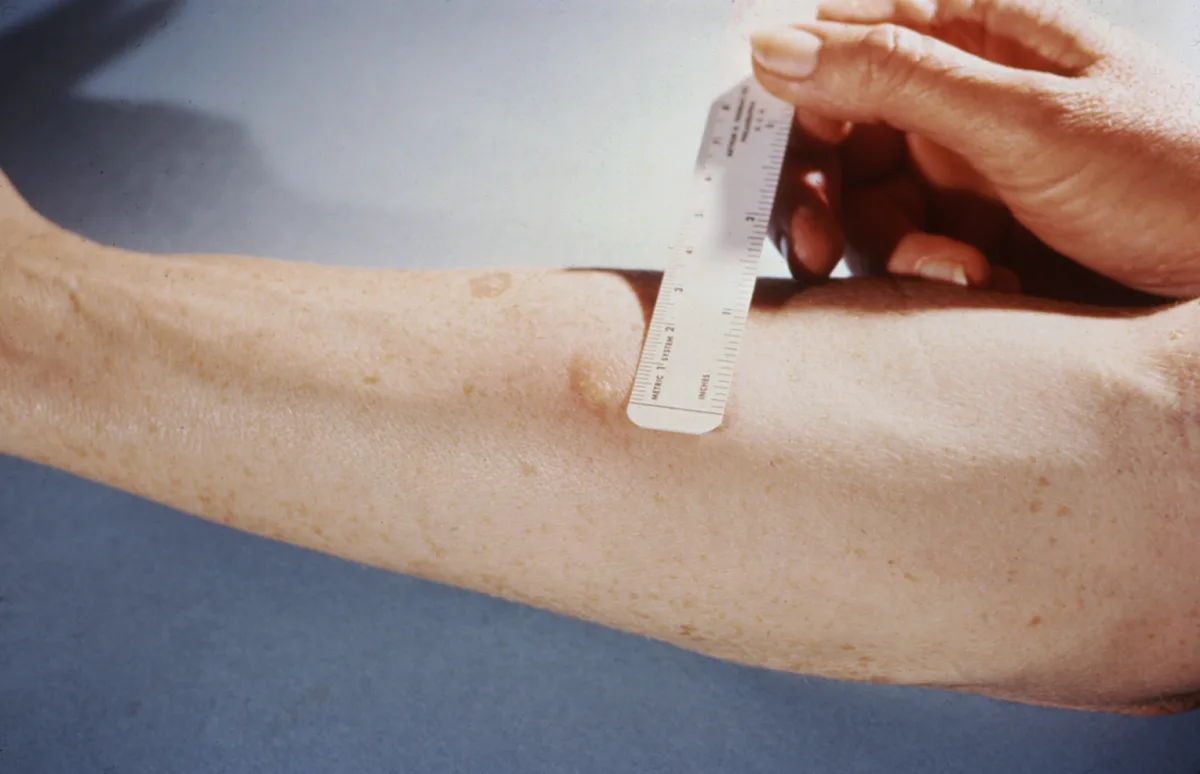
- Type IV: sensitised T cells cause delayed injury 24–72 hours (or days to weeks for drug eruptions) after exposure; no antibody involved
- Tests follow mechanism: tryptase and specific IgE (I), direct antiglobulin test (II), complement and immunofluorescence (III), patch test (IV)
- Anaphylaxis: adrenaline 0.5 mg IM (0.5 mL of 1 mg/mL) in adults, repeat after 5 minutes if no improvement (teaching dose; check local formulary)
- Mast-cell tryptase: first sample as soon as possible after resuscitation starts, second within 1–2 hours (no later than 4 hours), baseline at 24 hours or later
- HLA screening prevents severe type IV drug reactions: HLA-B*57:01 before abacavir, HLA-B*15:02 before carbamazepine in at-risk Asian populations
Differential diagnosis
| Condition | Clues | Key test |
|---|---|---|
| Anaphylaxis (type I) | Minutes after trigger: urticaria, angioedema, wheeze, hypotension | Serial mast-cell tryptase |
| Bradykinin-mediated angioedema | No urticaria or itch, slower onset, ACE inhibitor or family history; no response to adrenaline | C4 and C1-inhibitor level/function |
| Direct mast-cell activation (non-IgE) | Reaction on first exposure to opioids, vancomycin, contrast or fluoroquinolones | Clinical history; skin tests often negative |
| Vasovagal reaction | Bradycardia, pallor, sweating, no rash or wheeze, rapid recovery lying flat | Normal tryptase |
| Serum sickness (type III) | Fever, rash, arthralgia and lymphadenopathy 7–14 days after foreign protein or drug | Low C3/C4, proteinuria |
| Haemolytic transfusion reaction (type II) | Fever, loin pain, dark urine minutes into transfusion | Direct antiglobulin test, haemolysis screen |
| SJS/TEN or DRESS (type IV) | Rash with mucositis or blistering, or rash with eosinophilia and organ involvement 1–8 weeks after a new drug | Skin biopsy; FBC, LFTs |
Exam pearls
Guideline
EAACI position paper on nomenclature of allergic diseases and hypersensitivity reactions (2023); Resuscitation Council UK Emergency treatment of anaphylaxis (2021); NICE NG258 Anaphylaxis: assessment and referral after emergency treatment (2026)
References
- Jutel M, Agache I, Zemelka-Wiacek M, et al.. Nomenclature of allergic diseases and hypersensitivity reactions: Adapted to modern needs: An EAACI position paper. Allergy 2023.
- Muraro A, Worm M, Alviani C, et al.. EAACI guidelines: Anaphylaxis (2021 update). Allergy 2022.
- Resuscitation Council UK. Emergency treatment of anaphylaxis: guidelines for healthcare providers. Resuscitation Council UK guideline 2021.
- National Institute for Health and Care Excellence (NICE). Anaphylaxis: assessment and referral after emergency treatment (NG258). NICE guideline 2026.
- Pichler WJ.. Delayed drug hypersensitivity reactions. Ann Intern Med 2003.
- Gell PGH, Coombs RRA, eds.. Clinical Aspects of Immunology. Oxford: Blackwell Scientific 1963.
Related topics
By Dr Khalid Seidi (B.Sc., M.D.) · MedEd World Clinical Knowledge library. Original teaching content checked against current guidelines (November 2026); confirm the latest local guidance before clinical use. Not a substitute for clinical judgement.