Clinical Knowledge › Internal medicine › Rheumatology and immunology › Basics of rheumatology and immunology
Inflammatory markers (ESR and CRP)
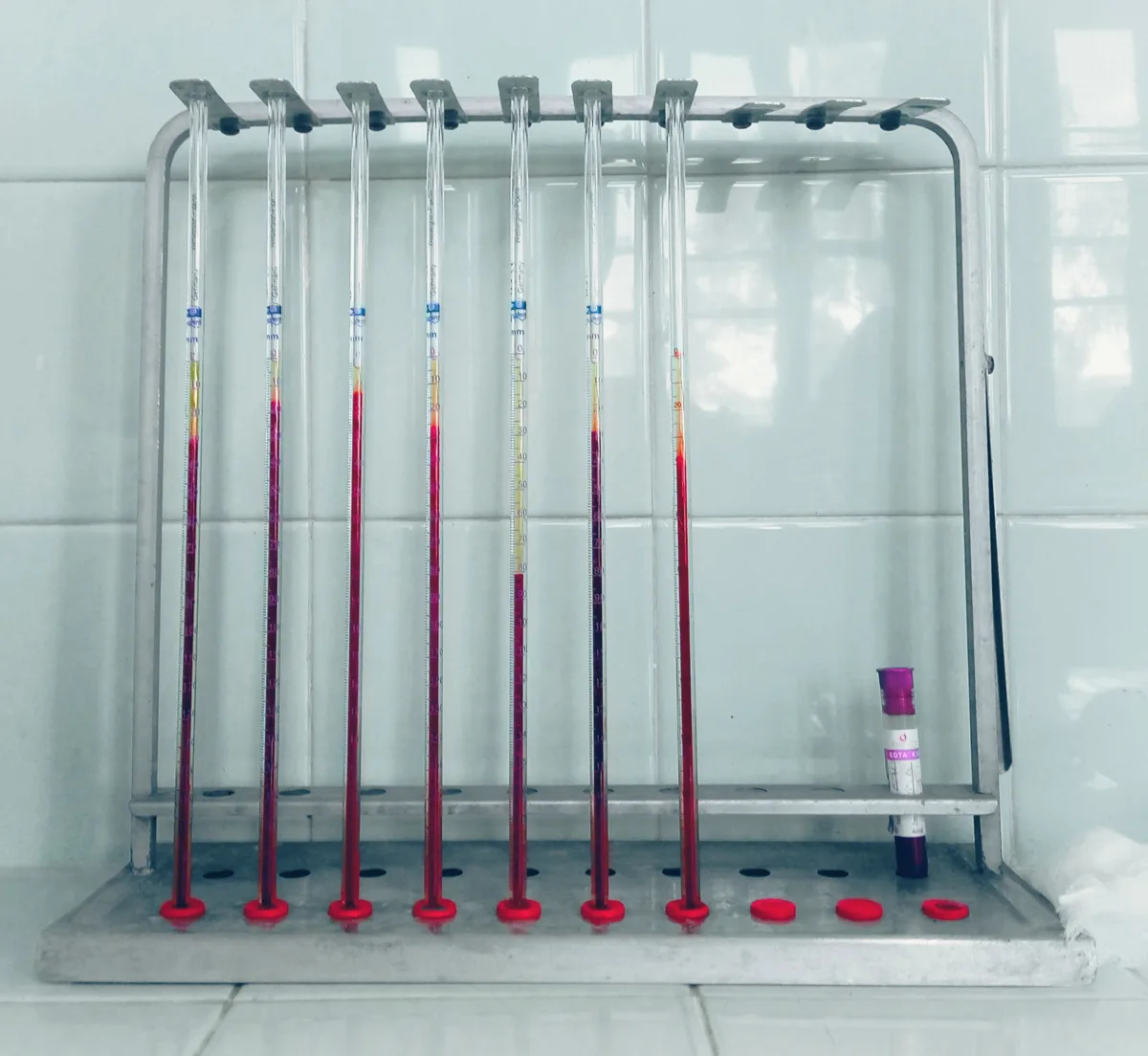
The erythrocyte sedimentation rate (ESR) and C-reactive protein (CRP) are non-specific markers of the acute-phase response. CRP is a pentraxin made by hepatocytes under interleukin-6 drive; it rises within 6 hours, peaks at about 48 hours and, with a half-life of about 19 hours, falls quickly when inflammation settles, so it is the better marker of acute change. ESR measures how far red cells fall in an hour; it rises when fibrinogen and immunoglobulins promote rouleaux, so it reflects inflammation more slowly and is also raised by anaemia, pregnancy, kidney disease, older age and paraproteins. Discordance is informative: a high ESR with normal CRP suggests SLE, myeloma or anaemia, whereas a very high CRP in a patient with lupus suggests infection or serositis. In rheumatology the markers support diagnosis of giant cell arteritis and polymyalgia rheumatica, score rheumatoid arthritis activity and monitor treatment, but neither diagnoses a disease, and IL-6 or JAK inhibitors suppress both.
Patient case, mechanism, investigations, management, flashcards and exam-style questions.Open the lesson →
Key facts
- CRP is synthesised by hepatocytes in response to IL-6; it rises in 6 hours, peaks at 36–50 hours and has a half-life of about 19 hours
- Normal CRP is usually below 5 mg/L; values above 100 mg/L most often mean bacterial infection, but also vasculitis, Still disease and major trauma
- ESR (Westergren, mm in the first hour) depends mainly on fibrinogen and immunoglobulins, which neutralise red-cell negative charge and promote rouleaux
- Rule of thumb for upper normal ESR: age ÷ 2 for men and (age + 10) ÷ 2 for women
- ESR above 100 mm/h suggests infection (endocarditis, osteomyelitis, TB), myeloma, GCA/PMR, malignancy or SLE
- High ESR with normal CRP: SLE, Sjögren syndrome, myeloma, anaemia, pregnancy, chronic kidney disease
- 2022 ACR/EULAR GCA criteria give ESR ≥50 mm/h or CRP ≥10 mg/L 3 points; a normal ESR and CRP make GCA much less likely but do not exclude it
- Tocilizumab, sarilumab and JAK inhibitors suppress CRP and ESR, masking infection and disease activity
Differential diagnosis
| Condition | Clues | Key test |
|---|---|---|
| Bacterial infection | CRP very high (often > 100 mg/L), fever, focal source, neutrophilia | Cultures, imaging; procalcitonin |
| Giant cell arteritis | Age ≥50, new headache, jaw claudication, ESR and CRP high | Temporal artery ultrasound or biopsy |
| Polymyalgia rheumatica | Shoulder and hip girdle stiffness > 45 minutes, raised CRP/ESR | Response to prednisolone 15 mg; exclude mimics |
| Multiple myeloma | Very high ESR with normal or mildly raised CRP, rouleaux, anaemia, bone pain | Serum protein electrophoresis, free light chains |
| SLE flare | High ESR, modest CRP, low C3/C4, rising anti-dsDNA | Complement, anti-dsDNA, urinalysis |
| Non-inflammatory causes of high ESR | Anaemia, pregnancy, CKD, obesity, older age | FBC, creatinine; CRP normal |
| Malignancy (lymphoma, renal cell, metastases) | Persistently raised markers, weight loss, night sweats | CT, LDH, biopsy |
Exam pearls
Guideline
ICSH recommendations for ESR measurement (2017); BSR guideline on GCA (2020); 2022 ACR/EULAR GCA classification criteria; 2012 EULAR/ACR PMR classification criteria and 2015 EULAR/ACR PMR recommendations; EULAR RA recommendations (2022 update)
References
- Kratz A, Plebani M, Peng M, et al.. ICSH recommendations for modified and alternate methods measuring the erythrocyte sedimentation rate. Int J Lab Hematol 2017.
- Pepys MB, Hirschfield GM.. C-reactive protein: a critical update. J Clin Invest 2003.
- Gabay C, Kushner I.. Acute-phase proteins and other systemic responses to inflammation. N Engl J Med 1999.
- Mackie SL, Dejaco C, Appenzeller S, et al.. British Society for Rheumatology guideline on diagnosis and treatment of giant cell arteritis. Rheumatology (Oxford) 2020.
- Ponte C, Grayson PC, Robson JC, et al.. 2022 American College of Rheumatology/EULAR classification criteria for giant cell arteritis. Ann Rheum Dis 2022.
- Dasgupta B, Cimmino MA, Maradit-Kremers H, et al.. 2012 provisional classification criteria for polymyalgia rheumatica: a European League Against Rheumatism/American College of Rheumatology collaborative initiative. Ann Rheum Dis 2012.
Related topics
By Dr Khalid Seidi (B.Sc., M.D.) · MedEd World Clinical Knowledge library. Original teaching content checked against current guidelines (November 2026); confirm the latest local guidance before clinical use. Not a substitute for clinical judgement.