Clinical Knowledge › Internal medicine › Pulmonology › Interstitial lung diseases
Cryptogenic organising pneumonia
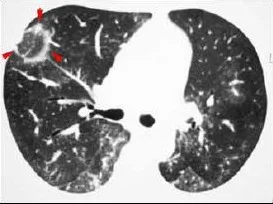
Organising pneumonia is a pattern of lung injury in which plugs of loose granulation tissue fill the alveolar ducts and alveoli, while the underlying lung architecture is preserved. When no cause is found it is called cryptogenic organising pneumonia (COP), formerly idiopathic BOOP. Many cases are secondary to infection, including COVID-19, drugs such as amiodarone and checkpoint inhibitors, connective tissue disease, radiotherapy or transplantation. Patients are usually aged 50–60 and present with a few weeks of flu-like illness, cough, fever, breathlessness and weight loss, often after several courses of antibiotics have failed. CT shows bilateral, patchy, peripheral or peribronchovascular consolidation that may migrate, sometimes with a reversed halo sign. Diagnosis needs compatible imaging, exclusion of infection and secondary causes, and ideally biopsy confirmation discussed by a multidisciplinary team. Corticosteroids produce rapid improvement, but relapse during tapering is common and responds to retreatment. The overall prognosis is excellent.
Patient case, mechanism, investigations, management, flashcards and exam-style questions.Open the lesson →
Key facts
- Histology: intra-alveolar buds of granulation tissue (Masson bodies) in alveolar ducts and alveoli, with preserved lung architecture
- COP is idiopathic; secondary organising pneumonia follows infection, drugs, connective tissue disease, radiotherapy, transplantation or aspiration
- Typical illness: subacute flu-like symptoms over less than 3 months with cough, fever and breathlessness that do not respond to antibiotics
- CT: bilateral patchy peripheral or peribronchovascular consolidation, often migratory; reversed halo (atoll) and perilobular patterns
- Diagnosis requires exclusion of infection and secondary causes, BAL (lymphocytosis) and usually transbronchial, cryo- or surgical biopsy
- Treatment: prednisolone about 0.75 mg/kg/day for 4 weeks, tapered over about 6 months; response is often dramatic within days
- Relapse occurs in roughly a third to a half of patients, usually below 10–15 mg prednisolone or after stopping, and responds to retreatment
- Prognosis is excellent; a minority have fulminant disease or progress to fibrosis
Differential diagnosis
| Condition | Clues | Key test |
|---|---|---|
| Community-acquired pneumonia | Acute onset, lobar consolidation, responds to antibiotics | Cultures, urinary antigens; response to antibiotics |
| Chronic eosinophilic pneumonia | Asthma, peripheral consolidation, blood eosinophilia | Blood and BAL eosinophils above 25% |
| Invasive mucinous adenocarcinoma or lymphoma | Persistent non-migratory consolidation, no steroid response | Biopsy, PET-CT |
| Hypersensitivity pneumonitis | Antigen exposure, centrilobular nodules, mosaic attenuation | Exposure history, BAL lymphocytosis, expiratory CT |
| Granulomatosis with polyangiitis | Cavitating nodules, sinus and renal disease | PR3-ANCA, urinalysis, biopsy |
| Pulmonary tuberculosis | Cavities, weight loss, endemic exposure | Sputum NAAT and culture |
| Pulmonary infarction from PE | Wedge-shaped peripheral opacities, pleuritic pain | CT pulmonary angiography |
Exam pearls
Guideline
ATS/ERS classification of idiopathic interstitial pneumonias (2013) updated by the ERS/ATS statement (2025), with the BTS interstitial lung disease guideline (2008)
References
- Travis WD, Costabel U, Hansell DM, et al.. An official American Thoracic Society/European Respiratory Society statement: update of the international multidisciplinary classification of the idiopathic interstitial pneumonias. Am J Respir Crit Care Med 2013.
- Ryerson CJ, et al.. Update of the international multidisciplinary classification of the interstitial pneumonias: an ERS/ATS statement. Eur Respir J 2025.
- Wells AU, Hirani N, et al.. Interstitial lung disease guideline: the British Thoracic Society in collaboration with the Thoracic Society of Australia and New Zealand and the Irish Thoracic Society. Thorax 2008.
- Cordier JF. Cryptogenic organising pneumonia. Eur Respir J 2006.
- Lazor R, Vandevenne A, Pelletier A, et al.. Cryptogenic organizing pneumonia: characteristics of relapses in a series of 48 patients. Am J Respir Crit Care Med 2000.
- King TE Jr, Lee JS. Cryptogenic organizing pneumonia. N Engl J Med 2022.
Related topics
By Dr Khalid Seidi (B.Sc., M.D.) · MedEd World Clinical Knowledge library. Original teaching content checked against current guidelines (November 2026); confirm the latest local guidance before clinical use. Not a substitute for clinical judgement.