Clinical Knowledge › Internal medicine › Pulmonology › Interstitial lung diseases
Drug-induced lung disease
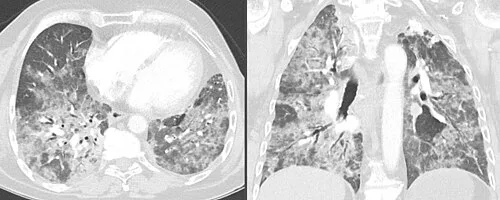
Drug-induced lung disease covers any harm to the airways, interstitium, pleura or pulmonary vessels caused by a medicine. More than a thousand drugs are implicated, and the list grows with every new cancer therapy. The commonest form is drug-induced interstitial lung disease, which can appear as organising pneumonia, non-specific interstitial pneumonia, hypersensitivity-type or eosinophilic pneumonia, or life-threatening diffuse alveolar damage. Classic culprits are amiodarone, nitrofurantoin, methotrexate, bleomycin and other cytotoxic drugs; today, immune checkpoint inhibitors, antibody–drug conjugates such as trastuzumab deruxtecan and targeted kinase inhibitors are leading causes. No test proves the diagnosis: it rests on a compatible time course, imaging pattern and exclusion of infection, cancer progression and heart failure. Management is to stop the drug, give corticosteroids according to severity and support breathing; for immunotherapy pneumonitis, severity grading guides whether treatment can be resumed.
Patient case, mechanism, investigations, management, flashcards and exam-style questions.Open the lesson →
Key facts
- Suspect a drug in any new pulmonary infiltrate: take a full drug history including over-the-counter and recent cancer treatments
- Diagnosis is by exclusion: compatible timing, imaging pattern and exclusion of infection, heart failure and tumour progression
- Amiodarone: risk rises with dose above 400 mg/day and cumulative exposure; high-attenuation lung and liver on CT; foamy macrophages on BAL
- Nitrofurantoin causes acute hypersensitivity pneumonitis (fever, eosinophilia) within days to weeks and chronic fibrosis after months to years
- Bleomycin toxicity is dose-related and worsened by high inspired oxygen, renal impairment, age and thoracic radiotherapy
- Checkpoint inhibitor pneumonitis affects about 3–5% of patients; grade 2 needs drug interruption and prednisolone 1–2 mg/kg
- Trastuzumab deruxtecan causes ILD in about 1 in 7 patients; grade 2 or more means permanent discontinuation
- Stop the culprit drug; corticosteroids for moderate to severe disease; report the reaction to pharmacovigilance
Differential diagnosis
| Condition | Clues | Key test |
|---|---|---|
| Opportunistic infection (PJP, CMV, fungal) | Fever, immunosuppression, high LDH or β-D-glucan | BAL with PCR and cultures |
| Cardiogenic pulmonary oedema | Orthopnoea, raised JVP, effusions, high BNP | Echocardiogram, BNP, response to diuretics |
| Lymphangitic carcinomatosis or tumour progression | Known cancer, nodular septal thickening, nodes | CT, biopsy or cytology |
| Radiation pneumonitis | Opacity confined to the radiation field 1–6 months after radiotherapy | Compare with the radiotherapy plan |
| CTD-associated ILD | Autoimmune features predating the drug | Autoantibodies, history |
| Diffuse alveolar haemorrhage | Falling haemoglobin, haemoptysis, rising DLCO | Sequential BAL showing increasingly bloody returns |
| Idiopathic pulmonary fibrosis | Slow progression unrelated to drug timing | HRCT, MDT |
Exam pearls
Guideline
Fleischner Society position paper on drug-related pneumonitis (2021); ASCO guideline on immune-related adverse events (2021 update); ESMO clinical practice guideline on immunotherapy toxicities (2022); product guidance for antibody–drug conjugates
References
- Johkoh T, Lee KS, Nishino M, et al.. Chest CT Diagnosis and Clinical Management of Drug-Related Pneumonitis in Patients Receiving Molecular Targeting Agents and Immune Checkpoint Inhibitors: A Position Paper From the Fleischner Society. Chest 2021.
- Schneider BJ, Naidoo J, Santomasso BD, et al.. Management of Immune-Related Adverse Events in Patients Treated With Immune Checkpoint Inhibitor Therapy: ASCO Guideline Update. J Clin Oncol 2021.
- Haanen J, Obeid M, Spain L, et al.. Management of toxicities from immunotherapy: ESMO Clinical Practice Guideline for diagnosis, treatment and follow-up. Ann Oncol 2022.
- Spagnolo P, Bonniaud P, Rossi G, Sverzellati N, Cottin V.. Drug-induced interstitial lung disease. Eur Respir J 2022.
- Skeoch S, Weatherley N, Swift AJ, et al.. Drug-Induced Interstitial Lung Disease: A Systematic Review. J Clin Med 2018.
- Naidoo J, Wang X, Woo KM, et al.. Pneumonitis in Patients Treated With Anti-Programmed Death-1/Programmed Death Ligand 1 Therapy. J Clin Oncol 2017.
Related topics
By Dr Khalid Seidi (B.Sc., M.D.) · MedEd World Clinical Knowledge library. Original teaching content checked against current guidelines (November 2026); confirm the latest local guidance before clinical use. Not a substitute for clinical judgement.