Clinical Knowledge › Internal medicine › Pulmonology › Interstitial lung diseases
Other idiopathic interstitial pneumonias (NSIP)
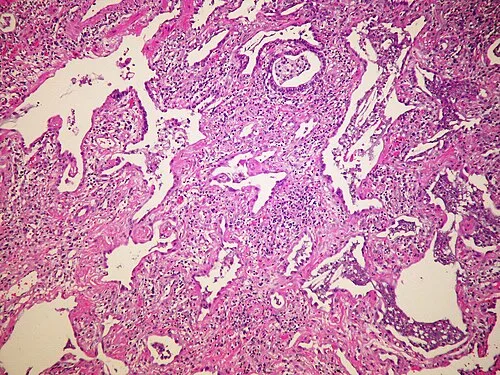
The idiopathic interstitial pneumonias (IIPs) are diffuse lung diseases of unknown cause, classified by clinical, radiological and pathological pattern. After idiopathic pulmonary fibrosis, the most important is non-specific interstitial pneumonia (NSIP), in which inflammation and fibrosis of the alveolar walls are uniform and all at the same stage, unlike the patchy, varied pattern of usual interstitial pneumonia. It typically affects middle-aged women who have never smoked, causing months of breathlessness, dry cough and fine basal crackles. HRCT shows symmetrical lower-zone ground glass and reticulation with traction bronchiectasis and sparing of the immediate subpleural lung. NSIP is often the lung manifestation of connective tissue disease, especially systemic sclerosis and antisynthetase syndrome, or of drugs or hypersensitivity pneumonitis, so autoimmune and exposure work-up and multidisciplinary discussion are essential. Treatment is with corticosteroids and mycophenolate, adding antifibrotic therapy if progressive pulmonary fibrosis develops. Prognosis is better than in IPF.
Patient case, mechanism, investigations, management, flashcards and exam-style questions.Open the lesson →
Key facts
- NSIP is the second most common IIP after IPF; its histology is temporally uniform interstitial inflammation (cellular) and/or fibrosis (fibrotic)
- Typical patient: woman aged 40–60, often a never-smoker, with subacute breathlessness and dry cough
- HRCT: bilateral symmetrical lower-zone ground glass and fine reticulation, traction bronchiectasis, subpleural sparing and little or no honeycombing
- Always look for a secondary cause: systemic sclerosis, myositis (antisynthetase syndrome), Sjögren syndrome, rheumatoid arthritis, drugs, hypersensitivity pneumonitis
- Interstitial pneumonia with autoimmune features (IPAF) describes ILD with autoimmune clues that do not meet criteria for a defined connective tissue disease
- Diagnosis is made by multidisciplinary discussion; BAL lymphocytosis and cryobiopsy or surgical biopsy help when HRCT is not diagnostic
- Treatment: prednisolone plus mycophenolate (or azathioprine); rituximab or cyclophosphamide for severe disease; nintedanib for progressive pulmonary fibrosis
- The 2025 ERS/ATS classification update renamed desquamative interstitial pneumonia as alveolar macrophage pneumonia and acute interstitial pneumonia as idiopathic diffuse alveolar damage
Differential diagnosis
| Condition | Clues | Key test |
|---|---|---|
| Idiopathic pulmonary fibrosis (UIP) | Older man, ex-smoker, clubbing, basal subpleural honeycombing | HRCT UIP pattern; MDT |
| Fibrotic hypersensitivity pneumonitis | Bird or mould exposure, mid or upper zone, mosaic attenuation and air trapping | Exposure history, expiratory CT, BAL lymphocytosis |
| Connective tissue disease-associated ILD | Raynaud phenomenon, sclerodactyly, mechanic's hands, arthritis, myositis | ANA, ENA, myositis antibodies, CK, rheumatology review |
| Organising pneumonia | Subacute illness with patchy migratory consolidation, perilobular or reverse halo pattern | HRCT, BAL, biopsy |
| Drug-induced pneumonitis | Methotrexate, amiodarone, nitrofurantoin, checkpoint inhibitors | Drug history; improvement after withdrawal |
| Chronic heart failure | Orthopnoea, raised JVP, septal lines, effusions | Echocardiography, BNP, response to diuretics |
| Sarcoidosis | Hilar lymphadenopathy, perilymphatic nodules, upper zone | HRCT and biopsy with non-caseating granulomas |
Exam pearls
Guideline
ATS/ERS/JRS/ALAT guideline on IPF (an update) and progressive pulmonary fibrosis (2022), ERS/ATS update of the classification of interstitial pneumonias (2025), ATS/ERS IIP classification (2013) and ERS/ATS IPAF statement (2015)
References
- Raghu G, Remy-Jardin M, Richeldi L, et al.. Idiopathic pulmonary fibrosis (an update) and progressive pulmonary fibrosis in adults: an official ATS/ERS/JRS/ALAT clinical practice guideline. Am J Respir Crit Care Med 2022.
- Ryerson CJ, et al.. Update of the international multidisciplinary classification of the interstitial pneumonias: an ERS/ATS statement. Eur Respir J 2025.
- Travis WD, Costabel U, Hansell DM, et al.. An official American Thoracic Society/European Respiratory Society statement: update of the international multidisciplinary classification of the idiopathic interstitial pneumonias. Am J Respir Crit Care Med 2013.
- Travis WD, Hunninghake G, King TE Jr, et al.. Idiopathic nonspecific interstitial pneumonia: report of an American Thoracic Society project. Am J Respir Crit Care Med 2008.
- Fischer A, Antoniou KM, Brown KK, et al.. An official European Respiratory Society/American Thoracic Society research statement: interstitial pneumonia with autoimmune features. Eur Respir J 2015.
- Flaherty KR, Wells AU, Cottin V, et al.. Nintedanib in progressive fibrosing interstitial lung diseases. N Engl J Med 2019.
Related topics
By Dr Khalid Seidi (B.Sc., M.D.) · MedEd World Clinical Knowledge library. Original teaching content checked against current guidelines (November 2026); confirm the latest local guidance before clinical use. Not a substitute for clinical judgement.