Clinical Knowledge › Internal medicine › Cardiology and angiology › Relevant pharmacology
Digoxin
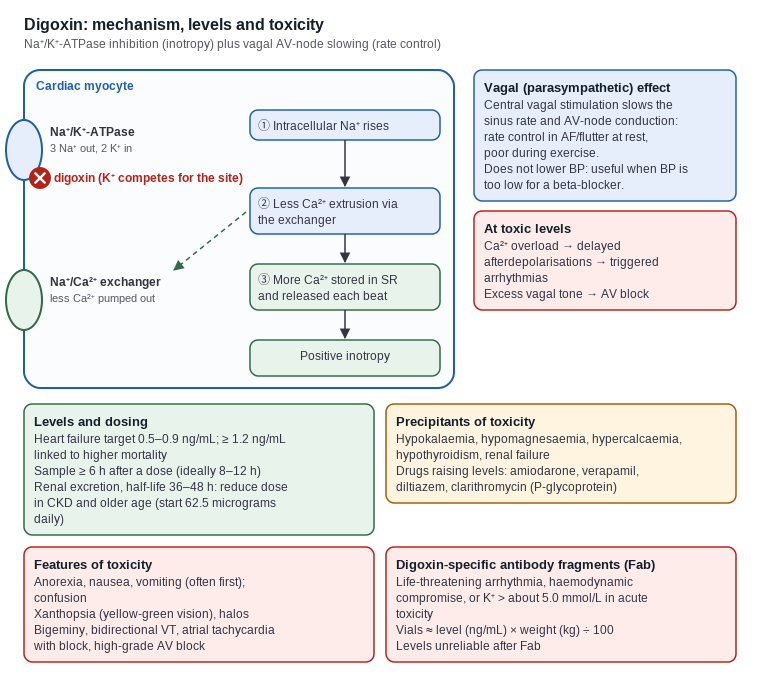
Digoxin is a cardiac glycoside that inhibits the sodium–potassium ATPase, raising intracellular calcium and contractility, and increases vagal tone, slowing conduction through the AV node. It is used for rate control in atrial fibrillation, especially with heart failure, and as additional therapy in symptomatic HFrEF. The DIG trial showed no effect on mortality but fewer heart failure admissions; DIGIT-HF (2025) showed that digitoxin reduced death or HF admission, and the 2026 ESC heart failure guideline strengthened the place of cardiac glycosides as additional therapy. Digoxin has a narrow therapeutic index, a half-life of about 36–48 hours and is cleared by the kidneys, so levels rise in renal impairment, older age and with interacting drugs such as amiodarone, verapamil and clarithromycin. Hypokalaemia increases toxicity. Toxicity causes nausea, visual disturbance (yellow-green vision), confusion and almost any arrhythmia, classically bidirectional VT or atrial tachycardia with block. Severe toxicity is treated with digoxin-specific antibody fragments.
Patient case, mechanism, investigations, management, flashcards and exam-style questions.Open the lesson →
Key facts
- Digoxin inhibits Na/K-ATPase: intracellular sodium rises, less calcium leaves via the Na/Ca exchanger, so contractility increases
- Vagomimetic action slows AV nodal conduction: good for rate control at rest, poor during exercise
- DIG trial: no mortality effect in HFrEF but fewer heart failure admissions; DIGIT-HF (2025): digitoxin reduced death or HF admission
- Target serum digoxin 0.5–0.9 ng/mL in heart failure; sample at least 6 hours (ideally 8–12 h) after the dose; higher levels are linked to higher mortality
- Renally excreted with a half-life of 36–48 h: reduce the dose in CKD and older adults; digitoxin is hepatically cleared
- Toxicity is promoted by hypokalaemia, hypomagnesaemia, hypercalcaemia, hypothyroidism, renal failure and interacting drugs (amiodarone, verapamil, clarithromycin)
- Toxicity: anorexia, nausea, xanthopsia, confusion; arrhythmias such as ventricular bigeminy, bidirectional VT, atrial tachycardia with block and high-grade AV block
- Life-threatening toxicity or acute overdose with potassium above about 5.0 mmol/L: give digoxin-specific antibody fragments (Fab)
Differential diagnosis
| Condition | Clues | Key test |
|---|---|---|
| Beta-blockers | First-line rate control at any LVEF; prognostic in HFrEF; better rate control on exertion | HR, BP, bronchospasm history |
| Diltiazem or verapamil | Rate control in AF only when LVEF above 40%; avoid in HFrEF | HR, BP, LVEF |
| Digoxin | Rate control in sedentary patients, HFrEF or hypotension; additional therapy in HFrEF | Serum level, potassium, creatinine |
| Digitoxin | Hepatic clearance, long half-life; DIGIT-HF evidence in HFrEF | Serum level |
| Amiodarone | Acute rate control in unstable or HFrEF patients when others fail | TFTs, LFTs, QT |
| Ivabradine | Slows sinus rate only (no AV nodal effect); HFrEF in sinus rhythm | Resting HR, rhythm |
Exam pearls
Guideline
2026 ESC heart failure guideline, 2024 ESC atrial fibrillation guideline, 2023 ACC/AHA/ACCP/HRS atrial fibrillation guideline and 2022 AHA/ACC/HFSA heart failure guideline
References
- Køber L, Adamo M, Ruwald AC, et al.. 2026 ESC Guidelines for the management of heart failure. Eur Heart J 2026.
- Van Gelder IC, Rienstra M, Bunting KV, et al.. 2024 ESC Guidelines for the management of atrial fibrillation developed in collaboration with the European Association for Cardio-Thoracic Surgery (EACTS). Eur Heart J 2024.
- Joglar JA, Chung MK, Armbruster AL, et al.. 2023 ACC/AHA/ACCP/HRS Guideline for the Diagnosis and Management of Atrial Fibrillation. Circulation 2024.
- The Digitalis Investigation Group. The effect of digoxin on mortality and morbidity in patients with heart failure. N Engl J Med 1997.
- Bavendiek U, Großhennig A, Schwab J, et al.. Digitoxin in Patients with Heart Failure and Reduced Ejection Fraction. N Engl J Med 2025.
- Kotecha D, Bunting KV, Gill SK, et al.. Effect of Digoxin vs Bisoprolol for Heart Rate Control in Atrial Fibrillation on Patient-Reported Quality of Life: The RATE-AF Randomized Clinical Trial. JAMA 2020.
Related topics
By Dr Khalid Seidi (B.Sc., M.D.) · MedEd World Clinical Knowledge library. Original teaching content checked against current guidelines (November 2026); confirm the latest local guidance before clinical use. Not a substitute for clinical judgement.