Clinical Knowledge › Internal medicine › Basics of internal medicine › Hospital medicine and patient safety
Discharge planning
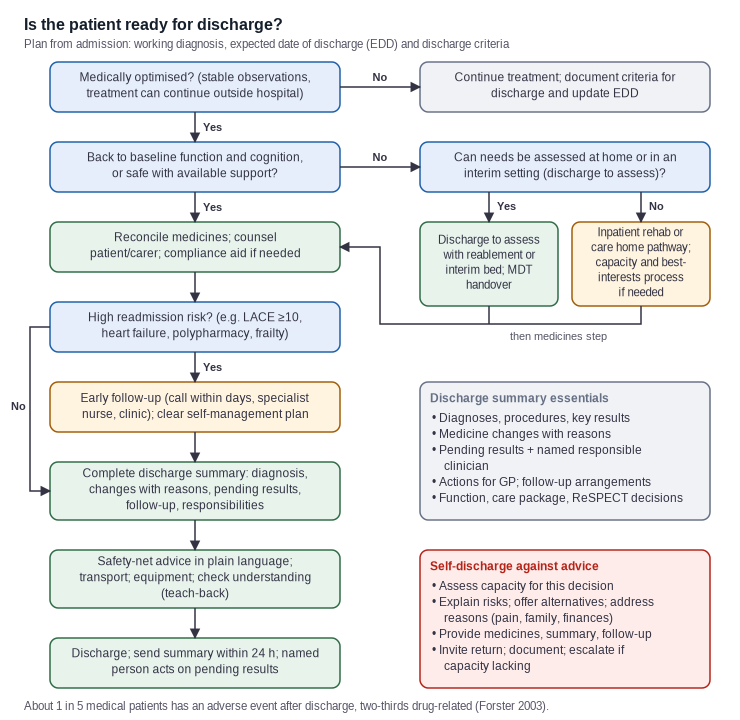
Discharge planning is the structured process of preparing a patient to leave hospital safely and on time to the most appropriate setting, with the right medicines, information, support and follow-up. It starts on admission with a working diagnosis, an expected date of discharge and early identification of needs, and continues through daily senior review, multidisciplinary assessment of function, cognition and social circumstances, and shared decisions with the patient and carers. Poor transitions are dangerous: about one in five medical patients has an adverse event within weeks of discharge, most often drug-related, and discharge summaries often reach the family doctor late or lack key information. Good practice includes medicines reconciliation and counselling, a timely, complete discharge summary listing changes, pending results and follow-up, clear safety-netting advice, and extra support for patients at high risk of readmission. Patients who wish to leave against advice must have their capacity assessed and be helped to leave as safely as possible.
Patient case, mechanism, investigations, management, flashcards and exam-style questions.Open the lesson →
Key facts
- Plan discharge from the day of admission: working diagnosis, expected date of discharge (EDD) and criteria for discharge
- Readiness includes medical stability, functional and cognitive status, safe destination, support, medicines and follow-up
- About 1 in 5 medical patients has an adverse event after discharge, two-thirds of them adverse drug events (Forster 2003)
- Discharge summaries are often unavailable at the first follow-up and miss key information (Kripalani 2007); send them promptly (UK contracts expect within 24 hours)
- Every discharge summary should list diagnosis, key results, medicine changes with reasons, pending results, follow-up and who is responsible
- Readmission risk tools: LACE (length of stay, acuity, comorbidity, ED visits) and HOSPITAL score
- Discharge to assess: once medically optimised, assess long-term care needs at home or in an interim setting rather than in hospital
- Self-discharge against advice: assess capacity, explain risks, offer alternatives, provide medicines and follow-up, document
Differential diagnosis
| Condition | Clues | Key test |
|---|---|---|
| Home with no new support | Independent, medically stable, understands plan | Functional review, medicines counselling |
| Home with care package or reablement | New functional limitation but safe at home with help | OT/PT assessment, social care referral |
| Discharge to assess (home or interim bed) | Medically optimised; long-term needs uncertain | Assessment in the community |
| Intermediate care or rehabilitation unit | Rehabilitation potential but not yet safe at home | MDT goals; rehabilitation criteria |
| Care home (residential or nursing) | Persistent high care needs or unsafe at home despite support | Capacity assessment and best-interests process if needed |
| Hospice or home for end-of-life care | Last weeks of life; preferred place of death | Rapid (fast-track) discharge planning |
| Self-discharge against medical advice | Patient insists on leaving before ready | Capacity assessment; risk explanation |
Exam pearls
Guideline
NICE NG27 Transition between inpatient hospital settings and community or care home settings for adults with social care needs (2015), NICE NG5 Medicines optimisation (2015), UK Hospital discharge and community support guidance (2022, with later updates) and the Cochrane review of discharge planning (2022)
References
- Gonçalves-Bradley DC, Lannin NA, Clemson L, Cameron ID, Shepperd S.. Discharge planning from hospital. Cochrane Database Syst Rev 2022.
- Jack BW, Chetty VK, Anthony D, et al.. A reengineered hospital discharge program to decrease rehospitalization: a randomized trial. Ann Intern Med 2009.
- Kripalani S, LeFevre F, Phillips CO, et al.. Deficits in communication and information transfer between hospital-based and primary care physicians: implications for patient safety and continuity of care. JAMA 2007.
- Forster AJ, Murff HJ, Peterson JF, Gandhi TK, Bates DW.. The incidence and severity of adverse events affecting patients after discharge from the hospital. Ann Intern Med 2003.
- van Walraven C, Dhalla IA, Bell C, et al.. Derivation and validation of an index to predict early death or unplanned readmission after discharge from hospital to the community. CMAJ 2010.
- Donzé J, Aujesky D, Williams D, Schnipper JL.. Potentially avoidable 30-day hospital readmissions in medical patients: derivation and validation of a prediction model. JAMA Intern Med 2013.
Related topics
By Dr Khalid Seidi (B.Sc., M.D.) · MedEd World Clinical Knowledge library. Original teaching content checked against current guidelines (November 2026); confirm the latest local guidance before clinical use. Not a substitute for clinical judgement.