Clinical Knowledge › Internal medicine › Basics of internal medicine › Hospital medicine and patient safety
Healthcare-associated infections and infection control
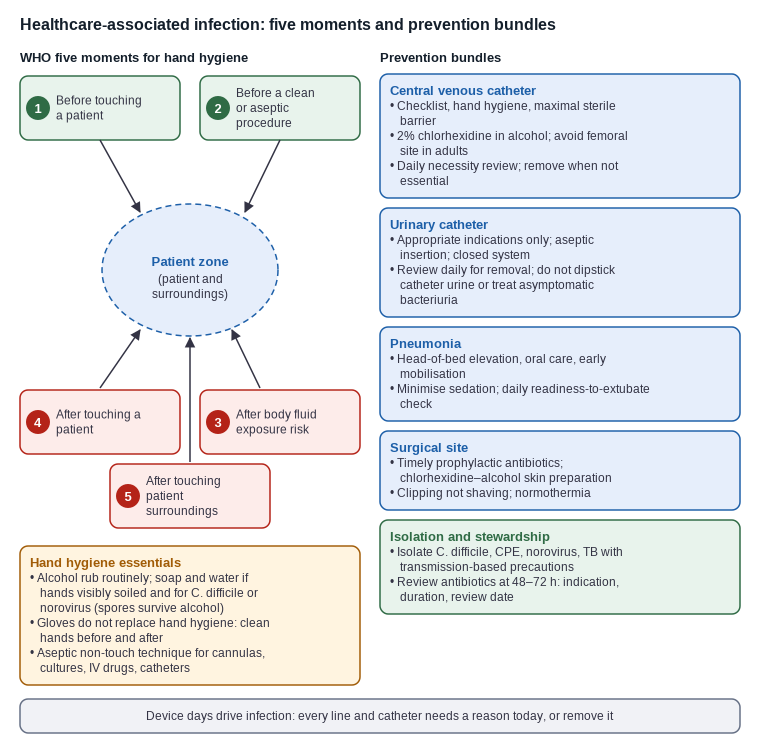
Healthcare-associated infections (HAIs) are infections that were neither present nor incubating at admission and arise as a result of care, usually 48 hours or more after admission, within 30 days of surgery (90 days with an implant) or after discharge from a healthcare setting. They affect about 3% of US inpatients and around 7% in European acute hospitals. The big five are pneumonia (including ventilator-associated), surgical site infection, urinary tract infection (mostly catheter-associated), bloodstream infection (mostly line-related) and Clostridioides difficile infection. Many are preventable: hand hygiene at the five moments, aseptic non-touch technique, prevention bundles for central lines, catheters, ventilated patients and surgery, daily review and prompt removal of devices, isolation of infectious patients, environmental cleaning and antimicrobial stewardship. The ward doctor's role is practical: question every line and catheter every day, take cultures properly, avoid treating colonisation, report clusters and prescribe antibiotics prudently.
Patient case, mechanism, investigations, management, flashcards and exam-style questions.Open the lesson →
Key facts
- HAI: not present or incubating on admission; typically onset 48 hours or more after admission, within 30 days of surgery (90 days with implants)
- Point prevalence: about 3% of US inpatients (2015) and around 7% in EU/EEA acute hospitals (2022–2023); higher in ICUs and low-resource settings
- Commonest HAIs: pneumonia, surgical site infection, urinary tract infection, bloodstream infection and C. difficile infection
- Hand hygiene at the WHO five moments is the single most important measure; alcohol rub does not kill C. difficile spores, so use soap and water
- Device days drive infection: catheter bacteriuria accrues at about 3–7% per day; remove lines and catheters as soon as not needed
- Central line bundle: hand hygiene, maximal barrier precautions, chlorhexidine–alcohol skin preparation, avoid femoral site, daily necessity review
- Do not dipstick catheter urine or treat asymptomatic bacteriuria (except in pregnancy and before urological procedures)
- Antimicrobial stewardship reduces C. difficile and resistant organisms: review antibiotics at 48–72 hours (start smart, then focus)
Differential diagnosis
| Condition | Clues | Key test |
|---|---|---|
| Hospital-acquired pneumonia | New infiltrate with fever, purulent sputum and hypoxia 48 h or more after admission | Chest X-ray, sputum culture, blood cultures |
| Catheter-associated UTI | Fever, suprapubic or loin pain, rigors, delirium with a catheter in situ; no other source | Culture from a new catheter; blood cultures |
| Central line-associated bloodstream infection | Fever, rigors on flushing, exit-site erythema or pus; no other source | Paired central and peripheral blood cultures (differential time to positivity) |
| Peripheral cannula phlebitis and S. aureus bacteraemia | Painful red cord along the vein, pus at site | Remove cannula; blood cultures; tip culture if pus |
| Surgical site infection | Wound erythema, discharge, dehiscence, deep collection within 30 days | Wound swab, ultrasound or CT for collection |
| Clostridioides difficile infection | Three or more unformed stools in 24 h after antibiotics or PPI | Stool GDH/toxin testing |
| Non-infective fever | Drug fever, VTE, transfusion reaction, gout, atelectasis | Clinical review, Doppler or CTPA as indicated |
Exam pearls
Guideline
WHO Guidelines on hand hygiene in health care (2009) and Core components of IPC programmes (2016), SHEA/IDSA/APIC Compendium of strategies to prevent HAIs in acute-care hospitals (2022 updates), epic3 national evidence-based guidelines (2014), NICE NG125 Surgical site infections (2019, updated 2020), CDC/HICPAC isolation precautions (2007) and NICE NG15 Antimicrobial stewardship (2015)
References
- World Health Organization. WHO guidelines on hand hygiene in health care: first global patient safety challenge – clean care is safer care. WHO 2009.
- Buetti N, Marschall J, Drees M, et al.. Strategies to prevent central line-associated bloodstream infections in acute-care hospitals: 2022 update. Infect Control Hosp Epidemiol 2022.
- Loveday HP, Wilson JA, Pratt RJ, et al.. epic3: national evidence-based guidelines for preventing healthcare-associated infections in NHS hospitals in England. J Hosp Infect 2014.
- Magill SS, O'Leary E, Janelle SJ, et al.. Changes in prevalence of health care-associated infections in U.S. hospitals. N Engl J Med 2018.
- Pronovost P, Needham D, Berenholtz S, et al.. An intervention to decrease catheter-related bloodstream infections in the ICU. N Engl J Med 2006.
- Pittet D, Hugonnet S, Harbarth S, et al.. Effectiveness of a hospital-wide programme to improve compliance with hand hygiene. Lancet 2000.
Related topics
By Dr Khalid Seidi (B.Sc., M.D.) · MedEd World Clinical Knowledge library. Original teaching content checked against current guidelines (November 2026); confirm the latest local guidance before clinical use. Not a substitute for clinical judgement.