Clinical Knowledge › Internal medicine › Endocrinology › Lipid disorders and obesity
Familial dysbetalipoproteinaemia
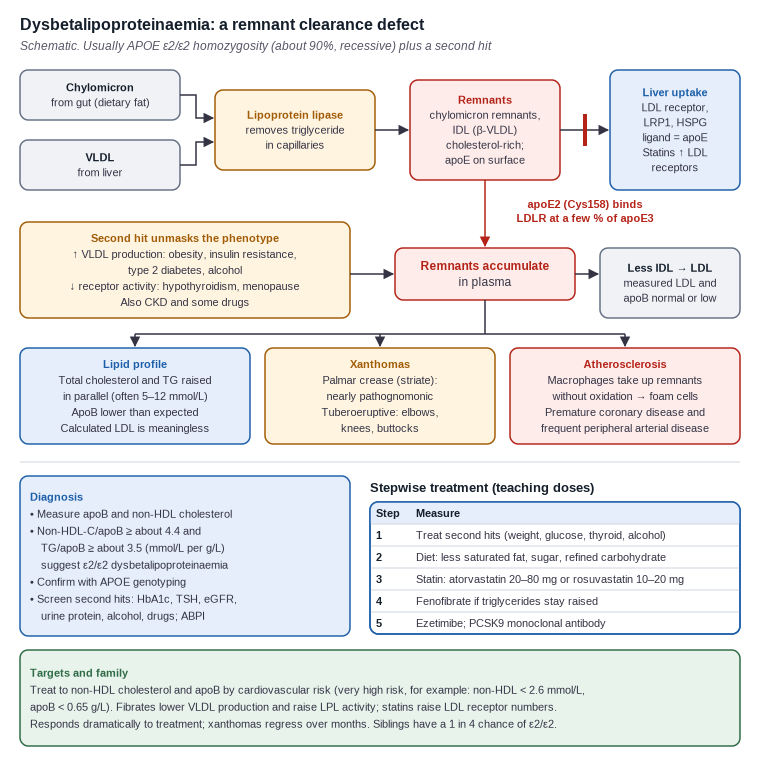
Familial dysbetalipoproteinaemia (type III hyperlipoproteinaemia, remnant removal disease) is an inherited disorder in which cholesterol-rich remnants of chylomicrons and VLDL accumulate because apolipoprotein E cannot bind normally to hepatic receptors. Most cases are autosomal recessive and occur in people homozygous for the APOE ε2 allele (ε2/ε2), which binds the LDL receptor very poorly; rarer dominant forms are caused by other APOE variants. Penetrance is variable, and the phenotype is usually brought out or worsened by a second factor such as obesity, type 2 diabetes, hypothyroidism, menopause, alcohol or kidney disease increases remnant production. The typical profile is a parallel rise of total cholesterol and triglycerides, often both 5–12 mmol/L, with an apolipoprotein B that is lower than expected. Palmar crease (striate) xanthomas are nearly pathognomonic, and tuberoeruptive xanthomas occur over elbows and knees. Remnants cause premature coronary and especially peripheral arterial disease. Diagnosis uses apoB-based ratios and APOE genotyping. The disorder responds very well to treatment of secondary factors, diet, statins and fibrates, with non-HDL cholesterol and apoB as targets.
Patient case, mechanism, investigations, management, flashcards and exam-style questions.Open the lesson →
Key facts
- Cause: defective apoE-mediated hepatic uptake of chylomicron and VLDL remnants (IDL, β-VLDL)
- About 90% are autosomal recessive APOE ε2/ε2 homozygotes; about 10% have dominant rare APOE variants
- ApoE2 (cysteine at position 158) binds the LDL receptor with only a few per cent of the affinity of apoE3
- Expression usually needs a 'second hit': obesity, diabetes, hypothyroidism, oestrogen loss at menopause, alcohol, CKD or drugs
- Lipids: total cholesterol and triglycerides raised to a similar degree, with relatively low apoB; calculated LDL is meaningless
- Palmar crease (striate) xanthomas are almost pathognomonic; tuberoeruptive xanthomas occur over elbows, knees and buttocks
- Premature coronary disease and disproportionately frequent peripheral arterial disease
- Diagnosis: non-HDL cholesterol/apoB and triglyceride/apoB ratios, confirmed by APOE genotyping (or ultracentrifugation/broad-beta band)
Differential diagnosis
| Condition | Clues | Key test |
|---|---|---|
| Familial combined hyperlipidaemia | Mixed hyperlipidaemia with high apoB; variable phenotypes in relatives; no palmar xanthomas | ApoB high; APOE genotype not ε2/ε2 |
| Heterozygous familial hypercholesterolaemia | Isolated high LDL, tendon xanthomas | LDL very high with normal triglycerides; LDLR/APOB/PCSK9 testing |
| Multifactorial chylomicronaemia | Triglycerides far higher than cholesterol, eruptive xanthomas, pancreatitis | Triglyceride/cholesterol ratio high; chylomicrons on refrigeration |
| Secondary mixed dyslipidaemia (diabetes, hypothyroidism, nephrotic syndrome) | Mixed profile resolving with treatment of cause | HbA1c, TSH, urine protein; reassess after treatment |
| Hepatic lipase deficiency | Rare; remnant-like profile with normal APOE genotype | Specialist lipoprotein analysis; LIPC genetic testing |
| Cholestatic hypercholesterolaemia | High cholesterol with cholestatic liver tests, planar xanthomas | Liver tests; lipoprotein X |
Exam pearls
Guideline
2019 ESC/EAS dyslipidaemia guidelines with the 2025 focused update, and 2026 ACC/AHA multisociety dyslipidaemia guideline (with expert diagnostic algorithms for dysbetalipoproteinaemia)
References
- Mach F, Baigent C, Catapano AL, et al.. 2019 ESC/EAS Guidelines for the management of dyslipidaemias: lipid modification to reduce cardiovascular risk. Eur Heart J 2020.
- Mach F, Koskinas KC, Roeters van Lennep JE, et al.. 2025 Focused Update of the 2019 ESC/EAS Guidelines for the management of dyslipidaemias. Eur Heart J 2025.
- Blumenthal RS, Morris PB, Gaudino M, et al.. 2026 ACC/AHA/AACVPR/ABC/ACPM/ADA/AGS/APhA/ASPC/NLA/PCNA Guideline on the Management of Dyslipidemia. J Am Coll Cardiol 2026.
- Bea AM, Cenarro A, Marco-Benedí V, et al.. Diagnosis of Familial Dysbetalipoproteinemia Based on the Lipid Abnormalities Driven by APOE2/E2 Genotype. Clin Chem 2023.
- Heidemann BE, Marais AD, Mulder MT, et al.. Composition and distribution of lipoproteins after evolocumab in familial dysbetalipoproteinemia: a randomized controlled trial. J Clin Lipidol 2023.
- Koopal C, Marais AD, Visseren FL.. Familial dysbetalipoproteinemia: an underdiagnosed lipid disorder. Curr Opin Endocrinol Diabetes Obes 2017.
Related topics
By Dr Khalid Seidi (B.Sc., M.D.) · MedEd World Clinical Knowledge library. Original teaching content checked against current guidelines (November 2026); confirm the latest local guidance before clinical use. Not a substitute for clinical judgement.