Clinical Knowledge › Surgery › Hernias and abdominal wall
Femoral hernia
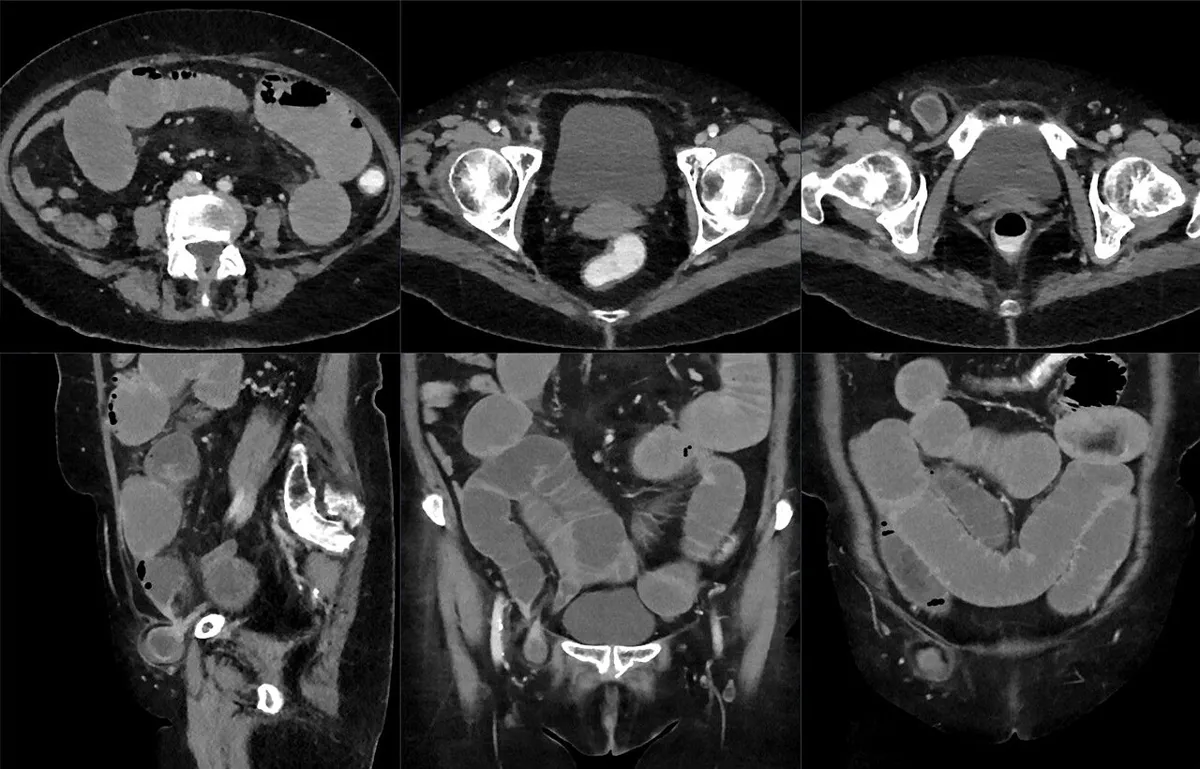
A femoral hernia is a protrusion of a peritoneal sac through the femoral ring into the femoral canal, the medial compartment of the femoral sheath. It accounts for only 2–4% of groin hernias, but is relatively common in older and multiparous women. The ring is narrow and rigid (inguinal, pectineal and lacunar ligaments and the femoral vein), so femoral hernias incarcerate and strangulate far more often than inguinal hernias; about a third present as emergencies, often with a Richter's hernia. The classic sign is a small, firm, often irreducible lump below and lateral to the pubic tubercle and medial to the femoral pulse, frequently without a cough impulse. Every femoral hernia should be repaired promptly; watchful waiting is not appropriate. Elective mesh repair is preferably laparo-endoscopic where expertise exists, with open low (infrainguinal), inguinal or high (preperitoneal) approaches as alternatives; the high approach suits emergencies needing bowel resection. Emergency repair carries several-fold higher bowel resection and mortality rates.
Patient case, mechanism, investigations, management, flashcards and exam-style questions.Open the lesson →
Key facts
- The femoral ring is bounded by the inguinal ligament (anterior), pectineal (Cooper's) ligament (posterior), lacunar ligament (medial) and femoral vein (lateral)
- Femoral hernias make up 2–4% of groin hernias; women outnumber men, but inguinal hernia is still the commonest groin hernia in women
- The lump lies below and lateral to the pubic tubercle and medial to the femoral pulse; it may turn upwards over the inguinal ligament
- About a third of femoral hernias present as emergencies, compared with about 5% of inguinal hernias
- Femoral hernia is the classic site of Richter's hernia: strangulation of part of the bowel wall without complete obstruction
- All femoral hernias should be repaired promptly; there is no role for watchful waiting
- Laparo-endoscopic mesh repair is suggested for elective femoral hernia repair where expertise is available
- An aberrant obturator artery ('corona mortis') may cross the lacunar ligament and bleed if the ligament is divided
Differential diagnosis
| Condition | Clues | Key test |
|---|---|---|
| Inguinal hernia | Above and medial to pubic tubercle; cough impulse; usually reducible | Clinical; ultrasound if unsure |
| Saphena varix | Soft, compressible, disappears lying down, fluid thrill on coughing, varicose veins | Duplex ultrasound |
| Femoral lymphadenopathy (including Cloquet's node) | Firm, often multiple, no impulse; skin, leg or perineal lesion | Ultrasound ± fine-needle aspiration or biopsy |
| Femoral artery aneurysm or pseudoaneurysm | Expansile pulsatile lump, recent arterial puncture | Duplex ultrasound |
| Psoas abscess | Lateral to femoral artery, fever, back pain, flexed hip | CT abdomen and pelvis |
| Lipoma | Soft, mobile, no impulse, long-standing | Ultrasound |
| Obturator hernia | Thin older woman, obstruction, pain down inner thigh (Howship–Romberg sign) | CT abdomen and pelvis |
Exam pearls
Guideline
HerniaSurge International Guidelines for Groin Hernia Management (2018) and 2023 update; WSES 2017 guidelines for emergency repair of complicated abdominal wall hernias
References
- HerniaSurge Group. International guidelines for groin hernia management. Hernia 2018.
- Stabilini C, van Veenendaal N, Aasvang E, et al.. Update of the international HerniaSurge guidelines for groin hernia management. BJS Open 2023.
- Dahlstrand U, Wollert S, Nordin P, Sandblom G, Gunnarsson U.. Emergency femoral hernia repair: a study based on a national register. Ann Surg 2009.
- Birindelli A, Sartelli M, Di Saverio S, et al.. 2017 update of the WSES guidelines for emergency repair of complicated abdominal wall hernias. World J Emerg Surg 2017.
- Farrell MS, Zhang Z, Kirsch J, et al.. Surgical management of incarcerated and strangulated inguinal hernias requiring urgent surgical intervention: a systematic review, meta-analysis, and practice management guideline from the Eastern Association for the Surgery of Trauma. J Trauma Acute Care Surg 2025.
- Miserez M, Alexandre JH, Campanelli G, et al.. The European hernia society groin hernia classification: simple and easy to remember. Hernia 2007.
Related topics
By Dr Khalid Seidi (B.Sc., M.D.) · MedEd World Clinical Knowledge library. Original teaching content checked against current guidelines (November 2026); confirm the latest local guidance before clinical use. Not a substitute for clinical judgement.