Clinical Knowledge › Surgery › Hernias and abdominal wall
Incarcerated and strangulated hernia
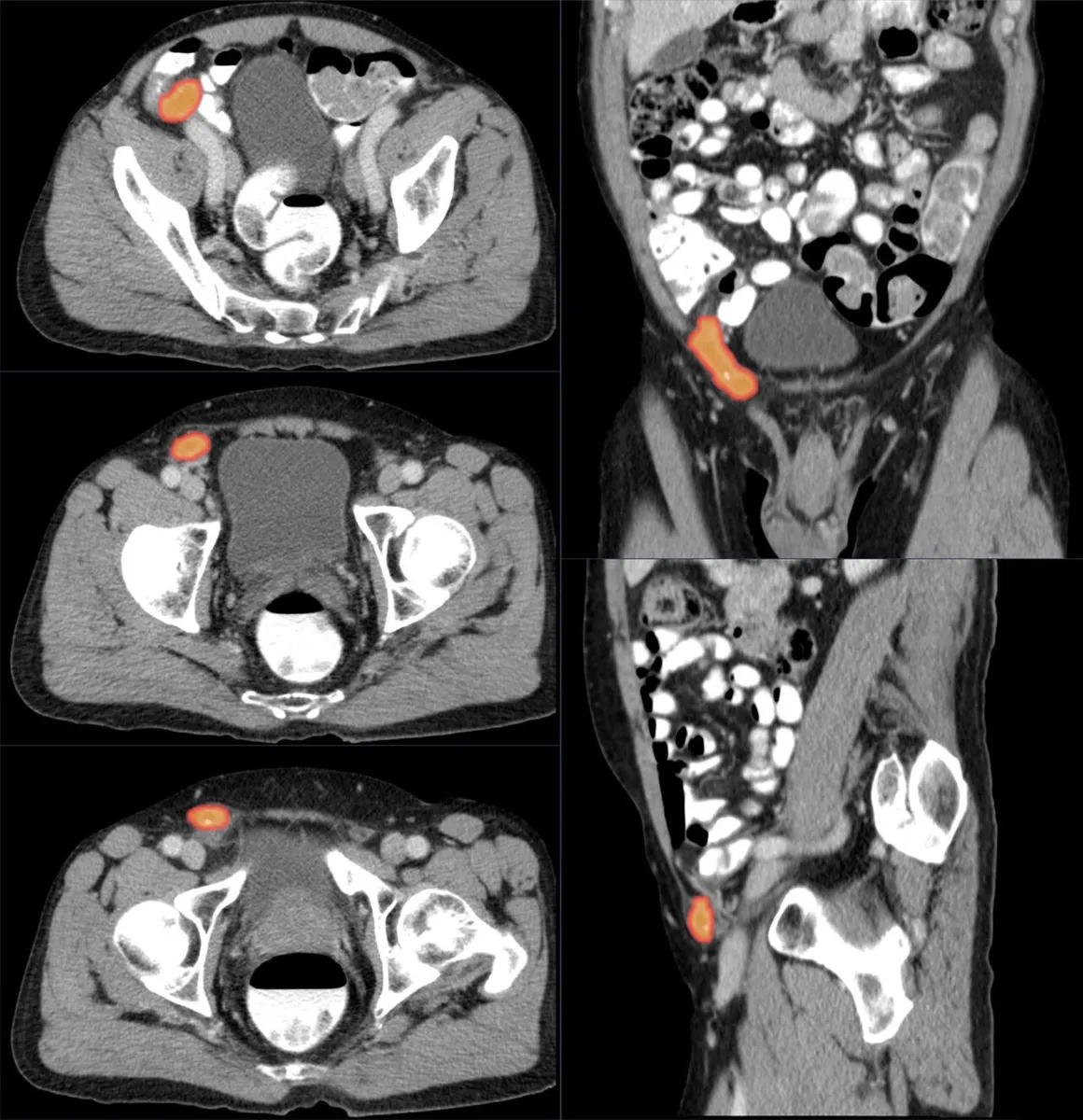
An incarcerated hernia is one whose contents cannot be returned to the abdomen; it becomes obstructed when the bowel lumen is occluded and strangulated when the blood supply is compromised, leading to ischaemia, necrosis and perforation. Strangulation is a surgical emergency. Risk is highest with femoral and narrow-necked hernias. The patient has a painful, tense, tender, irreducible lump without a cough impulse, often with colicky pain, vomiting and distension; erythema, fever, tachycardia and raised lactate suggest strangulation, although a Richter's hernia may strangulate without obstruction. Management is resuscitation, analgesia, nasogastric decompression, antibiotics when strangulation is suspected, consent including bowel resection and stoma, and urgent surgery; CT must not delay theatre. Gentle reduction may be tried only without signs of strangulation. Operating within about 6 hours lowers bowel resection. Synthetic mesh is safe in clean and clean-contaminated fields (WSES); contaminated fields need tissue repair, biological mesh or staged repair.
Patient case, mechanism, investigations, management, flashcards and exam-style questions.Open the lesson →
Key facts
- Incarcerated = irreducible; obstructed = bowel lumen blocked; strangulated = blood supply compromised (ischaemia, necrosis)
- Highest-risk hernias: femoral, narrow-necked umbilical, epigastric and incisional hernias; women and recent-onset hernias
- Signs of strangulation: constant severe pain, tenderness, overlying erythema, fever, tachycardia, peritonism, raised lactate and white cell count
- Richter's hernia traps part of the bowel wall and may strangulate without obstruction
- Early surgery (within about 6 hours of symptom onset) is associated with less bowel resection (EAST 2025 meta-analysis)
- Attempt gentle reduction (taxis) only if there are no clinical signs of strangulation; never force it
- WSES: synthetic mesh can be used in clean and clean-contaminated fields even with bowel resection without gross spillage
- Emergency groin hernia repair carries several-fold higher mortality than elective repair, mostly in frail older patients
Differential diagnosis
| Condition | Clues | Key test |
|---|---|---|
| Simple irreducible (chronically incarcerated) hernia | Long-standing irreducible, non-tender, no systemic upset | Clinical; elective repair |
| Small bowel obstruction from adhesions | Previous surgery, no tender hernia | CT abdomen |
| Torsion of the testis | Acute scrotal pain, high-riding tender testis, no impulse | Clinical; urgent scrotal exploration |
| Inguinal lymphadenitis or abscess | Fever, tender node, skin infection in drainage area | Ultrasound |
| Torsion of omentum or appendix in a sac (Amyand's) | Tender groin lump with right iliac fossa signs | CT; found at operation |
| Haematoma after groin puncture | Recent catheterisation, bruising | Duplex ultrasound |
| Obturator hernia | Older thin woman, obstruction, inner-thigh pain (Howship–Romberg) | CT abdomen and pelvis |
Exam pearls
Guideline
WSES 2017 update of guidelines for emergency repair of complicated abdominal wall hernias; EAST 2025 practice management guideline for incarcerated and strangulated inguinal hernias; HerniaSurge international groin hernia guidelines (2018, updated 2023)
References
- Birindelli A, Sartelli M, Di Saverio S, et al.. 2017 update of the WSES guidelines for emergency repair of complicated abdominal wall hernias. World J Emerg Surg 2017.
- Farrell MS, Zhang Z, Kirsch J, et al.. Surgical management of incarcerated and strangulated inguinal hernias requiring urgent surgical intervention: a systematic review, meta-analysis, and practice management guideline from the Eastern Association for the Surgery of Trauma. J Trauma Acute Care Surg 2025.
- HerniaSurge Group. International guidelines for groin hernia management. Hernia 2018.
- Stabilini C, van Veenendaal N, Aasvang E, et al.. Update of the international HerniaSurge guidelines for groin hernia management. BJS Open 2023.
- Dahlstrand U, Wollert S, Nordin P, Sandblom G, Gunnarsson U.. Emergency femoral hernia repair: a study based on a national register. Ann Surg 2009.
- Henriksen NA, Montgomery A, Kaufmann R, et al.. Guidelines for treatment of umbilical and epigastric hernias from the European Hernia Society and Americas Hernia Society. Br J Surg 2020.
Related topics
By Dr Khalid Seidi (B.Sc., M.D.) · MedEd World Clinical Knowledge library. Original teaching content checked against current guidelines (November 2026); confirm the latest local guidance before clinical use. Not a substitute for clinical judgement.