Clinical Knowledge › Surgery › Hernias and abdominal wall
Inguinal hernia
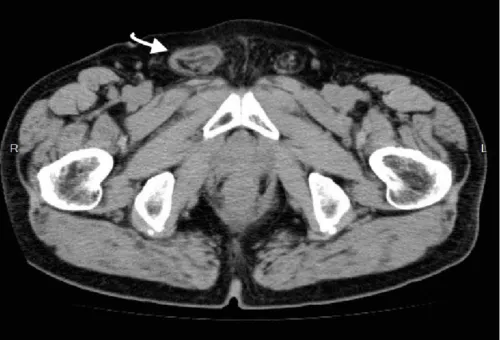
An inguinal hernia is a protrusion of abdominal contents through the inguinal canal (indirect, lateral to the inferior epigastric vessels through the deep ring) or through a weak posterior wall in Hesselbach's triangle (direct, medial to those vessels). It is the commonest abdominal wall hernia (lifetime risk about 27% in men, 3% in women). Diagnosis is clinical in most patients: a groin lump above and medial to the pubic tubercle with a cough impulse; ultrasound is reserved for diagnostic doubt. Symptomatic hernias should be repaired. Men with asymptomatic or minimally symptomatic hernias may choose watchful waiting because the emergency risk is low, but most eventually need surgery. Mesh repair is the standard: open Lichtenstein (possible under local anaesthesia) or laparo-endoscopic TEP or TAPP, which give faster recovery and less chronic pain where expertise exists and are preferred for bilateral and recurrent-after-open hernias and in women. Most repairs are day cases. Key complications are chronic groin pain, recurrence, haematoma, urinary retention and testicular injury.
Patient case, mechanism, investigations, management, flashcards and exam-style questions.Open the lesson →
Key facts
- Indirect hernias leave through the deep ring lateral to the inferior epigastric vessels (patent processus vaginalis); direct hernias bulge through Hesselbach's triangle medial to them
- An inguinal hernia emerges above and medial to the pubic tubercle; a femoral hernia lies below and lateral to it
- Indirect hernias are commonest in both sexes; in women any groin hernia may be femoral, so plan a repair that inspects the femoral canal
- Diagnosis is clinical in most cases; ultrasound only if doubtful, dynamic MRI for occult hernia with persistent symptoms
- Watchful waiting is safe for minimally symptomatic men (acute incarceration about 1.8 per 1000 patient-years) but about two-thirds cross over to surgery within 10 years
- Mesh repair is first choice: Lichtenstein (open, anterior) or TEP/TAPP (laparo-endoscopic, posterior); Shouldice is the preferred tissue repair
- Recurrence after an anterior repair is best repaired posteriorly, and vice versa
- Chronic postoperative inguinal pain (moderate pain lasting 3 months or more) affects about 10% and is the main long-term complication
Differential diagnosis
| Condition | Clues | Key test |
|---|---|---|
| Femoral hernia | Below and lateral to pubic tubercle; women; often irreducible | Clinical; ultrasound or CT if unsure |
| Saphena varix | Soft, disappears lying flat, fluid thrill on coughing, varicose veins | Duplex ultrasound |
| Inguinal lymphadenopathy | Firm, often multiple, no cough impulse; look at leg, perineum, anus | Examine drainage area; ultrasound ± biopsy |
| Hydrocele or encysted hydrocele of the cord | Can get above it; transilluminates; no cough impulse | Scrotal ultrasound |
| Lipoma of the cord | Soft, no definite impulse, may mimic small hernia | Ultrasound; found at operation |
| Undescended or retractile testis | Empty hemiscrotum on that side | Examination; ultrasound |
| Femoral artery aneurysm | Expansile pulsation below the inguinal ligament; post-puncture | Duplex ultrasound |
| Sportsman's groin (inguinal disruption) | Exertional groin pain in athletes, no palpable lump | Clinical; MRI to exclude other causes |
Exam pearls
Guideline
HerniaSurge International Guidelines for Groin Hernia Management (2018) and HerniaSurge 2023 update; Japanese Hernia Society groin hernia guideline 2024
References
- HerniaSurge Group. International guidelines for groin hernia management. Hernia 2018.
- Stabilini C, van Veenendaal N, Aasvang E, et al.. Update of the international HerniaSurge guidelines for groin hernia management. BJS Open 2023.
- Idani H, Shimada G, Suwa K, et al.. The Japanese Hernia Society (JHS) Guidelines for Adult Groin Hernia Management 2024. Ann Gastroenterol Surg 2026.
- Miserez M, Alexandre JH, Campanelli G, et al.. The European hernia society groin hernia classification: simple and easy to remember. Hernia 2007.
- Fitzgibbons RJ, Giobbie-Hurder A, Gibbs JO, et al.. Watchful waiting vs repair of inguinal hernia in minimally symptomatic men: a randomized clinical trial. JAMA 2006.
- Fitzgibbons RJ, Ramanan B, Arya S, et al.. Long-term results of a randomized controlled trial of a nonoperative strategy (watchful waiting) for men with minimally symptomatic inguinal hernias. Ann Surg 2013.
Related topics
By Dr Khalid Seidi (B.Sc., M.D.) · MedEd World Clinical Knowledge library. Original teaching content checked against current guidelines (November 2026); confirm the latest local guidance before clinical use. Not a substitute for clinical judgement.