Clinical Knowledge › Internal medicine › Infectious diseases › Clinical problems
Fever and rash: approach to the patient
Fever with rash ranges from a harmless childhood exanthem to conditions that kill within hours, such as meningococcal septicaemia, toxic shock syndrome, Rocky Mountain spotted fever, severe drug reactions and viral haemorrhagic fever. The approach starts by asking whether the patient is unwell and whether the rash is non-blanching (petechial or purpuric): if so, give empirical treatment immediately. Next, classify the rash by morphology (maculopapular, petechial/purpuric, vesicular or pustular, diffuse erythema with desquamation, nodular, urticarial, target lesions, eschar) and by distribution and evolution (central or peripheral, palms and soles, mucosae, order of spread). Combine this with exposures: vaccination status, sick contacts, travel, ticks and animals, sexual history, new drugs in the previous 8 weeks, pregnancy and immune status. Targeted tests include blood cultures, FBC with eosinophils, liver and renal tests, PCR of vesicle or blood, serology, and skin biopsy. Infection control matters from the door: suspected measles, varicella, mpox or VHF need isolation and public health notification.
Patient case, mechanism, investigations, management, flashcards and exam-style questions.Open the lesson →
Key facts
- A non-blanching rash with fever is meningococcal disease until proven otherwise: give parenteral antibiotics immediately (e.g. ceftriaxone 2 g IV)
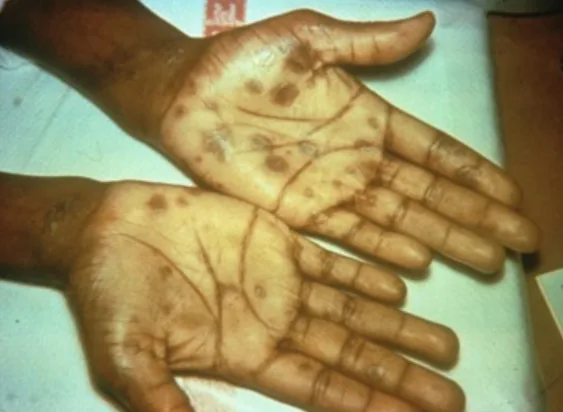
- Rashes involving palms and soles: secondary syphilis, rickettsial infection (RMSF), hand, foot and mouth disease, endocarditis (Janeway lesions), Kawasaki disease, erythema multiforme, toxic shock (desquamation)
- Measles: 3–4 day prodrome of cough, coryza and conjunctivitis, Koplik spots, then a maculopapular rash starting behind the ears and spreading downwards
- Chickenpox lesions appear in crops at different stages and are centripetal; smallpox and mpox lesions tend to be at the same stage
- Suspected Rocky Mountain spotted fever: start doxycycline immediately at any age; do not wait for serology
- SJS/TEN: fever, painful dusky skin, mucosal erosions 4–28 days after a new drug; SJS <10%, TEN >30% body surface detachment; stop the drug, specialist burns/dermatology care
- DRESS: fever, widespread rash, facial oedema, eosinophilia and organ involvement 2–8 weeks after a drug (allopurinol, anticonvulsants, sulfonamides, vancomycin)
- Kawasaki disease: fever ≥5 days plus conjunctivitis, oral changes, rash, extremity changes and cervical lymphadenopathy; IVIG within 10 days prevents coronary aneurysms
Differential diagnosis
| Condition | Clues | Key test |
|---|---|---|
| Meningococcal septicaemia | Rapidly spreading petechiae/purpura, cold peripheries, shock | Blood cultures and meningococcal PCR; treat first |
| Toxic shock syndrome | Diffuse macular erythroderma, hypotension, multi-organ failure, later desquamation | Clinical criteria; cultures from focus (tampon, wound) |
| Rickettsial infection (RMSF, typhus, African tick-bite fever) | Tick bite or travel, rash from wrists/ankles spreading centrally, eschar | Clinical; serology or PCR of eschar; treat with doxycycline |
| Viral exanthem (measles, rubella, parvovirus, HHV-6, enterovirus, acute HIV, dengue) | Prodrome, contacts, vaccination status, travel | PCR (saliva, throat, blood) and IgM serology |
| Varicella, disseminated zoster, mpox, HSV | Vesicles or pustules; synchrony and distribution | Lesion swab PCR |
| Secondary syphilis | Copper-coloured macules on palms and soles, condylomata lata, mucous patches | Treponemal and RPR serology |
| Severe cutaneous drug reaction (SJS/TEN, DRESS, AGEP) | New drug, mucosal involvement, eosinophilia, organ dysfunction | FBC, LFTs, renal tests, skin biopsy |
| Kawasaki disease, Still disease, vasculitis, SLE | Prolonged fever with non-infectious features; salmon-pink evanescent rash in Still disease | Echocardiography; ferritin; ANA, ANCA; biopsy |
Exam pearls
Guideline
NICE NG240 Meningitis (bacterial) and meningococcal disease (2024), PHE/UKHSA viral rash in pregnancy guidance (2019), CDC tickborne rickettsial diseases (2016) and AHA Kawasaki disease scientific statement (2017, updated 2024)
References
- National Institute for Health and Care Excellence (NICE). Meningitis (bacterial) and meningococcal disease: recognition, diagnosis and management (NG240). NICE guideline 2024.
- Public Health England. Guidance on the investigation and management of viral rash illness, or exposure to viral rash illness, in pregnancy. PHE, London 2019.
- Biggs HM, Behravesh CB, Bradley KK, et al.. Diagnosis and management of tickborne rickettsial diseases: Rocky Mountain spotted fever and other spotted fever group rickettsioses, ehrlichioses, and anaplasmosis - United States. MMWR Recomm Rep 2016.
- McCrindle BW, Rowley AH, Newburger JW, et al.. Diagnosis, treatment, and long-term management of Kawasaki disease: a scientific statement for health professionals from the American Heart Association. Circulation 2017.
- Stevens DL, Bisno AL, Chambers HF, et al.. Practice guidelines for the diagnosis and management of skin and soft tissue infections: 2014 update by the Infectious Diseases Society of America. Clin Infect Dis 2014.
- Kardaun SH, Sidoroff A, Valeyrie-Allanore L, et al.. Variability in the clinical pattern of cutaneous side-effects of drugs with systemic symptoms: does a DRESS syndrome really exist?. Br J Dermatol 2007.
Related topics
By Dr Khalid Seidi (B.Sc., M.D.) · MedEd World Clinical Knowledge library. Original teaching content checked against current guidelines (November 2026); confirm the latest local guidance before clinical use. Not a substitute for clinical judgement.