Clinical Knowledge › Dermatology › Psoriasis, acne and other inflammatory dermatoses
Hidradenitis suppurativa
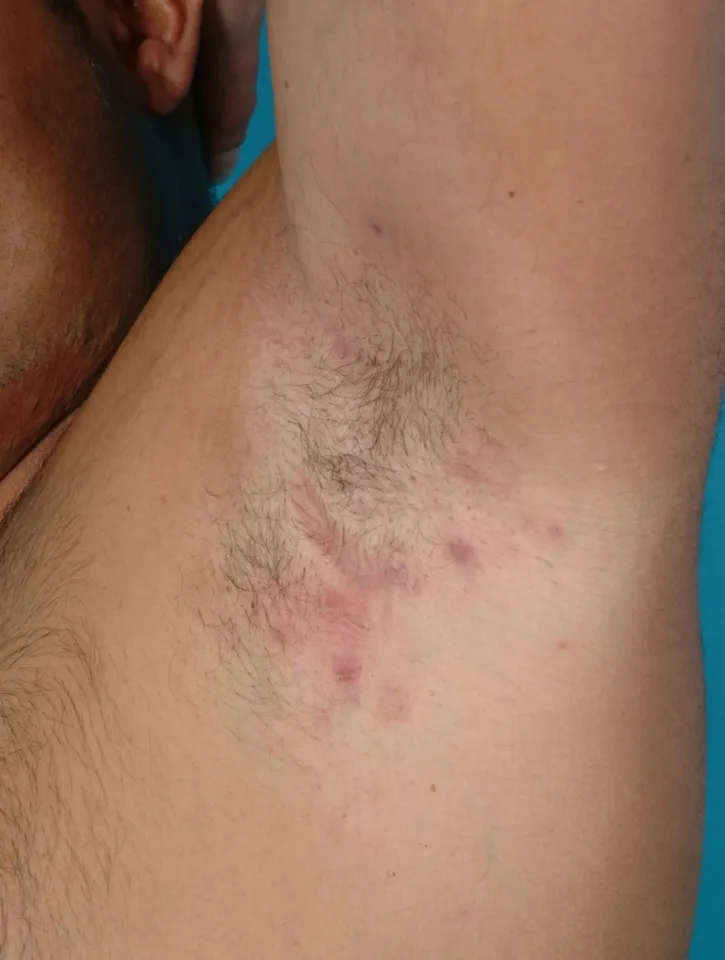
Hidradenitis suppurativa (HS, acne inversa) is a chronic, relapsing, inflammatory disease of the hair follicle that affects intertriginous skin - axillae, groins, inframammary folds, perineum and buttocks. It affects about 1% of people, usually begins after puberty, is commoner in women and people of African descent, and is strongly associated with smoking and obesity. Follicular occlusion and rupture trigger TNF-, IL-17- and IL-1-driven inflammation, producing deep painful nodules, abscesses, draining tunnels (sinus tracts), double-ended comedones and rope-like or bridged scars. The diagnosis is clinical, based on typical lesions, typical sites and recurrence; it is often delayed by years. Severity is graded with Hurley staging and the dynamic IHS4 score, and ultrasound shows tunnels. Treatment combines smoking cessation, weight loss, pain control and wound care with a ladder of topical clindamycin, intralesional steroid, oral tetracyclines, clindamycin plus rifampicin, and then biologics (adalimumab, secukinumab or bimekizumab), together with deroofing or wide excision of tunnels.
Patient case, mechanism, investigations, management, flashcards and exam-style questions.Open the lesson →
Key facts
- Prevalence about 1%; onset after puberty, peak in the 20s; female:male about 3:1 in Western cohorts; more common in people of African descent
- Diagnostic triad: typical lesions (nodules, abscesses, tunnels, scars), typical sites (intertriginous), chronicity (at least 2 recurrences in 6 months)
- Primary event is follicular occlusion and rupture - not infection; cultures are usually commensals
- Risk factors: smoking, obesity, family history (gamma-secretase gene variants), metabolic syndrome
- Severity: Hurley I (no tunnels or scars), II (tunnels and scars, separated), III (diffuse interconnected tunnels); IHS4 = nodules + 2 x abscesses + 4 x draining tunnels
- Ladder: topical clindamycin -> oral tetracycline 12 weeks -> clindamycin plus rifampicin -> biologics
- Licensed biologics: adalimumab, secukinumab (SUNSHINE/SUNRISE) and bimekizumab (BE HEARD)
- Surgery: deroofing for tunnels, wide excision for Hurley III; incision and drainage only relieves acute abscesses
Differential diagnosis
| Condition | Clues | Key test |
|---|---|---|
| Recurrent furunculosis | Isolated boils at any hair-bearing site, often S. aureus (PVL) carriage, no tunnels or bridged scars | Swab with PVL testing; nasal carriage screen |
| Pilonidal disease | Midline natal cleft sinus pits with hair; may coexist with HS | Clinical; examination for midline pits |
| Perianal Crohn disease | Perianal fistulae, fissures, skin tags, GI symptoms | Colonoscopy, MRI pelvis, faecal calprotectin |
| Bartholin abscess | Unilateral posterolateral vestibular swelling | Clinical |
| Epidermoid cyst (inflamed) | Single cyst with punctum, no recurrence at multiple sites | Clinical |
| Cutaneous tuberculosis (scrofuloderma) | Cold abscess over lymph nodes, sinuses, systemic TB features | Biopsy, culture, IGRA |
| Lymphogranuloma venereum | Inguinal buboes with grooves after genital ulcer | Chlamydia NAAT with L-serovar typing |
Exam pearls
Guideline
BAD guidelines for HS 2018; North American HS guidelines 2019; European S2k HS guideline part 2 treatment 2025 (EHSF/EADV); NICE technology appraisals TA392 adalimumab and TA935 secukinumab
References
- British Association of Dermatologists (Ingram JR, Collier F, Brown D, et al.). British Association of Dermatologists guidelines for the management of hidradenitis suppurativa (acne inversa) 2018. Br J Dermatol 2019.
- United States and Canadian Hidradenitis Suppurativa Foundations (Alikhan A, Sayed C, Alavi A, et al.). North American clinical management guidelines for hidradenitis suppurativa. Part I: diagnosis, evaluation, and the use of complementary and procedural management. J Am Acad Dermatol 2019.
- United States and Canadian Hidradenitis Suppurativa Foundations (Alikhan A, Sayed C, Alavi A, et al.). North American clinical management guidelines for hidradenitis suppurativa. Part II: topical, intralesional, and systemic medical management. J Am Acad Dermatol 2019.
- European Hidradenitis Suppurativa Foundation / EADV (Zouboulis CC, Bechara FG, Benhadou F, et al.). European S2k guidelines for hidradenitis suppurativa/acne inversa part 2: treatment. J Eur Acad Dermatol Venereol 2025.
- Kimball AB, Jemec GBE, Alavi A, et al.. Secukinumab in moderate-to-severe hidradenitis suppurativa (SUNSHINE and SUNRISE): week 16 and week 52 results of two identical, multicentre, randomised, placebo-controlled, double-blind phase 3 trials. Lancet 2023.
- Kimball AB, Jemec GBE, Sayed CJ, et al.. Efficacy and safety of bimekizumab in patients with moderate-to-severe hidradenitis suppurativa (BE HEARD I and BE HEARD II): two 48-week, randomised, double-blind, placebo-controlled, multicentre phase 3 trials. Lancet 2024.
Related topics
By Dr Khalid Seidi (B.Sc., M.D.) · MedEd World Clinical Knowledge library. Original teaching content checked against current guidelines (November 2026); confirm the latest local guidance before clinical use. Not a substitute for clinical judgement.