Clinical Knowledge › Dermatology › Psoriasis, acne and other inflammatory dermatoses
Pityriasis rubra pilaris
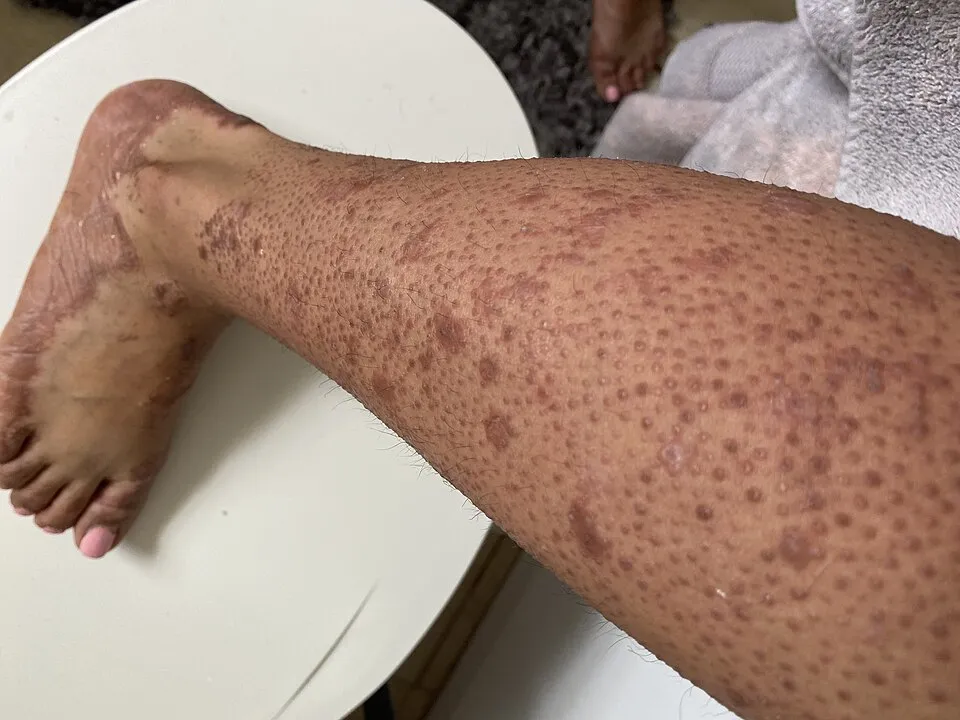
Pityriasis rubra pilaris (PRP) is a rare inflammatory papulosquamous disorder of keratinisation. The classic adult form begins on the scalp and face and spreads downwards over weeks as orange-red follicular hyperkeratotic papules that merge into salmon-coloured scaly plaques, leaving sharply demarcated 'islands of sparing' of normal skin. A waxy orange palmoplantar keratoderma, 'nutmeg-grater' follicular papules over the knuckles and thickened yellow-brown nails are typical, and many patients become erythrodermic. Six Griffiths types are recognised: type I (classic adult) is the most common; type V is familial and linked to CARD14 gain-of-function variants; type VI occurs with HIV infection. Clinically PRP is often mistaken for psoriasis, but biopsy shows alternating orthokeratosis and parakeratosis in a 'checkerboard' pattern with follicular plugging and no neutrophil microabscesses. Treatment combines emollients and keratolytics with systemic retinoids or methotrexate; IL-17 and IL-23 inhibitors are increasingly used off-label for refractory disease. Classic adult PRP often remits within about 3 years.
Patient case, mechanism, investigations, management, flashcards and exam-style questions.Open the lesson →
Key facts
- Rare (around 1 in 3500-5000 new dermatology patients); bimodal - first and sixth decades
- Orange-red follicular keratotic papules coalescing into salmon plaques with 'islands of sparing'
- Cephalocaudal spread from scalp and face in classic adult (type I) disease; may become erythrodermic
- Waxy orange palmoplantar keratoderma ('sandal' appearance) and 'nutmeg-grater' papules on dorsal fingers
- Histology: checkerboard alternating ortho- and parakeratosis, follicular plugs with shoulder parakeratosis, no Munro microabscesses
- Type V (atypical juvenile, familial): CARD14 gain-of-function; type VI: HIV-associated - test for HIV
- First-line systemic: oral retinoids (acitretin or isotretinoin) or methotrexate; IL-17/IL-23 biologics off-label for refractory disease
- Type I often resolves within about 3 years; juvenile circumscribed and familial types are chronic
Differential diagnosis
| Condition | Clues | Key test |
|---|---|---|
| Psoriasis | Well-demarcated silvery plaques on extensors, no islands of sparing, nail pits and oil spots | Biopsy: confluent parakeratosis, neutrophil microabscesses |
| Erythrodermic drug eruption | Recent drug, eosinophilia, facial oedema (DRESS) | Drug history, eosinophil count, liver tests |
| Sezary syndrome / mycosis fungoides | Erythroderma, intense itch, lymphadenopathy, older adult | Biopsy with T-cell clonality; blood flow cytometry |
| Seborrhoeic dermatitis (early facial phase) | Greasy yellow scale on scalp and nasolabial folds, no follicular papules | Clinical |
| Keratosis pilaris | Follicular papules on upper arms and thighs without erythroderma or keratoderma | Clinical |
| Phrynoderma (vitamin A deficiency) | Follicular hyperkeratosis with night blindness and malnutrition | Serum retinol |
| Erythrokeratodermia | Fixed geometric hyperkeratotic plaques from infancy | Genetic testing |
Exam pearls
Guideline
No formal international guideline (2026): systematic reviews (Engelmann 2019; Kromer 2019; Sood 2023 biologics) and expert reviews (Joshi 2024; Zhou 2024); Griffiths clinical classification
References
- Joshi TP, Duvic M. Pityriasis rubra pilaris: an updated review of clinical presentation, etiopathogenesis, and treatment options. Am J Clin Dermatol 2024.
- Zhou T, Al Muqrin A, Abu-Hilal M. Updates on pityriasis rubra pilaris: a scoping review. J Cutan Med Surg 2024.
- Engelmann C, Elsner P, Miguel D. Treatment of pityriasis rubra pilaris type I: a systematic review. Eur J Dermatol 2019.
- Kromer C, Sabat R, Celis D, Mössner R. Systemic therapies of pityriasis rubra pilaris: a systematic review. J Dtsch Dermatol Ges 2019.
- Sood S, Akuffo-Addo E, Yeung J, et al.. Biologic treatment options for pityriasis rubra pilaris: an evidence-based systematic review. J Am Acad Dermatol 2023.
- Moretta G, De Luca EV, Di Stefani A. Management of refractory pityriasis rubra pilaris: challenges and solutions. Clin Cosmet Investig Dermatol 2017.
Related topics
By Dr Khalid Seidi (B.Sc., M.D.) · MedEd World Clinical Knowledge library. Original teaching content checked against current guidelines (November 2026); confirm the latest local guidance before clinical use. Not a substitute for clinical judgement.