Clinical Knowledge › Dermatology › Psoriasis, acne and other inflammatory dermatoses
Pityriasis rosea
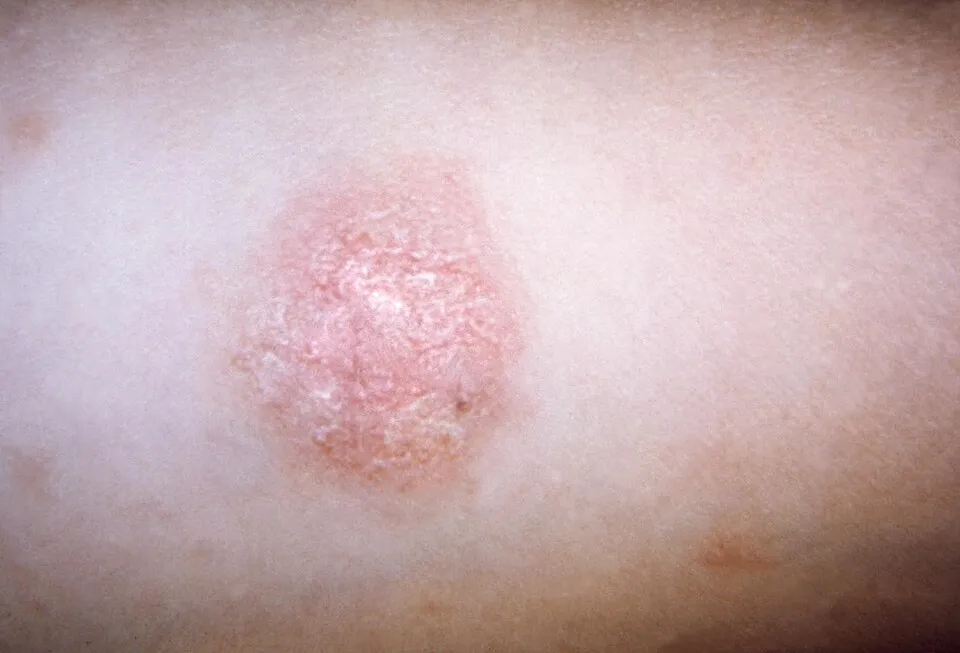
Pityriasis rosea is a common, acute, self-limiting papulosquamous eruption of adolescents and young adults, linked to reactivation of human herpesviruses 6 and 7. It usually begins with a single 'herald patch': a 2-10 cm oval, salmon-pink patch with a fine collarette of scale just inside its edge. One to two weeks later, crops of smaller oval pink macules and thin plaques appear on the trunk and proximal limbs, aligned along the skin cleavage lines so that on the back they form a 'Christmas-tree' pattern. The face, palms and soles are usually spared and itch is mild to moderate. Inverse and papular variants are commoner in children and skin of colour. Diagnosis is clinical, but secondary syphilis must be excluded with serology when the palms or soles are involved or sexual risk exists, and a skin scraping helps exclude tinea. Treatment is reassurance, emollients, antihistamines and a mild topical steroid; aciclovir may shorten early extensive disease. The rash fades in 6-10 weeks. In early pregnancy it has been associated with miscarriage, so obstetric follow-up is advised.
Patient case, mechanism, investigations, management, flashcards and exam-style questions.Open the lesson →
Key facts
- Peak age 10-35 years; slightly more common in spring and autumn
- Associated with systemic reactivation of HHV-6 and HHV-7
- Herald patch in about 80%: a single larger oval salmon-pink patch with collarette scale on the trunk
- Secondary eruption 4-14 days later: oval macules and patches along cleavage lines - 'Christmas-tree' pattern on the back
- Collarette scale is attached at the periphery and free towards the centre ('trailing' scale)
- Exclude secondary syphilis (palms, soles, mucosa, lymphadenopathy) with serology
- Self-limiting over 6-10 weeks; recurrence is uncommon (about 2-3%)
- Pregnancy in the first 15 weeks: reported association with miscarriage - inform the obstetric team
Differential diagnosis
| Condition | Clues | Key test |
|---|---|---|
| Secondary syphilis | Copper-red papules on palms and soles, mucous patches, lymphadenopathy, no herald patch | Treponemal and non-treponemal serology (e.g. TPPA and RPR) |
| Tinea corporis (herald patch mimic) | Annular plaque with active scaly edge and central clearing; scale at leading edge | Skin scraping for KOH microscopy and culture |
| Guttate psoriasis | Drop-like scaly papules after streptococcal throat infection; thicker silvery scale | Clinical; ASO titre or throat swab |
| Pityriasis rosea-like drug eruption | Larger lesions, more itch, no herald patch; started after ACE inhibitor, isotretinoin, metronidazole, gold or vaccination | Drug history; resolves on withdrawal |
| Nummular (discoid) eczema | Coin-shaped, crusted, very itchy plaques on limbs | Clinical |
| Pityriasis versicolor | Fine-scaled hypo- or hyperpigmented macules on upper trunk; chronic | KOH: 'spaghetti and meatballs'; Wood's lamp yellow-green |
| Pityriasis lichenoides chronica | Recurrent crops of papules with mica-like scale over months | Biopsy |
Exam pearls
Guideline
No dedicated international guideline (2026): evidence from Ciccarese 2024 network meta-analysis and Leung 2021 review; CDC STI treatment guidelines 2021 for exclusion of secondary syphilis
References
- Leung AKC, Lam JM, Leong KF, Hon KL. Pityriasis rosea: an updated review. Curr Pediatr Rev 2021.
- Eisman S, Sinclair R. Pityriasis rosea. BMJ 2015.
- Ciccarese G, Facciorusso A, Herzum A, et al.. Comparative efficacy of different pharmacological treatments for pityriasis rosea: a network meta-analysis. J Clin Med 2024.
- Wenger-Oehn L, Graier T, Ambros-Rudolph C, et al.. Pityriasis rosea in pregnancy: a case series and literature review. J Dtsch Dermatol Ges 2022.
- Potestio L, Martora F, Cacciapuoti S, et al.. Pityriasis rosea and pityriasis rosea-like eruption following COVID-19 vaccination: a narrative review. Clin Cosmet Investig Dermatol 2024.
- Stulberg DL, Wolfrey J. Pityriasis rosea. Am Fam Physician 2004.
Related topics
By Dr Khalid Seidi (B.Sc., M.D.) · MedEd World Clinical Knowledge library. Original teaching content checked against current guidelines (November 2026); confirm the latest local guidance before clinical use. Not a substitute for clinical judgement.