Clinical Knowledge › Anaesthesiology › Critical care: organ support
High-flow nasal oxygen
High-flow nasal oxygen (HFNO, also called high-flow nasal cannula) delivers heated (about 37 °C), fully humidified gas through wide-bore nasal prongs at flows up to 60 L/min in adults, with a precisely set FiO2 from 0.21 to 1.0. Because the flow matches or exceeds the patient's peak inspiratory flow, the delivered FiO2 stays close to the set value; it also washes out nasopharyngeal dead space, generates a small, flow-dependent positive pressure (roughly 1 cmH2O per 10 L/min with the mouth closed), reduces work of breathing and improves comfort and secretion clearance. The ERS 2022 guideline suggests HFNO over conventional oxygen and over NIV in acute hypoxaemic respiratory failure, after extubation in low-risk patients, and between NIV sessions, while NIV remains first choice in hypercapnic COPD exacerbations and for high-risk extubations. HFNO is also used for preoxygenation and apnoeic oxygenation at intubation. Its main danger is delayed intubation: progress must be reassessed within hours, for example with the ROX index.
Patient case, mechanism, investigations, management, flashcards and exam-style questions.Open the lesson →
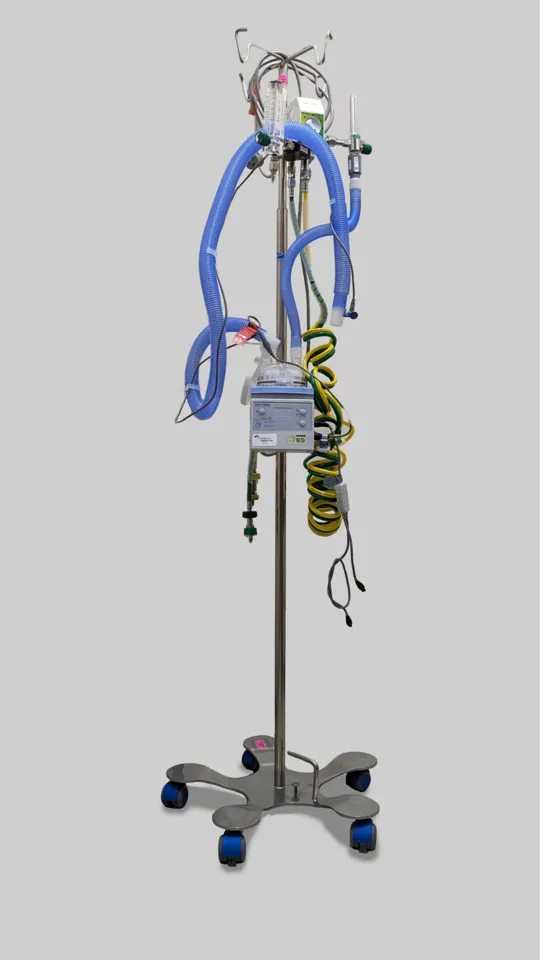
Key facts
- Adult HFNO: flow up to 60 L/min, FiO2 0.21–1.0, gas heated to about 37 °C with near 100% relative humidity
- Mechanisms: stable FiO2, dead-space washout (lower PaCO2 and work of breathing), low-level PEEP, humidification and comfort
- Positive pressure is modest and variable: about 1 cmH2O per 10 L/min with the mouth closed, much less with mouth open
- FLORALI (2015): in non-hypercapnic hypoxaemic failure HFNO did not reduce intubation overall but improved ventilator-free days and 90-day mortality versus face mask and NIV
- ERS 2022: HFNO over conventional oxygen and over NIV in hypoxaemic failure; NIV before HFNO in hypercapnic COPD
- After extubation: HFNO for low-risk patients; NIV (alternating with HFNO) for high-risk patients unless NIV is contraindicated
- ROX index = (SpO2/FiO2) ÷ respiratory rate; 4.88 or more at 2, 6 or 12 hours predicts success; falling or low values predict failure
- Infants with bronchiolitis: about 2 L/kg/min; HFNO reduced escalation of care compared with standard oxygen (PARIS trial, 2018)
Differential diagnosis
| Condition | Clues | Key test |
|---|---|---|
| Conventional oxygen (nasal cannula, face mask) | Mild hypoxaemia, low respiratory effort | SpO2 target reached with FiO2 needs below about 0.4 |
| High-flow nasal oxygen | Hypoxaemic failure with tachypnoea and high FiO2 need, no significant hypercapnic acidosis | ABG: PaCO2 normal or low; PaO2/FiO2 300 mmHg or less |
| CPAP | Hypoxaemia from alveolar collapse or pulmonary oedema needing higher, reliable PEEP | Cardiogenic pulmonary oedema; COVID-19 pneumonitis |
| Non-invasive ventilation (bilevel) | Hypercapnic acidosis (pH below 7.35, PaCO2 above 6.5 kPa) in COPD, obesity hypoventilation or neuromuscular disease | ABG |
| Invasive ventilation | Exhaustion, falling consciousness, inability to protect airway, refractory hypoxaemia or shock | Clinical assessment; ROX falling; worsening ABG |
| Palliative HFNO | Breathlessness at the end of life where intubation is not wanted | Treatment escalation plan |
Exam pearls
Guideline
ERS Clinical Practice Guidelines: high-flow nasal cannula in acute respiratory failure (2022), ESICM ARDS guidelines (2023), BTS emergency oxygen guideline (2017) and ERS/ATS NIV guideline (2017)
References
- Oczkowski S, Ergan B, Bos L, et al.. ERS clinical practice guidelines: high-flow nasal cannula in acute respiratory failure. Eur Respir J 2022.
- Grasselli G, Calfee CS, Camporota L, et al.. ESICM guidelines on acute respiratory distress syndrome: definition, phenotyping and respiratory support strategies. Intensive Care Med 2023.
- O'Driscoll BR, Howard LS, Earis J, Mak V; BTS Emergency Oxygen Guideline Group. BTS guideline for oxygen use in adults in healthcare and emergency settings. Thorax 2017.
- Rochwerg B, Brochard L, Elliott MW, et al.. Official ERS/ATS clinical practice guidelines: noninvasive ventilation for acute respiratory failure. Eur Respir J 2017.
- Frat JP, Thille AW, Mercat A, et al.. High-flow oxygen through nasal cannula in acute hypoxemic respiratory failure. N Engl J Med 2015.
- Roca O, Caralt B, Messika J, et al.. An index combining respiratory rate and oxygenation to predict outcome of nasal high-flow therapy. Am J Respir Crit Care Med 2019.
Related topics
By Dr Khalid Seidi (B.Sc., M.D.) · MedEd World Clinical Knowledge library. Original teaching content checked against current guidelines (November 2026); confirm the latest local guidance before clinical use. Not a substitute for clinical judgement.