Clinical Knowledge › Anaesthesiology › Critical care: organ support
ICU admission, levels of care and outreach
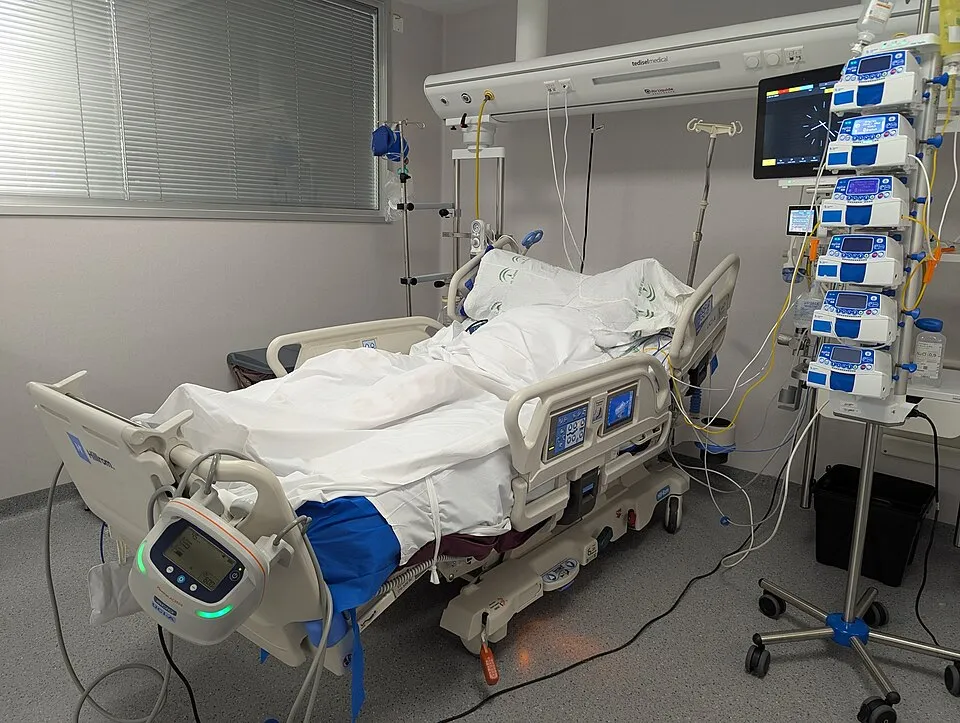
Critical care works best when deterioration is recognised early and the right patient reaches the right level of care in time. Hospitals use a rapid response system: an afferent limb (regular observations scored with a track-and-trigger tool such as NEWS2) and an efferent limb (critical care outreach, a medical emergency team or the ward team with escalating seniority). UK practice describes care in levels: level 0 (normal ward), level 1 (ward care with outreach support or after step-down), level 2 (single-organ support or close monitoring, usually one nurse to two patients) and level 3 (advanced respiratory support, or support of two or more organs, one nurse per patient); perioperative enhanced care sits between ward and level 2. Decisions about admission weigh reversibility, likely benefit, frailty, comorbidity and, above all, what the patient would want; age alone is never the criterion. Delayed admission, out-of-hours discharge and premature step-down all increase mortality, so timely admission, structured handover, outreach follow-up and rehabilitation for survivors are core standards.
Patient case, mechanism, investigations, management, flashcards and exam-style questions.Open the lesson →
Key facts
- NEWS2 aggregates respiratory rate, SpO2 (scale 1 or scale 2), supplemental oxygen, systolic BP, pulse, consciousness (ACVPU) and temperature
- NEWS2 0–4 low risk; 3 in any single parameter needs urgent ward review; 5–6 medium (urgent response); 7 or more high (emergency response by a team with critical care competencies)
- Level 3 care: advanced respiratory support alone (invasive ventilation) or basic respiratory support plus support of at least two organ systems; nurse:patient ratio 1:1
- Level 2 care: single organ support, basic respiratory support, or detailed monitoring and intervention; ratio 1:2
- Critical care outreach aims to avert admissions, enable timely admissions, support discharge and share critical care skills with ward staff
- GPICS standard: admit within 4 hours of the decision; discharge to the ward between 07:00 and 21:59, ideally within 4 hours of being ready
- Age alone should not determine admission; frailty (Clinical Frailty Scale), reversibility, comorbidity and patient wishes matter more
- Survivors of critical illness need a rehabilitation assessment before ICU discharge and follow-up for physical, psychological and cognitive problems (post-intensive care syndrome)
Differential diagnosis
| Condition | Clues | Key test |
|---|---|---|
| Level 3 (intensive care) | Invasive ventilation, or basic respiratory support with two or more other organs supported (e.g. vasopressor plus renal replacement) | Count organ supports; 1:1 nursing |
| Level 2 (high-dependency care) | Single organ support (e.g. one vasoactive drug, CPAP/NIV) or need for invasive monitoring and frequent intervention | Organ support review; 1:2 nursing |
| Perioperative enhanced care | Postoperative patient needing closer monitoring (e.g. arterial line, epidural, hourly observations) without organ support | Risk score (e.g. NELA, P-POSSUM) and local enhanced care criteria |
| Level 1 (ward plus outreach) | Ward patient at risk of deterioration or recently stepped down from critical care | NEWS2 trend; outreach review |
| Level 0 (standard ward) | Needs can be met by usual ward observations and care | NEWS2 0–4 with stable trend |
| Palliative or end-of-life pathway | Irreversible illness where organ support would not achieve outcomes the patient values | Shared decision, treatment escalation plan, palliative care input |
Exam pearls
Guideline
FICM/ICS Guidelines for the Provision of Intensive Care Services (GPICS, 3rd edition, 2026), ICS Levels of Adult Critical Care (2nd edition, 2021), RCP NEWS2 (2017) with NICE NG253 (2025) and NICE CG50 (2007), and SCCM ICU Admission, Discharge and Triage Guidelines (2016)
References
- Faculty of Intensive Care Medicine and Intensive Care Society. Guidelines for the Provision of Intensive Care Services (GPICS), 3rd edition. FICM/ICS, London 2026.
- Intensive Care Society. Levels of Adult Critical Care, 2nd edition: consensus statement. Intensive Care Society, London 2021.
- Royal College of Physicians. National Early Warning Score (NEWS) 2: standardising the assessment of acute-illness severity in the NHS. RCP, London 2017.
- National Institute for Health and Care Excellence. Suspected sepsis in people aged 16 or over: recognition, assessment and early management (NG253). NICE, London 2025.
- National Institute for Health and Care Excellence. Acutely ill adults in hospital: recognising and responding to deterioration (CG50). NICE, London 2007.
- Nates JL, Nunnally M, Kleinpell R, et al.. ICU Admission, Discharge, and Triage Guidelines: A Framework to Enhance Clinical Operations, Development of Institutional Policies, and Further Research. Crit Care Med 2016.
Related topics
By Dr Khalid Seidi (B.Sc., M.D.) · MedEd World Clinical Knowledge library. Original teaching content checked against current guidelines (November 2026); confirm the latest local guidance before clinical use. Not a substitute for clinical judgement.