Clinical Knowledge › Internal medicine › Cardiology and angiology › Hypertension
Hypertensive heart disease
Hypertensive heart disease is the set of structural and functional cardiac changes caused by chronically raised blood pressure. Pressure overload triggers concentric left ventricular hypertrophy with interstitial fibrosis, which stiffens the ventricle and causes diastolic dysfunction and left atrial enlargement. Over time this leads to heart failure with preserved ejection fraction, atrial fibrillation, myocardial ischaemia from coronary microvascular dysfunction and epicardial disease, ventricular arrhythmias and, in some patients, progression to a dilated ventricle with reduced ejection fraction. Hypertension is the leading population risk factor for heart failure worldwide. Left ventricular hypertrophy is detected by ECG voltage criteria or more accurately by echocardiography and cardiac MRI, and it independently predicts stroke, heart failure and death. Treatment centres on strict BP control (systolic 120–129 mmHg where tolerated), using RAS blockers and calcium channel blockers, which regress hypertrophy more than beta blockers, plus guideline therapy for heart failure and AF.
Patient case, mechanism, investigations, management, flashcards and exam-style questions.Open the lesson →
Key facts
- Chronic pressure overload causes concentric LV hypertrophy, myocardial fibrosis and diastolic dysfunction
- Spectrum: LVH, left atrial enlargement, HFpEF, AF, microvascular angina and CAD, ventricular arrhythmias, and late HFrEF
- Hypertension precedes heart failure in most patients and is its leading population risk factor
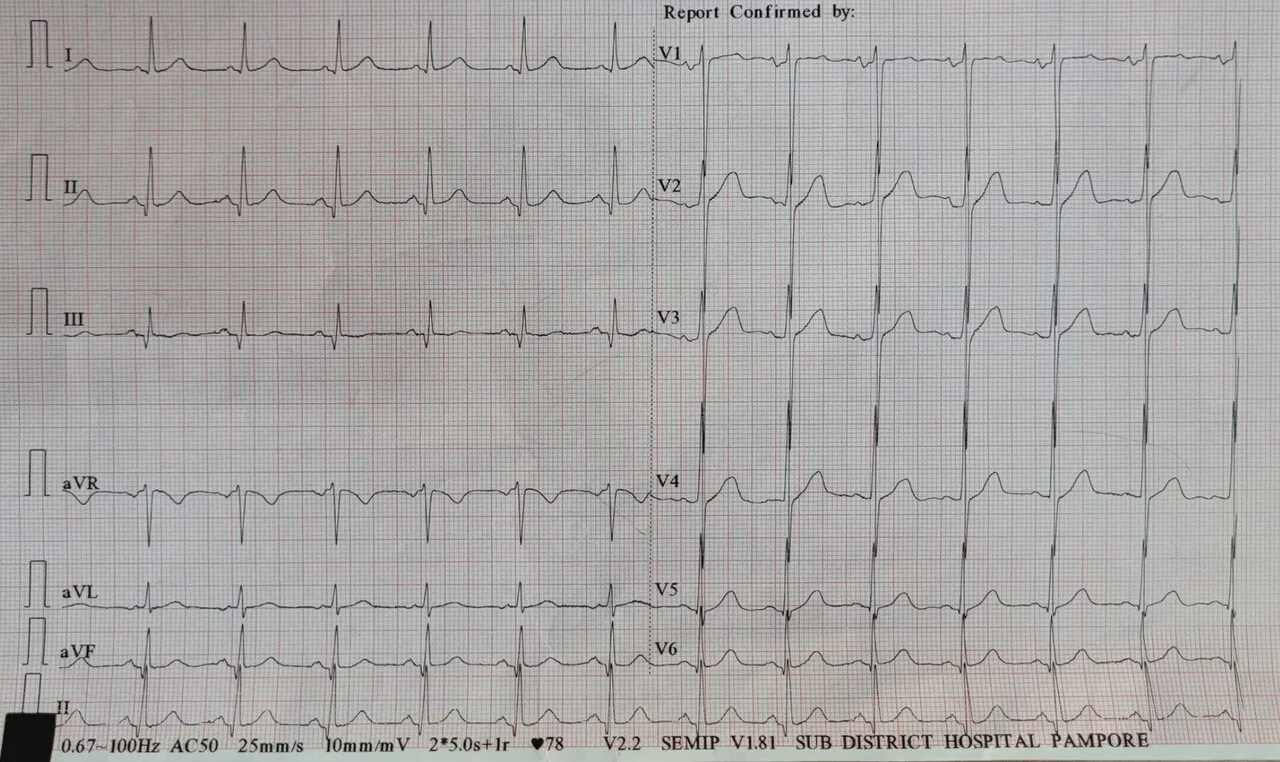
- ECG LVH (Sokolow–Lyon SV1 + RV5/6 > 35 mm; Cornell RaVL + SV3 > 28 mm in men, > 20 mm in women) is specific but insensitive
- Echo LV mass index above 115 g/m² (men) or 95 g/m² (women); relative wall thickness above 0.42 means concentric geometry
- LVH independently predicts stroke, heart failure, sudden death and all-cause mortality
- RAS blockers and CCBs regress LVH more than beta blockers (LIFE: losartan better than atenolol)
- Target systolic BP 120–129 mmHg if tolerated; treat HFpEF with diuretics, SGLT2 inhibitors and an MRA
Differential diagnosis
| Condition | Clues | Key test |
|---|---|---|
| Hypertrophic cardiomyopathy | Wall ≥15 mm (often asymmetric septal), LVOT obstruction, family history, young age | Echo, cardiac MRI, genetic testing |
| Aortic stenosis | Ejection systolic murmur to carotids, slow-rising pulse | Echo gradients and valve area |
| Cardiac amyloidosis | Thick walls with low QRS voltage, carpal tunnel, neuropathy, older man | Bone scintigraphy, free light chains, cardiac MRI |
| Athlete's heart | Mild symmetric hypertrophy with dilated cavity, normal diastolic function, regresses with detraining | Echo with tissue Doppler, CPET, detraining |
| Fabry disease | Concentric LVH, neuropathic pain, angiokeratomas, proteinuria | Alpha-galactosidase A activity, GLA gene, MRI low native T1 |
| Coarctation of the aorta | Young patient, radio-femoral delay, upper limb hypertension | Four-limb BP, echo, CT or MR angiography |
| Ischaemic cardiomyopathy | Regional wall-motion abnormality, angina, Q waves | Coronary angiography or CT, MRI LGE pattern |
Exam pearls
Guideline
2024 ESC Guidelines for elevated blood pressure and hypertension, 2025 AHA/ACC high blood pressure guideline and 2026 ESC Guidelines for the management of heart failure
References
- McEvoy JW, McCarthy CP, Bruno RM, et al.. 2024 ESC Guidelines for the management of elevated blood pressure and hypertension. Eur Heart J 2024.
- Jones DW, Ferdinand KC, Taler SJ, et al.. 2025 AHA/ACC/AANP/AAPA/ABC/ACCP/ACPM/AGS/AMA/ASPC/NMA/PCNA/SGIM Guideline for the Prevention, Detection, Evaluation and Management of High Blood Pressure in Adults. Circulation 2025.
- Køber L, Adamo M, Ruwald AC, et al.. 2026 ESC Guidelines for the management of heart failure. Eur Heart J 2026.
- Levy D, Garrison RJ, Savage DD, et al.. Prognostic implications of echocardiographically determined left ventricular mass in the Framingham Heart Study. N Engl J Med 1990.
- Levy D, Larson MG, Vasan RS, et al.. The progression from hypertension to congestive heart failure. JAMA 1996.
- Dahlöf B, Devereux RB, Kjeldsen SE, et al.. Cardiovascular morbidity and mortality in the Losartan Intervention For Endpoint reduction in hypertension study (LIFE): a randomised trial against atenolol. Lancet 2002.
Related topics
By Dr Khalid Seidi (B.Sc., M.D.) · MedEd World Clinical Knowledge library. Original teaching content checked against current guidelines (November 2026); confirm the latest local guidance before clinical use. Not a substitute for clinical judgement.