Clinical Knowledge › Internal medicine › Pulmonology › Relevant pharmacology
Inhaled bronchodilators and corticosteroids
Inhaled bronchodilators and corticosteroids are the backbone of treatment for asthma and chronic obstructive pulmonary disease (COPD). Beta-2 agonists relax airway smooth muscle by raising cyclic AMP; short-acting agents such as salbutamol relieve symptoms within minutes, while long-acting agents (salmeterol, formoterol, vilanterol, indacaterol, olodaterol) give 12–24 hours of bronchodilation. Muscarinic antagonists such as ipratropium and tiotropium block vagal bronchoconstriction and are especially effective in COPD. Inhaled corticosteroids (ICS) suppress eosinophilic airway inflammation and are the main controller drug in asthma, but in COPD they are reserved for patients with exacerbations and raised blood eosinophils. Current asthma guidance avoids reliever therapy with a short-acting beta-2 agonist alone, preferring as-needed ICS–formoterol, while COPD guidance builds on long-acting bronchodilators. Inhaler technique, adherence and device choice decide whether any of these drugs works.
Patient case, mechanism, investigations, management, flashcards and exam-style questions.Open the lesson →
Key facts
- Beta-2 agonists act through Gs-coupled receptors: raised cAMP activates protein kinase A and relaxes airway smooth muscle
- Muscarinic antagonists block M3 receptors on airway smooth muscle and glands; tiotropium is long-acting, ipratropium short-acting
- Inhaled corticosteroids reduce airway eosinophils, airway hyper-responsiveness and exacerbations; they treat asthma's cause, not just its symptoms
- Asthma: never use a LABA without an ICS; LABA monotherapy increases the risk of severe and fatal attacks
- GINA and BTS/NICE/SIGN prefer as-needed low-dose ICS–formoterol (AIR) or maintenance-and-reliever therapy (MART) over SABA-only treatment
- COPD: start with long-acting bronchodilators (LAMA, or LABA+LAMA); add ICS only with exacerbations and blood eosinophils of 100 cells/µL or more (strongest if 300 or more)
- Common ICS effects: oral candidiasis and dysphonia; in COPD, ICS increase pneumonia risk
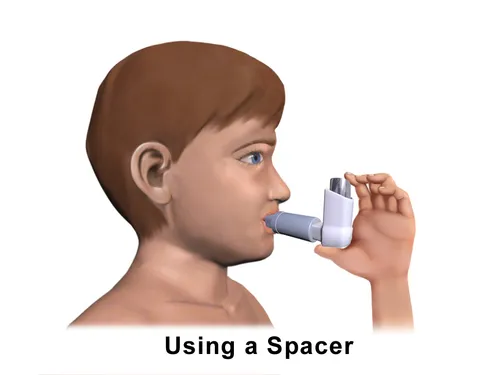
- Up to 70–80% of patients use their inhaler incorrectly; check technique before stepping up treatment
Differential diagnosis
| Condition | Clues | Key test |
|---|---|---|
| Short-acting beta-2 agonist (salbutamol, terbutaline) | Onset within 5 minutes, lasts 4–6 hours; reliever | Symptom relief and peak flow improvement after dose |
| Long-acting beta-2 agonist (salmeterol, formoterol) | 12-hour action; formoterol has fast onset, salmeterol slow | Used only with an ICS in asthma |
| Short-acting muscarinic antagonist (ipratropium) | Onset 15–30 minutes, lasts 6–8 hours | Added to salbutamol in acute severe asthma and COPD exacerbations |
| Long-acting muscarinic antagonist (tiotropium, umeclidinium, glycopyrronium) | Once- or twice-daily maintenance; first-line in COPD | Spirometry and symptom scores (CAT, mMRC) |
| Inhaled corticosteroid (budesonide, beclometasone, fluticasone) | No immediate bronchodilation; benefit over days to weeks | FeNO and blood eosinophils predict response |
| Leukotriene receptor antagonist (montelukast) | Oral add-on; neuropsychiatric warnings | Trial with objective review at 8–12 weeks |
| Biologic therapy (anti-IL-5, anti-IL-4R, anti-IgE, anti-TSLP) | Severe asthma despite high-dose ICS–LABA | Blood eosinophils, IgE, FeNO; specialist assessment |
Exam pearls
Guideline
GINA 2025 report (with 2026 update), GOLD 2027 report and BTS/NICE/SIGN asthma guideline NG245 (2024)
References
- Global Initiative for Asthma (GINA). Global Strategy for Asthma Management and Prevention (2025 update). 2025.
- Global Initiative for Chronic Obstructive Lung Disease (GOLD). Global Strategy for the Diagnosis, Management, and Prevention of Chronic Obstructive Pulmonary Disease: 2027 Report. 2025.
- National Institute for Health and Care Excellence (NICE), British Thoracic Society (BTS), Scottish Intercollegiate Guidelines Network (SIGN). Asthma: diagnosis, monitoring and chronic asthma management (NICE guideline NG245). 2024.
- O'Byrne PM, FitzGerald JM, Bateman ED, et al.. Inhaled Combined Budesonide-Formoterol as Needed in Mild Asthma. N Engl J Med 2018.
- Beasley R, Holliday M, Reddel HK, et al.. Controlled Trial of Budesonide-Formoterol as Needed for Mild Asthma. N Engl J Med 2019.
- Papi A, Chipps BE, Beasley R, et al.. Albuterol-Budesonide Fixed-Dose Combination Rescue Inhaler for Asthma. N Engl J Med 2022.
Related topics
By Dr Khalid Seidi (B.Sc., M.D.) · MedEd World Clinical Knowledge library. Original teaching content checked against current guidelines (November 2026); confirm the latest local guidance before clinical use. Not a substitute for clinical judgement.