Clinical Knowledge › Internal medicine › Pulmonology › Relevant pharmacology
Leukotriene receptor antagonists
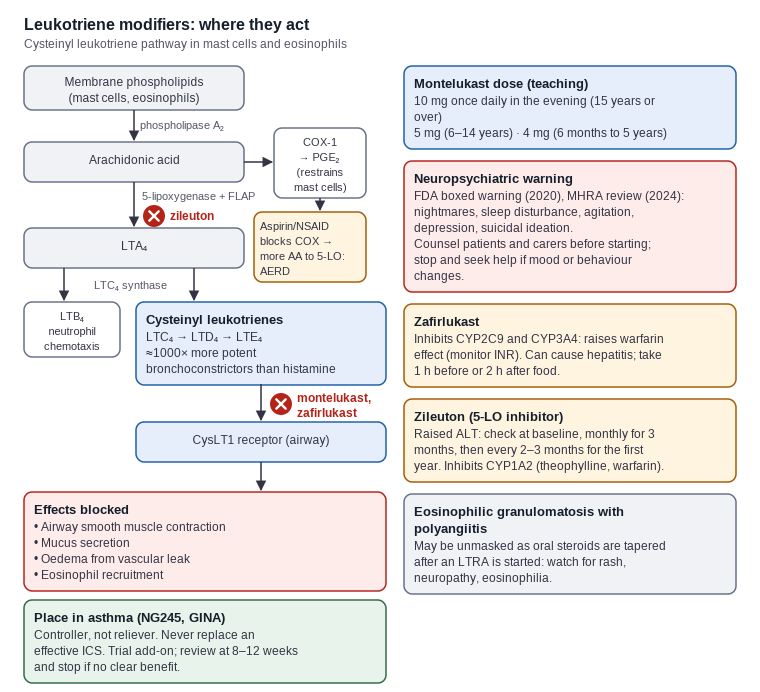
Leukotriene receptor antagonists (LTRAs) such as montelukast, zafirlukast and pranlukast are oral controller drugs that block the type 1 cysteinyl leukotriene (CysLT1) receptor. Cysteinyl leukotrienes (LTC4, LTD4, LTE4) are made from arachidonic acid by 5-lipoxygenase in mast cells and eosinophils; they constrict airway smooth muscle, increase mucus and vascular leak and recruit eosinophils. LTRAs give modest bronchodilation and anti-inflammatory effect, less than inhaled corticosteroids, so current asthma guidance uses them mainly as add-on or alternative options, especially in children, in exercise-induced bronchoconstriction, in asthma with allergic rhinitis and in aspirin- or NSAID-exacerbated respiratory disease. Montelukast is taken once daily and is generally well tolerated, but it carries a boxed warning for neuropsychiatric reactions, including nightmares, agitation, depression and suicidal thoughts. Zileuton, a 5-lipoxygenase inhibitor, needs liver monitoring, and zafirlukast interacts with warfarin.
Patient case, mechanism, investigations, management, flashcards and exam-style questions.Open the lesson →
Key facts
- Montelukast, zafirlukast and pranlukast block the CysLT1 receptor; zileuton inhibits 5-lipoxygenase and so blocks leukotriene synthesis
- Cysteinyl leukotrienes (LTC4, LTD4, LTE4) are about 1000 times more potent bronchoconstrictors than histamine
- LTRAs are less effective than inhaled corticosteroids as first-line controllers and less effective than LABA as add-on in adults
- Montelukast dose: 10 mg once daily in the evening (adults and 15 years or over), 5 mg (6–14 years), 4 mg (6 months to 5 years); teaching doses
- Boxed warning (FDA 2020) and MHRA review (2024): nightmares, sleep disturbance, agitation, depression and suicidal ideation; counsel patients and carers
- Useful niches: exercise-induced bronchoconstriction, asthma with allergic rhinitis, aspirin-exacerbated respiratory disease and preschool viral wheeze
- Zafirlukast inhibits CYP2C9 and CYP3A4 (raises warfarin effect) and can cause hepatitis; zileuton needs liver function monitoring
- Eosinophilic granulomatosis with polyangiitis may be unmasked when oral steroids are tapered after an LTRA is started
Differential diagnosis
| Condition | Clues | Key test |
|---|---|---|
| Montelukast | Once-daily oral CysLT1 antagonist; chewable and granule forms for children | Clinical response at 4–8 weeks; ask about mood and sleep |
| Zafirlukast | Twice daily, on an empty stomach; CYP2C9 inhibitor | Liver function tests; INR if on warfarin |
| Pranlukast | CysLT1 antagonist used mainly in Japan and parts of Asia | Clinical response |
| Zileuton | 5-lipoxygenase inhibitor; blocks LTB4 and cysteinyl leukotrienes | ALT before and during treatment |
| Inhaled corticosteroid | More effective first-line controller; reduces exacerbations and FeNO | FeNO and blood eosinophils |
| Long-acting beta-2 agonist (with ICS) | Better add-on than LTRA in adults | Lung function and symptom scores |
| Long-acting muscarinic antagonist add-on | Alternative add-on in adults uncontrolled on ICS–LABA | Spirometry and exacerbation rate |
| Oral antihistamine or intranasal steroid | Preferred over montelukast for allergic rhinitis alone | Symptom response |
Exam pearls
Guideline
GINA 2025 report (with 2026 update), BTS/NICE/SIGN asthma guideline NG245 (2024), FDA boxed warning (2020) and MHRA review of montelukast (2024)
References
- Global Initiative for Asthma (GINA). Global Strategy for Asthma Management and Prevention (2025 update). 2025.
- National Institute for Health and Care Excellence (NICE), British Thoracic Society (BTS), Scottish Intercollegiate Guidelines Network (SIGN). Asthma: diagnosis, monitoring and chronic asthma management (NICE guideline NG245). 2024.
- US Food and Drug Administration. FDA requires Boxed Warning about serious mental health side effects for asthma and allergy drug montelukast (Singulair); advises restricting use for allergic rhinitis (Drug Safety Communication). 2020.
- Medicines and Healthcare products Regulatory Agency (MHRA). Outcome of MHRA review of neuropsychiatric reactions with montelukast. 2024.
- Drazen JM, Israel E, O'Byrne PM.. Treatment of asthma with drugs modifying the leukotriene pathway. N Engl J Med 1999.
- Price D, Musgrave SD, Shepstone L, et al.. Leukotriene antagonists as first-line or add-on asthma-controller therapy. N Engl J Med 2011.
Related topics
By Dr Khalid Seidi (B.Sc., M.D.) · MedEd World Clinical Knowledge library. Original teaching content checked against current guidelines (November 2026); confirm the latest local guidance before clinical use. Not a substitute for clinical judgement.