Clinical Knowledge › Obstetrics and gynaecology › Medical disorders in pregnancy
Intrahepatic cholestasis of pregnancy
Intrahepatic cholestasis of pregnancy (ICP, obstetric cholestasis) is the commonest pregnancy-specific liver disorder, affecting about 0.7% of pregnancies in the UK and more in South Asian and South American women. Rising oestrogen and progesterone metabolites overwhelm hepatocyte bile transport in genetically susceptible women (variants in ABCB4, ABCB11, ATP8B1), so bile acids accumulate. The hallmark is itching without a rash, typically of the palms and soles and worse at night, in the third trimester. Diagnosis (RCOG 2022) requires itch plus a peak random total bile acid concentration of 19 µmol/L or more after other causes are excluded; transaminases are often raised. For the mother ICP is uncomfortable but benign, resolving within days to weeks of birth; for the baby it increases spontaneous preterm birth, meconium-stained fluid and neonatal unit admission, and stillbirth risk rises sharply when bile acids reach 100 µmol/L or more. Fetal monitoring cannot predict stillbirth, so timing of birth is based on peak bile acids: consider birth at 35–36 weeks if 100 µmol/L or more, and at 38–39 weeks if 40–99 µmol/L. Ursodeoxycholic acid did not improve perinatal outcomes in the PITCHES trial. ICP often recurs, and liver tests are rechecked after birth.
Patient case, mechanism, investigations, management, flashcards and exam-style questions.Open the lesson →
Key facts
- Commonest liver disorder unique to pregnancy: about 0.7% in the UK, 1.2–1.5% in women of South Asian origin, higher in parts of South America
- Itch without rash, especially palms and soles and worse at night, usually after 30 weeks
- RCOG 2022 diagnosis: itch plus peak random total bile acids 19 µmol/L or more, after excluding other causes; transaminases are often raised
- Severity by peak bile acids: mild 19–39, moderate 40–99, severe 100 µmol/L or more
- Stillbirth risk is not clearly raised below 40 µmol/L but rises to about 3–3.5% with bile acids 100 µmol/L or more (IPD meta-analysis 2019)
- Timing of birth: 100 µmol/L or more consider 35–36 weeks; 40–99 consider 38–39 weeks; 19–39 standard care (birth by 40 weeks is not supported by evidence)
- Ursodeoxycholic acid did not reduce the composite of perinatal death, preterm birth or neonatal unit admission (PITCHES 2019)
- Recurs in roughly 40–90% of later pregnancies (more than half in most series); recheck liver tests at least 4 weeks after birth
Differential diagnosis
| Condition | Clues | Key test |
|---|---|---|
| Atopic eruption of pregnancy or eczema | Rash present, often earlier in pregnancy, atopic history | Clinical; normal bile acids |
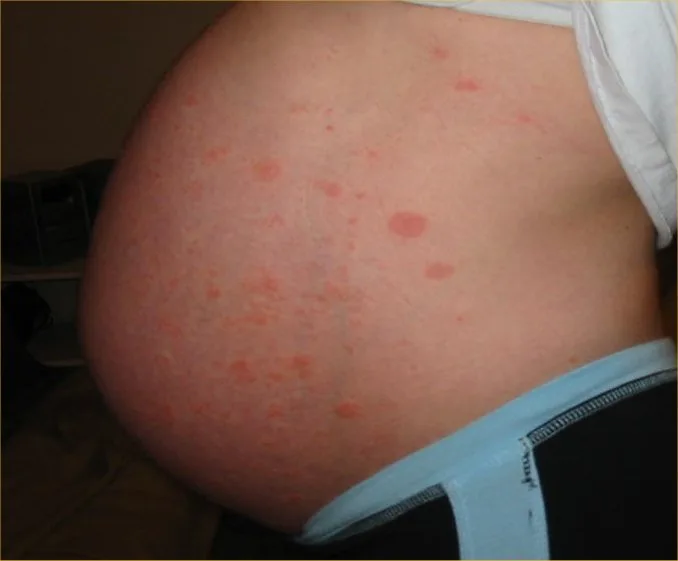
| Polymorphic eruption of pregnancy | Itchy urticarial papules in abdominal striae sparing the umbilicus, late pregnancy | Clinical; normal bile acids |
| Pemphigoid gestationis | Periumbilical urticarial plaques progressing to blisters | Skin biopsy with direct immunofluorescence |
| Pre-eclampsia or HELLP | Hypertension, proteinuria, low platelets, epigastric pain | BP, urine PCR, FBC, LDH |
| Acute fatty liver of pregnancy | Vomiting, abdominal pain, hypoglycaemia, coagulopathy, jaundice | Glucose, PT, ammonia, renal function |
| Viral hepatitis | Very high transaminases, exposure history, jaundice | Hepatitis A, B, C, E serology, CMV and EBV |
| Gallstones or biliary obstruction | RUQ pain, dilated ducts | Liver and biliary ultrasound |
| Primary biliary cholangitis or sclerosing cholangitis | Pre-existing or persisting cholestasis after birth | Antimitochondrial antibody, MRCP |
Exam pearls
Guideline
RCOG Green-top Guideline No. 43 Intrahepatic cholestasis of pregnancy (2022); SMFM Consult Series #53 (2021); EASL Clinical Practice Guidelines on the management of liver diseases in pregnancy (2023)
References
- Girling J, Knight CL, Chappell L.. Intrahepatic cholestasis of pregnancy: Green-top Guideline No. 43 June 2022. BJOG 2022.
- Ovadia C, Seed PT, Sklavounos A, et al.. Association of adverse perinatal outcomes of intrahepatic cholestasis of pregnancy with biochemical markers: results of aggregate and individual patient data meta-analyses. Lancet 2019.
- Chappell LC, Bell JL, Smith A, et al.. Ursodeoxycholic acid versus placebo in women with intrahepatic cholestasis of pregnancy (PITCHES): a randomised controlled trial. Lancet 2019.
- Lee RH, Greenberg M, Metz TD, Pettker CM.. Society for Maternal-Fetal Medicine Consult Series #53: Intrahepatic cholestasis of pregnancy. Am J Obstet Gynecol 2021.
- European Association for the Study of the Liver. EASL Clinical Practice Guidelines on the management of liver diseases in pregnancy. J Hepatol 2023.
- College of Sexual and Reproductive Healthcare. UK Medical Eligibility Criteria for Contraceptive Use (UKMEC 2025). CoSRH 2025.
Related topics
By Dr Khalid Seidi (B.Sc., M.D.) · MedEd World Clinical Knowledge library. Original teaching content checked against current guidelines (November 2026); confirm the latest local guidance before clinical use. Not a substitute for clinical judgement.