Clinical Knowledge › Surgery › Clinical problems
Leg ulcer: approach to the patient
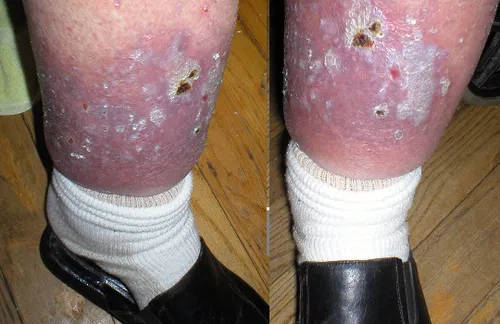
A leg ulcer is a break in the skin of the leg or foot that has not healed within 2 weeks. Chronic leg ulcers affect about 1% of adults and become commoner with age. Venous disease causes most (around 60–70%), followed by arterial disease, mixed arteriovenous disease, diabetic neuropathy and pressure; vasculitis, pyoderma gangrenosum, malignancy, sickle cell disease and infection explain the rest. The surgeon's approach is to establish the cause from site, appearance and pulses, and always to measure the ankle–brachial pressure index (ABPI) before compression, because compressing an ischaemic leg can cause gangrene. Venous ulcers heal with strong compression and are best treated with early endovenous ablation of superficial reflux. Arterial ulcers need urgent vascular assessment for revascularisation; chronic limb-threatening ischaemia risks amputation. Diabetic foot ulcers need offloading, debridement and multidisciplinary care. Atypical or non-healing ulcers need biopsy to exclude squamous cell carcinoma.
Patient case, mechanism, investigations, management, flashcards and exam-style questions.Open the lesson →
Key facts
- Leg ulcer = wound below the knee that has not healed within 2 weeks; it is a symptom, not a diagnosis
- Causes: venous about 60–70%, arterial about 10–20%, mixed in many older patients, plus diabetic, pressure, vasculitic, neoplastic and infective ulcers
- Measure the ABPI (hand-held Doppler) in every leg ulcer before compression; it may be falsely high with calcified arteries
- ABPI 0.8–1.3: full compression (about 40 mmHg) is usually safe; 0.5–0.8: reduced compression under specialist supervision; below 0.5: no compression, urgent vascular referral
- Venous ulcers: gaiter area, shallow, sloping edges, exudate, haemosiderin staining, lipodermatosclerosis, oedema
- Arterial ulcers: toes, heels and pressure points, punched-out, painful (worse with elevation and at night), absent pulses
- Early endovenous ablation plus compression speeds healing of venous ulcers and reduces recurrence (EVRA trial)
- Biopsy an ulcer that is atypical, has rolled or raised edges or overgranulation, or fails to heal by 12 weeks: Marjolin squamous cell carcinoma
Differential diagnosis
| Condition | Clues | Key test |
|---|---|---|
| Venous ulcer | Gaiter area (often medial malleolus), shallow, exudating, varicose veins, haemosiderin, lipodermatosclerosis | ABPI then venous duplex ultrasound |
| Arterial ulcer | Toes, heels, lateral malleolus; punched-out, pale base, pain at night, absent pulses, cold foot | ABPI, toe pressures, arterial duplex or CT angiography |
| Diabetic neuropathic ulcer | Plantar pressure points (metatarsal heads), painless, callus, warm foot, pulses may be present | Monofilament testing, probe-to-bone, foot X-ray or MRI for osteomyelitis |
| Pressure ulcer | Heel or malleolus in immobile patient | Clinical; staging |
| Pyoderma gangrenosum | Rapidly enlarging painful ulcer, violaceous undermined edge, pathergy, IBD or rheumatoid arthritis | Clinical diagnosis of exclusion; biopsy edge to exclude other causes |
| Vasculitic ulcer | Multiple painful punched-out ulcers with purpura, systemic disease | ANCA, ANA, complement, cryoglobulins, biopsy |
| Malignant ulcer (Marjolin SCC, BCC, melanoma) | Rolled or everted edge, overgranulation, non-healing at 12 weeks, bleeding | Punch or incisional biopsy of the edge |
| Infective (tuberculosis, Buruli ulcer, leishmaniasis) | Travel or residence in endemic area, undermined painless ulcer | Biopsy with microscopy, culture and PCR |
Exam pearls
Guideline
ESVS 2022 Clinical Practice Guidelines on chronic venous disease of the lower limbs; Global Vascular Guidelines on chronic limb-threatening ischaemia (2019); 2024 ESC Guidelines for peripheral arterial and aortic diseases; NICE NG152 Leg ulcer infection: antimicrobial prescribing (2020); UK National Wound Care Strategy Programme lower limb recommendations
References
- De Maeseneer MG, Kakkos SK, Aherne T, et al.. European Society for Vascular Surgery (ESVS) 2022 clinical practice guidelines on the management of chronic venous disease of the lower limbs. Eur J Vasc Endovasc Surg 2022.
- Conte MS, Bradbury AW, Kolh P, et al.. Global vascular guidelines on the management of chronic limb-threatening ischemia. J Vasc Surg 2019.
- Mazzolai L, Teixido-Tura G, Lanzi S, et al.. 2024 ESC Guidelines for the management of peripheral arterial and aortic diseases. Eur Heart J 2024.
- Gohel MS, Heatley F, Liu X, et al.. A randomized trial of early endovenous ablation in venous ulceration. N Engl J Med 2018.
- National Institute for Health and Care Excellence (NICE). Leg ulcer infection: antimicrobial prescribing (NG152). NICE guideline 2020.
- National Wound Care Strategy Programme (NHS England). Recommendations for lower limb ulcers. National Wound Care Strategy Programme 2020.
Related topics
By Dr Khalid Seidi (B.Sc., M.D.) · MedEd World Clinical Knowledge library. Original teaching content checked against current guidelines (November 2026); confirm the latest local guidance before clinical use. Not a substitute for clinical judgement.