Clinical Knowledge › Surgery › Clinical problems
Neck lump: approach to the patient
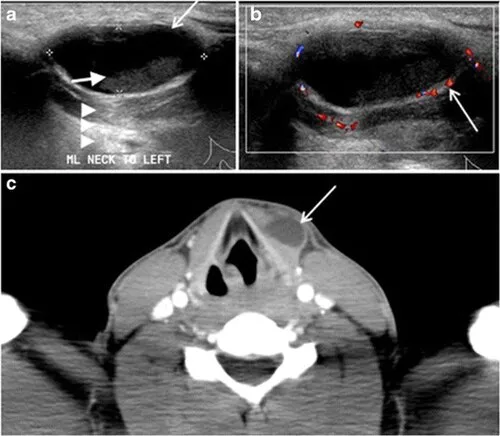
A neck lump is a common surgical referral. Age, site and duration give the best first clues. In children most lumps are reactive lymph nodes or congenital cysts; in adults over about 40, a persistent lateral neck lump is a metastatic squamous cell carcinoma until proved otherwise, and HPV-associated oropharyngeal cancer now causes cystic nodes in younger non-smokers that mimic branchial cysts. Midline lumps are usually thyroid or thyroglossal cysts (which rise on tongue protrusion); anterior triangle lumps include nodes, branchial cysts, salivary glands and carotid body tumours (pulsatile, mobile side to side only); posterior triangle nodes suggest nasopharyngeal cancer, lymphoma or tuberculosis; a left supraclavicular node suggests abdominal malignancy. Assessment includes a full head and neck examination with flexible nasendoscopy. Ultrasound with fine-needle aspiration is the first investigation; open excision biopsy of a suspected cancer node is avoided. Routine antibiotics are not given without signs of infection, and a lump persisting beyond 2–3 weeks needs referral.
Patient case, mechanism, investigations, management, flashcards and exam-style questions.Open the lesson →
Key facts
- Adult over 40 with a persistent lateral neck lump: metastatic squamous cell carcinoma until proved otherwise
- HPV-positive oropharyngeal cancer often presents as a painless cystic level II node in a younger non-smoker; a 'branchial cyst' in an adult over about 35–40 is cancer until proved otherwise
- Midline lump moving with swallowing = thyroid; moving up on tongue protrusion = thyroglossal cyst
- Carotid body tumour: pulsatile lump at the carotid bifurcation, moves side to side but not up and down
- Ultrasound with fine-needle aspiration (cytology, p16/HPV, flow cytometry, culture) is the first-line investigation
- Avoid open excision biopsy of a suspected metastatic SCC node before ENT assessment: it seeds tumour and worsens outcome
- Do not prescribe empirical antibiotics for an adult neck mass without clear signs of bacterial infection (AAO-HNS 2017)
- Thyroid FNA is reported with Bethesda categories I–VI (2023 edition) after ultrasound risk scoring (U1–U5 or ACR TI-RADS)
Differential diagnosis
| Condition | Clues | Key test |
|---|---|---|
| Reactive lymphadenopathy | Tender, mobile, under 1–2 cm, recent upper respiratory infection, settles within 2–6 weeks | Clinical review; ultrasound if persistent |
| Metastatic squamous cell carcinoma | Hard or cystic, painless, persistent node in an adult; smoking, alcohol or HPV; hoarseness, dysphagia, otalgia | Nasendoscopy, ultrasound-guided FNA with p16, CT or MRI, PET-CT |
| Lymphoma | Rubbery, painless, multiple nodes; B symptoms; other node groups or splenomegaly | Core or excision biopsy after FNA; CT staging |
| Thyroid nodule or goitre | Moves with swallowing, midline or lateral to trachea | TFTs, ultrasound (U score or TI-RADS), FNA (Bethesda) |
| Thyroglossal duct cyst | Midline, near hyoid, rises on tongue protrusion, child or young adult | Ultrasound, confirm normal thyroid; Sistrunk operation |
| Branchial cyst | Smooth, fluctuant, anterior border of sternocleidomastoid at junction of upper and middle thirds, young adult | Ultrasound and FNA (cholesterol crystals); exclude cystic metastasis in adults over about 35–40 |
| Carotid body tumour (paraganglioma) | Pulsatile, at bifurcation, mobile laterally not vertically, may have bruit | Duplex ultrasound, CT or MR angiography, metanephrines; never biopsy |
| Tuberculous lymphadenitis | Matted, firm or fluctuant nodes, posterior triangle, sinus formation (scrofula), endemic area or HIV | FNA for AFB, GeneXpert/PCR and culture; chest X-ray |
Exam pearls
Guideline
AAO-HNS Clinical Practice Guideline: Evaluation of the Neck Mass in Adults (2017); NICE NG12 Suspected cancer (2015, updated) and NG36 upper aerodigestive tract cancer (2016); 2023 Bethesda System for thyroid cytopathology
References
- Pynnonen MA, Gillespie MB, Roman B, et al.. Clinical Practice Guideline: Evaluation of the Neck Mass in Adults Executive Summary. Otolaryngol Head Neck Surg 2017.
- National Institute for Health and Care Excellence (NICE). Suspected cancer: recognition and referral (NG12). NICE guideline 2015.
- Ali SZ, Baloch ZW, Cochand-Priollet B, et al.. The 2023 Bethesda System for reporting thyroid cytopathology. J Am Soc Cytopathol 2023.
- Tessler FN, Middleton WD, Grant EG, et al.. ACR Thyroid Imaging, Reporting and Data System (TI-RADS): White Paper of the ACR TI-RADS Committee. J Am Coll Radiol 2017.
- Perros P, Boelaert K, Colley S, et al.. Guidelines for the management of thyroid cancer. Clin Endocrinol (Oxf) 2014.
- National Institute for Health and Care Excellence (NICE). Cancer of the upper aerodigestive tract: assessment and management in people aged 16 and over (NG36). NICE guideline 2016.
Related topics
By Dr Khalid Seidi (B.Sc., M.D.) · MedEd World Clinical Knowledge library. Original teaching content checked against current guidelines (November 2026); confirm the latest local guidance before clinical use. Not a substitute for clinical judgement.