Clinical Knowledge › Surgery › Clinical problems
Scrotal swelling: approach to the patient
Scrotal swelling is common and usually benign, but two diagnoses must never be missed: testicular torsion, which destroys the testis within hours, and testicular cancer, the commonest solid malignancy of men aged 15–40. The surgeon sorts every swelling with a few bedside questions: is it acute and painful or slow and painless; can you get above it (if not, it is an inguinoscrotal hernia); is it separate from the testis or part of it; does it transilluminate; and is it tender? Painful acute swellings include torsion, torsion of a testicular appendage, epididymo-orchitis, trauma and Fournier gangrene. Painless swellings include hydrocele, epididymal cyst, varicocele and tumour. Suspected torsion goes straight to theatre for scrotal exploration, detorsion and bilateral fixation; ultrasound must not delay surgery. Any solid intratesticular mass is cancer until proven otherwise: urgent ultrasound, tumour markers (AFP, β-hCG, LDH) and radical inguinal orchidectomy. Most other swellings are managed electively, by observation or by repair when symptomatic.
Patient case, mechanism, investigations, management, flashcards and exam-style questions.Open the lesson →
Key facts
- Three bedside questions: can you get above it, is it separate from the testis, and does it transilluminate?
- Cannot get above the swelling = inguinoscrotal hernia until proven otherwise
- Testicular torsion: peaks in adolescence; salvage is about 90% or more if detorsed within 6 hours, falling steeply after 12 hours
- Suspected torsion is a clinical diagnosis: explore the scrotum urgently and do not wait for Doppler ultrasound
- A firm painless lump within the testis in a man aged 15–40 is testicular cancer until proven otherwise
- Testicular cancer is removed by radical inguinal orchidectomy after tumour markers (AFP, β-hCG, LDH); never biopsy or operate through the scrotum
- Adult hydrocele needs an ultrasound because it may hide a tumour or follow infection or trauma
- Varicocele is left-sided in about 90%; a new right-sided or non-collapsing varicocele needs imaging for a retroperitoneal or renal mass
Differential diagnosis
| Condition | Clues | Key test |
|---|---|---|
| Testicular torsion | Sudden severe pain, vomiting, high-riding horizontal testis, absent cremasteric reflex, age 12–18 | Urgent scrotal exploration (Doppler only if it causes no delay) |
| Torsion of testicular appendage | Child 7–12, pain localised to upper pole, 'blue dot' sign, cremasteric reflex present | Clinical; Doppler shows normal testicular flow |
| Epididymo-orchitis | Gradual onset, fever, dysuria or urethral discharge, tender epididymis, pain eased by elevation | Urinalysis, first-void urine NAAT for chlamydia and gonorrhoea, MSU culture |
| Testicular tumour | Painless hard irregular lump within the testis, age 15–40, heaviness, gynaecomastia | Scrotal ultrasound and AFP, β-hCG, LDH |
| Hydrocele | Painless fluctuant swelling, testis impalpable within it, brilliantly transilluminates, can get above | Ultrasound in adults to examine the testis |
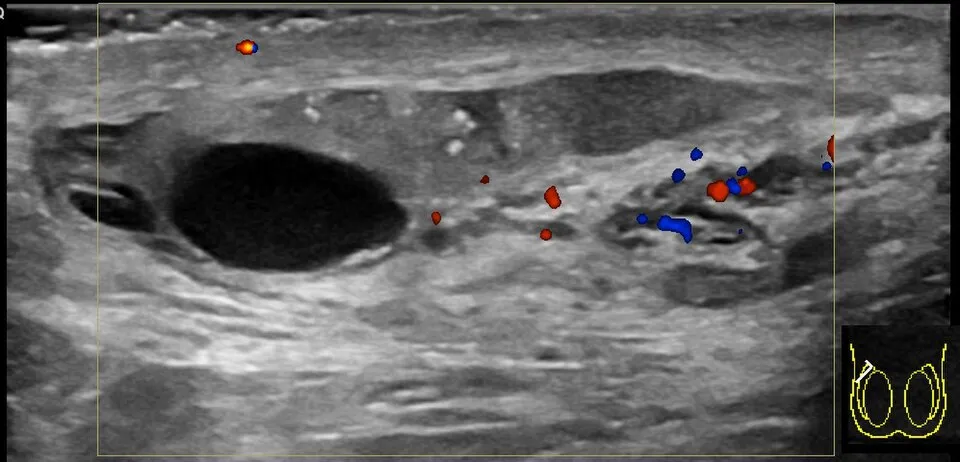
| Epididymal cyst / spermatocele | Smooth lump separate from and above/behind the testis, transilluminates | Ultrasound if doubt |
| Varicocele | 'Bag of worms', usually left, enlarges on standing and Valsalva, collapses supine | Clinical; Doppler ultrasound; renal imaging if right-sided or non-collapsing |
| Inguinoscrotal hernia | Cannot get above, cough impulse, may reduce, bowel sounds | Clinical; ultrasound if uncertain |
Exam pearls
Guideline
EAU Guidelines on Testicular Cancer (2026 summary), EAU/ESPU Guidelines on Paediatric Urology (acute scrotum, 2025), BASHH UK national guideline on epididymo-orchitis (2020) and NICE NG12 Suspected cancer: recognition and referral
References
- Patrikidou A, Cazzaniga W, Oing C, et al.. European Association of Urology Guidelines on Testicular Cancer: summary of the 2026 guidelines. Eur Urol 2026.
- European Association of Urology / European Society for Paediatric Urology. EAU Guidelines on Paediatric Urology: acute scrotum in children. EAU Guidelines Office, Arnhem 2025.
- British Association for Sexual Health and HIV (BASHH). UK national guideline for the management of epididymo-orchitis. BASHH 2020.
- National Institute for Health and Care Excellence (NICE). Suspected cancer: recognition and referral (NG12). NICE guideline 2015.
- Barbosa JA, Tiseo BC, Barayan GA, et al.. Development and initial validation of a scoring system to diagnose testicular torsion in children. J Urol 2013.
- European Association of Urology. EAU Guidelines on Sexual and Reproductive Health: varicocele. EAU Guidelines Office, Arnhem 2025.
Related topics
By Dr Khalid Seidi (B.Sc., M.D.) · MedEd World Clinical Knowledge library. Original teaching content checked against current guidelines (November 2026); confirm the latest local guidance before clinical use. Not a substitute for clinical judgement.