Clinical Knowledge › Paediatrics › Genetic and chromosomal disorders
Marfan syndrome
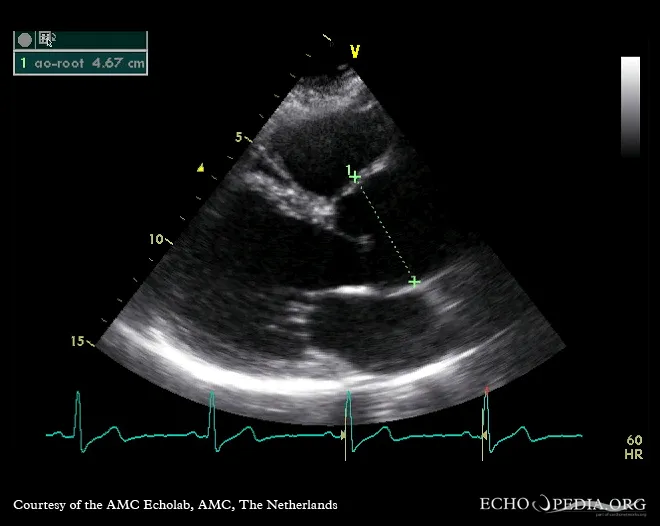
Marfan syndrome is an autosomal dominant connective tissue disorder caused by pathogenic variants in FBN1, which encodes fibrillin-1; about 1 in 5000 people are affected and about a quarter of cases are de novo. Abnormal microfibrils and excess TGF-beta signalling weaken the aortic wall, the suspensory ligament of the lens and other tissues. The cardinal features are progressive aortic root dilatation at the sinuses of Valsalva, with risk of type A dissection, and ectopia lentis (usually upward), together with skeletal features: tall stature with long limbs, arachnodactyly, positive wrist and thumb signs, pectus deformity, scoliosis and joint laxity. Diagnosis uses the revised Ghent criteria (aortic Z-score, ectopia lentis, systemic score, FBN1 result and family history). Care is lifelong: yearly echocardiography, a beta-blocker or angiotensin receptor blocker to slow aortic growth, activity advice, eye and spine review, and elective root replacement before dissection (about 50 mm in adults, earlier with risk factors). Family screening and pre-pregnancy counselling are essential.
Patient case, mechanism, investigations, management, flashcards and exam-style questions.Open the lesson →
Key facts
- Autosomal dominant, FBN1 on 15q21.1; prevalence about 1 in 5000; about 25% de novo; complete penetrance with variable expression
- Aortic root dilatation at the sinuses of Valsalva is the main cause of death (type A dissection, aortic regurgitation)
- Ectopia lentis in about 60%, typically upward (superotemporal); homocystinuria gives downward displacement
- Revised Ghent 2010: aortic root Z-score of 2 or more plus ectopia lentis, or plus FBN1 variant, or plus systemic score of 7 or more, establishes the diagnosis
- Skeletal: arm span greater than height, reduced upper-to-lower segment ratio, arachnodactyly, wrist (Walker–Murdoch) and thumb (Steinberg) signs, pectus, scoliosis, flat feet
- Beta-blockers and ARBs (losartan) slow aortic root growth to a similar degree; an IPD meta-analysis (2022) supports ARBs alongside beta-blockers
- Elective root replacement (valve-sparing where possible) at about 50 mm, or 45 mm with risk factors (ESC 2024, ACC/AHA 2022)
- Pregnancy is high risk; pre-pregnancy counselling and aortic imaging are essential, and surgery is advised before pregnancy if the root is above about 45 mm
Differential diagnosis
| Condition | Clues | Key test |
|---|---|---|
| Loeys–Dietz syndrome | Hypertelorism, bifid uvula or cleft palate, arterial tortuosity, aneurysms beyond the root, dissection at smaller diameters | TGFBR1/2, SMAD3, TGFB2/3 testing; head-to-pelvis MRA or CTA |
| Homocystinuria (CBS deficiency) | Downward lens dislocation, intellectual disability, thromboembolism, marfanoid habitus | Plasma total homocysteine (very high) |
| Vascular Ehlers–Danlos syndrome | Thin translucent skin, easy bruising, arterial, bowel or uterine rupture; no ectopia lentis | COL3A1 testing |
| Congenital contractural arachnodactyly (Beals) | Crumpled ears, joint contractures, arachnodactyly, usually no aortic disease | FBN2 testing |
| Klinefelter syndrome | Tall, long legs, small testes, gynaecomastia, no aortic or lens disease | Karyotype 47,XXY |
| Familial thoracic aortic aneurysm and dissection | Aortic disease without systemic features | Gene panel (ACTA2, MYH11 and others) |
| MASS phenotype or isolated ectopia lentis | Mild aortic enlargement, mitral prolapse, skin and skeletal features below Ghent thresholds | FBN1 testing, serial echocardiography |
Exam pearls
Guideline
Revised Ghent nosology (2010), 2024 ESC Guidelines for peripheral arterial and aortic diseases, 2022 ACC/AHA Guideline for aortic disease and 2025 ESC Guidelines for cardiovascular disease and pregnancy
References
- Loeys BL, Dietz HC, Braverman AC, et al.. The revised Ghent nosology for the Marfan syndrome. J Med Genet 2010.
- Isselbacher EM, Preventza O, Hamilton Black J 3rd, et al.. 2022 ACC/AHA guideline for the diagnosis and management of aortic disease. Circulation 2022.
- Mazzolai L, Teixido-Tura G, Lanzi S, et al.. 2024 ESC Guidelines for the management of peripheral arterial and aortic diseases. Eur Heart J 2024.
- Lacro RV, Dietz HC, Sleeper LA, et al.. Atenolol versus losartan in children and young adults with Marfan's syndrome. N Engl J Med 2014.
- Pitcher A, Spata E, Emberson J, et al.. Angiotensin receptor blockers and beta blockers in Marfan syndrome: an individual patient data meta-analysis of randomised trials. Lancet 2022.
- European Society of Cardiology. 2025 ESC Guidelines for the management of cardiovascular disease and pregnancy. Eur Heart J 2025.
Related topics
By Dr Khalid Seidi (B.Sc., M.D.) · MedEd World Clinical Knowledge library. Original teaching content checked against current guidelines (November 2026); confirm the latest local guidance before clinical use. Not a substitute for clinical judgement.