Clinical Knowledge › Surgery › Burns, plastic and skin surgery
Melanoma
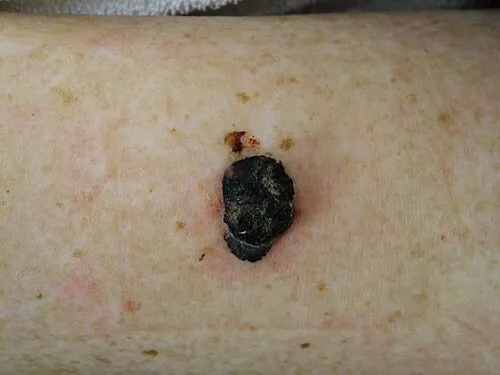
Cutaneous melanoma, a malignant tumour of melanocytes, causes most skin cancer deaths. Risk rises with intermittent intense sun exposure and sunburn, fair skin, many or atypical naevi, family history and immunosuppression. Main subtypes are superficial spreading, nodular, lentigo maligna and acral lentiginous (the commonest type in people with darker skin). Suspicious lesions are recognised with ABCDE, the weighted 7-point checklist, the 'ugly duckling' sign and dermoscopy, and removed by complete excisional biopsy with a 2 mm margin. Breslow thickness and ulceration define the AJCC 8th edition T stage and guide surgery: wide local excision with 0.5–2 cm margins and sentinel lymph node biopsy for tumours thicker than about 0.8–1 mm. After a positive sentinel node, completion lymphadenectomy is no longer routine; nodal ultrasound surveillance is used instead. Adjuvant anti-PD-1 or BRAF/MEK therapy is offered for high-risk stage II–III disease, neoadjuvant immunotherapy is now used for clinically detected nodes, and immunotherapy or targeted therapy has transformed metastatic disease.
Patient case, mechanism, investigations, management, flashcards and exam-style questions.Open the lesson →
Key facts
- Breslow thickness (mm from granular layer to deepest tumour cell) is the most important prognostic factor for a primary melanoma; ulceration is next
- AJCC 8th edition T categories: T1 ≤ 1.0 mm (T1a < 0.8 mm without ulceration; T1b < 0.8 mm with ulceration or 0.8–1.0 mm), T2 > 1–2, T3 > 2–4, T4 > 4 mm
- Diagnostic excision: full-thickness excisional biopsy with a 2 mm clinical margin; avoid shave biopsy of a suspected melanoma
- Wide local excision margins: in situ 0.5–1 cm; ≤ 2 mm thick about 1 cm (1–2 cm for 1–2 mm); > 2 mm thick 2 cm
- Sentinel lymph node biopsy is offered for melanomas > 1 mm and discussed for 0.8–1.0 mm or thinner ulcerated tumours; it stages but does not itself improve survival
- MSLT-II and DeCOG-SLT: completion lymph node dissection after a positive sentinel node does not improve melanoma-specific survival
- About 40–50% of cutaneous melanomas carry a BRAF V600 mutation; test from high-risk stage II (IIB–IIC) and in stage III–IV disease
- Acral lentiginous melanoma: palms, soles and nail beds; Hutchinson sign (pigment spreading onto the nail fold)
Differential diagnosis
| Condition | Clues | Key test |
|---|---|---|
| Benign melanocytic naevus | Symmetrical, uniform colour, stable | Dermoscopy; excise if changing |
| Dysplastic (atypical) naevus | Multiple irregular naevi, often on trunk | Dermoscopy, monitoring, excision if suspicious |
| Seborrhoeic keratosis | Stuck-on, warty, keratin plugs, older adult | Dermoscopy: milia-like cysts, comedo-like openings |
| Pigmented basal cell carcinoma | Pearly edge, telangiectasia, slow growth | Dermoscopy, biopsy |
| Haemangioma or angiokeratoma | Red-purple, blanchable or lacunae | Dermoscopy: red lacunae |
| Subungual haematoma | Trauma history, pigment grows out with nail | Monitor; biopsy if not growing out or Hutchinson sign |
| Pyogenic granuloma | Rapid bleeding red nodule (mimics amelanotic melanoma) | Excision with histology |
Exam pearls
Guideline
European consensus-based interdisciplinary guideline for melanoma (EADO/EDF/EORTC, 2024 update), NICE NG14 Melanoma: assessment and management (2015, with later updates), and AJCC 8th edition staging
References
- Garbe C, et al.. European consensus-based interdisciplinary guideline for melanoma. Part 1: Diagnostics – Update 2024. Eur J Cancer 2024.
- Garbe C, et al.. European consensus-based interdisciplinary guideline for melanoma. Part 2: Treatment – Update 2024. Eur J Cancer 2024.
- National Institute for Health and Care Excellence. Melanoma: assessment and management (NG14). NICE 2015.
- Keung EZ, Gershenwald JE.. The eighth edition American Joint Committee on Cancer (AJCC) melanoma staging system: implications for melanoma treatment and care. Expert Rev Anticancer Ther 2018.
- Faries MB, Thompson JF, Cochran AJ, et al.. Completion dissection or observation for sentinel-node metastasis in melanoma. N Engl J Med 2017.
- Patel SP, Othus M, Chen Y, et al.. Neoadjuvant-adjuvant or adjuvant-only pembrolizumab in advanced melanoma. N Engl J Med 2023.
Related topics
By Dr Khalid Seidi (B.Sc., M.D.) · MedEd World Clinical Knowledge library. Original teaching content checked against current guidelines (November 2026); confirm the latest local guidance before clinical use. Not a substitute for clinical judgement.