Clinical Knowledge › Surgery › Burns, plastic and skin surgery
Squamous cell carcinoma of the skin
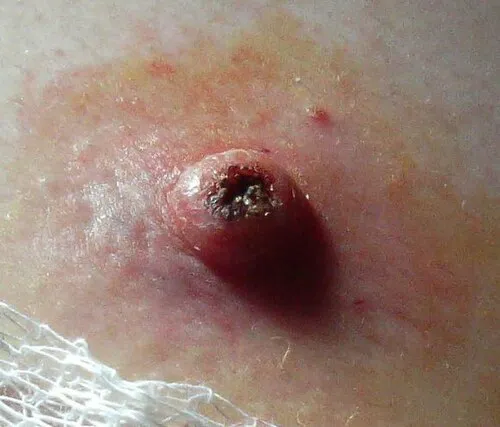
Cutaneous squamous cell carcinoma (cSCC) is a malignant tumour of epidermal keratinocytes and the second commonest skin cancer after basal cell carcinoma. Cumulative ultraviolet exposure is the main cause, so it arises on the head, neck, ears, lower lip, forearms and backs of the hands of older, fair-skinned people, often from actinic keratoses or Bowen disease. Immunosuppression, especially after organ transplantation, raises the risk dramatically and makes tumours more aggressive. It presents as a growing, tender, keratotic or ulcerated nodule; diagnosis is always histological. Most tumours are cured by surgical excision with clear margins (4–6 mm, or 10 mm for very high-risk lesions) or by Mohs micrographic surgery, but a minority recur or metastasise, mainly to regional lymph nodes and the parotid. Radiotherapy treats patients unfit for surgery and is used after surgery for high-risk features. Advanced disease is treated with anti-PD-1 immunotherapy (cemiplimab), which since 2025 also has an adjuvant role after surgery and radiotherapy for very high-risk tumours.
Patient case, mechanism, investigations, management, flashcards and exam-style questions.Open the lesson →
Key facts
- cSCC is the second commonest skin cancer; risk factors are cumulative UV exposure, fair skin, age, male sex, immunosuppression, chronic wounds and scars, and ionising radiation
- Organ transplant recipients have a 65–250-fold higher risk; SCC outnumbers BCC in them and behaves more aggressively
- Precursors: actinic keratosis (low per-lesion risk) and Bowen disease (SCC in situ, about 3–5% progress to invasion)
- A rapidly growing (weeks) crateriform nodule with a keratin plug is a keratoacanthoma, but it is managed as a well-differentiated SCC
- High-risk features: diameter 2 cm or more, thickness over 6 mm or invasion beyond subcutaneous fat, poor differentiation, perineural invasion, ear or lip site, recurrence, immunosuppression
- BAD margins for standard excision: 4 mm low risk, 6 mm high risk, 10 mm very high risk; Mohs surgery suits high-risk facial or recurrent tumours
- Metastasis is uncommon (about 2–5%) and mostly lymphatic, to regional and parotid nodes, usually within 2 years
- Anti-PD-1 therapy (cemiplimab) is first-line for advanced cSCC not curable by surgery or radiotherapy; adjuvant cemiplimab improved disease-free survival in the C-POST trial
Differential diagnosis
| Condition | Clues | Key test |
|---|---|---|
| Basal cell carcinoma | Pearly, rolled edge with telangiectasia; slow growth; rarely keratotic | Biopsy: palisading basaloid cells |
| Keratoacanthoma | Grows over weeks to a dome with a central keratin plug; may involute | Excision biopsy; treat as SCC |
| Actinic keratosis | Flat, rough, scaly patch without induration or tenderness | Clinical; biopsy if thick, tender or growing |
| Bowen disease (SCC in situ) | Slowly enlarging, well-demarcated scaly red plaque | Biopsy: full-thickness atypia, intact basement membrane |
| Amelanotic melanoma | Pink nodule, rapid growth, may bleed; no keratin | Excision biopsy with Breslow thickness |
| Pyoderma gangrenosum or chronic infection | Ulcer with undermined violaceous edge or discharge | Biopsy of edge; culture |
| Merkel cell carcinoma | Rapidly growing, painless red-violet nodule in older or immunosuppressed person | Biopsy with CK20 dot-like staining |
| Seborrhoeic keratosis (irritated) | Stuck-on, waxy, warty lesion with horn cysts | Dermoscopy; biopsy if doubt |
Exam pearls
Guideline
EADO/EDF/ESTRO/UEMS/EORTC European guideline for invasive cutaneous SCC, update 2026 (Parts 1 and 2), and BAD guidelines for cutaneous SCC 2020
References
- Stratigos AJ, Garbe C, Dessinioti C, et al.. European consensus-based interdisciplinary guideline for invasive cutaneous squamous cell carcinoma. Part 1: Diagnostics and prevention - Update 2026. Eur J Cancer 2026.
- Stratigos AJ, Garbe C, Dessinioti C, et al.. European consensus-based interdisciplinary guideline for invasive cutaneous squamous cell carcinoma: Part 2. Treatment - update 2026. Eur J Cancer 2026.
- Keohane SG, Botting J, Budny PG, et al.. British Association of Dermatologists guidelines for the management of people with cutaneous squamous cell carcinoma 2020. Br J Dermatol 2021.
- Rischin D, Porceddu S, Day F, et al.. Adjuvant cemiplimab or placebo in high-risk cutaneous squamous-cell carcinoma. N Engl J Med 2025.
- Karia PS, Jambusaria-Pahlajani A, Harrington DP, et al.. Evaluation of American Joint Committee on Cancer, International Union Against Cancer, and Brigham and Women's Hospital tumor staging for cutaneous squamous cell carcinoma. J Clin Oncol 2014.
- National Comprehensive Cancer Network. NCCN Clinical Practice Guidelines in Oncology: Squamous Cell Skin Cancer. NCCN 2026.
Related topics
By Dr Khalid Seidi (B.Sc., M.D.) · MedEd World Clinical Knowledge library. Original teaching content checked against current guidelines (November 2026); confirm the latest local guidance before clinical use. Not a substitute for clinical judgement.