Clinical Knowledge › Internal medicine › Haematology and oncology › Plasma cell disorders
Monoclonal gammopathy of undetermined significance (MGUS)
Monoclonal gammopathy of undetermined significance (MGUS) is an asymptomatic premalignant clonal plasma-cell or lymphoplasmacytic disorder defined by a serum monoclonal protein below 30 g/L, fewer than 10% clonal cells in the marrow and no myeloma-defining events, lymphoma or amyloidosis. It is found in about 3% of people over 50 and 5% over 70, more often in men, Black people and relatives of patients with myeloma. There are three types: non-IgM MGUS, which can progress to multiple myeloma or AL amyloidosis; IgM MGUS, which can progress to Waldenström macroglobulinaemia or other lymphomas; and light-chain MGUS. Overall progression is about 1% a year for life. The Mayo model (M-protein 15 g/L or more, non-IgG type, abnormal free light chain ratio) separates low-risk patients, who need only infrequent monitoring, from those needing marrow examination, imaging and annual follow-up. MGUS itself is not treated, but a small clone can still damage kidneys, nerves or skin, which is called monoclonal gammopathy of clinical significance.
Patient case, mechanism, investigations, management, flashcards and exam-style questions.Open the lesson →
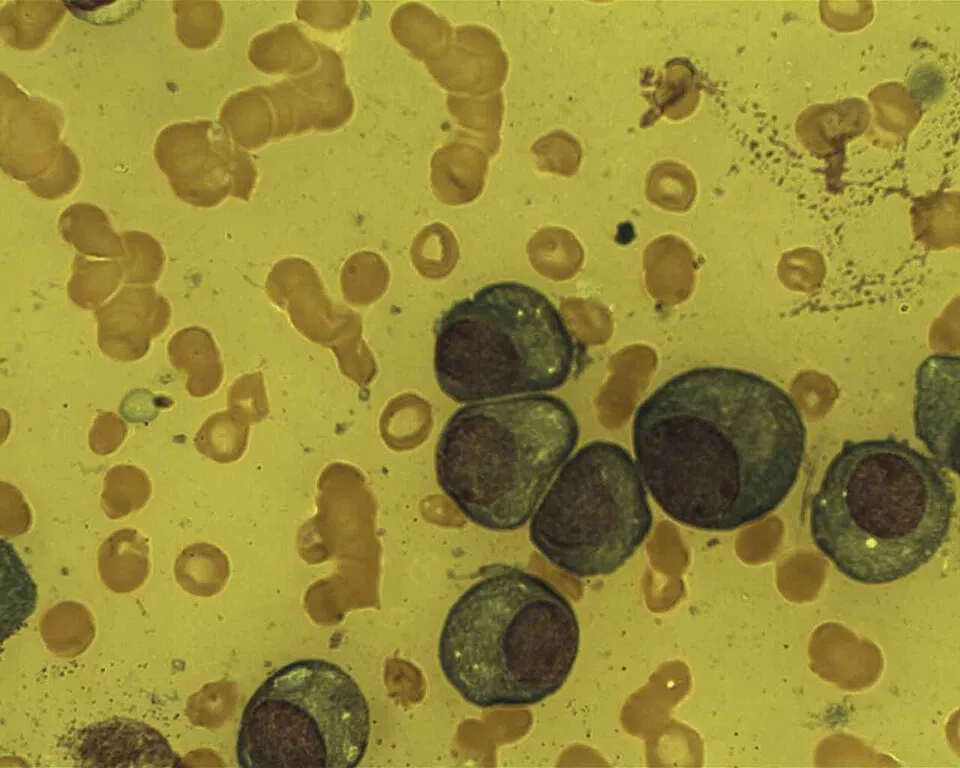
Key facts
- Non-IgM MGUS: serum M-protein <30 g/L, clonal marrow plasma cells <10%, and no CRAB features or amyloidosis attributable to the clone
- IgM MGUS: IgM M-protein <30 g/L, marrow lymphoplasmacytic infiltrate <10%, no anaemia, B symptoms, hyperviscosity, lymphadenopathy or organomegaly
- Light-chain MGUS: abnormal free light chain ratio with raised involved light chain, no heavy chain on immunofixation, urine M-protein <500 mg/24 h
- Prevalence about 3% over age 50 and 5% over 70; roughly twice as common in Black people and in first-degree relatives of patients with myeloma
- Risk of progression about 1% per year and does not fall with time; IgM MGUS progresses faster than non-IgM; light-chain MGUS slowest
- Mayo risk factors: M-protein ≥15 g/L, IgA or IgM type, abnormal FLC ratio (<0.26 or >1.65); 20-year progression about 5% with none and 58% with all three
- Low-risk MGUS (IgG <15 g/L, normal FLC ratio) usually needs no bone marrow or skeletal imaging
- MGUS increases risk of fractures, venous thrombosis and infections even without progression
Differential diagnosis
| Condition | Clues | Key test |
|---|---|---|
| Smouldering multiple myeloma | M-protein ≥30 g/L or marrow plasma cells 10–59% without myeloma-defining events | Bone marrow biopsy and whole-body low-dose CT or MRI |
| Multiple myeloma | CRAB features: hypercalcaemia, renal impairment, anaemia, lytic lesions; or SLiM biomarkers | Marrow plasma cells ≥10% plus myeloma-defining event |
| Waldenström macroglobulinaemia | IgM paraprotein with anaemia, lymphadenopathy, hyperviscosity or B symptoms | Marrow lymphoplasmacytic infiltrate, MYD88 L265P |
| AL amyloidosis | Nephrotic syndrome, heart failure, neuropathy, macroglossia with a small (often λ) clone | NT-proBNP, urine albumin; tissue biopsy with Congo red |
| Monoclonal gammopathy of renal significance | Proteinuria or falling eGFR with a 'MGUS-sized' clone | Kidney biopsy with immunofluorescence |
| Polyclonal hypergammaglobulinaemia | Broad diffuse gamma band in chronic infection, liver disease or autoimmunity | Immunofixation shows no monoclonal band |
| Chronic lymphocytic leukaemia or other B-cell lymphoma | Lymphocytosis, nodes or splenomegaly with a small paraprotein | Blood flow cytometry, CT |
Exam pearls
Guideline
BSH Good Practice Paper: investigation and management of MGUS (2023), IMWG updated criteria for the diagnosis of multiple myeloma (2014) with IMWG MGUS monitoring guidance (2010), and IKMG consensus on monoclonal gammopathy of renal significance (2019)
References
- Stern S, Chaudhuri S, Drayson M, et al.. Investigation and management of the monoclonal gammopathy of undetermined significance: A British Society for Haematology Good Practice Paper. Br J Haematol 2023.
- Rajkumar SV, Dimopoulos MA, Palumbo A, et al.. International Myeloma Working Group updated criteria for the diagnosis of multiple myeloma. Lancet Oncol 2014.
- Kyle RA, Durie BGM, Rajkumar SV, et al.. Monoclonal gammopathy of undetermined significance (MGUS) and smoldering (asymptomatic) multiple myeloma: IMWG consensus perspectives risk factors for progression and guidelines for monitoring and management. Leukemia 2010.
- Leung N, Bridoux F, Batuman V, et al.. The evaluation of monoclonal gammopathy of renal significance: a consensus report of the International Kidney and Monoclonal Gammopathy Research Group. Nat Rev Nephrol 2019.
- Kyle RA, Larson DR, Therneau TM, et al.. Long-term follow-up of monoclonal gammopathy of undetermined significance. N Engl J Med 2018.
- Rajkumar SV, Kyle RA, Therneau TM, et al.. Serum free light chain ratio is an independent risk factor for progression in monoclonal gammopathy of undetermined significance. Blood 2005.
Related topics
By Dr Khalid Seidi (B.Sc., M.D.) · MedEd World Clinical Knowledge library. Original teaching content checked against current guidelines (November 2026); confirm the latest local guidance before clinical use. Not a substitute for clinical judgement.