Clinical Knowledge › Internal medicine › Haematology and oncology › Plasma cell disorders
Multiple myeloma
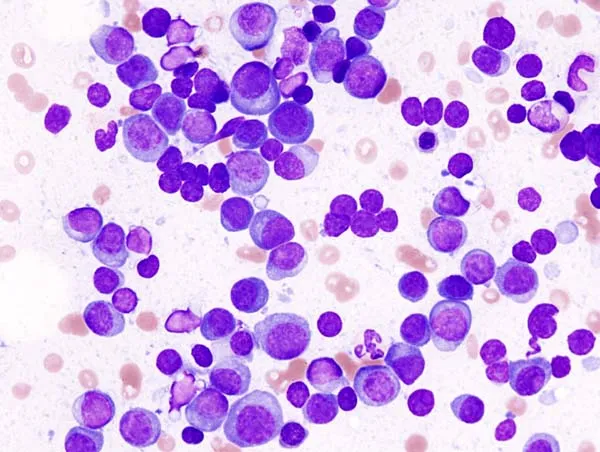
Multiple myeloma is a malignancy of clonal plasma cells in the bone marrow that usually secrete a monoclonal immunoglobulin (paraprotein) or free light chains. It is almost always preceded by monoclonal gammopathy of undetermined significance (MGUS) and often by smouldering myeloma. End-organ damage follows the CRAB pattern: hypercalcaemia, renal impairment, anaemia and lytic bone lesions, with recurrent infection from immunoparesis. Typical patients have back pain, fatigue and a high ESR, or an incidental raised globulin. Diagnosis rests on serum protein electrophoresis with immunofixation, serum free light chains, bone marrow examination and whole-body low-dose CT, PET-CT or MRI; the IMWG 2014 criteria require at least 10% clonal plasma cells plus a CRAB or SLiM myeloma-defining event. Treatment has been transformed by quadruplet induction combining an anti-CD38 antibody with bortezomib, lenalidomide and dexamethasone, autologous transplant for fit patients and lenalidomide maintenance, while CAR-T cells and bispecific antibodies treat relapse.
Patient case, mechanism, investigations, management, flashcards and exam-style questions.Open the lesson →
Key facts
- Clonal plasma cell neoplasm; almost always preceded by MGUS (progression about 1% per year)
- IMWG 2014 diagnosis: clonal marrow plasma cells 10% or more (or plasmacytoma) plus at least one myeloma-defining event (CRAB or SLiM)
- CRAB: calcium above 2.75 mmol/L (11 mg/dL); creatinine above 177 µmol/L or CrCl below 40 mL/min; Hb below 100 g/L; one or more lytic lesions
- SLiM biomarkers: 60% or more clonal plasma cells, involved:uninvolved free light chain ratio 100 or more, more than one focal MRI lesion of 5 mm or more
- First tests: serum protein electrophoresis with immunofixation plus serum free light chains (together detect almost all cases)
- Imaging: whole-body low-dose CT is preferred to the skeletal survey; PET-CT or whole-body MRI as alternatives
- Transplant-eligible: daratumumab–bortezomib–lenalidomide–dexamethasone induction, autologous transplant, consolidation and lenalidomide maintenance (PERSEUS)
- Bone protection (zoledronic acid or denosumab), VTE prophylaxis with lenalidomide, and aciclovir with bortezomib or anti-CD38 therapy are standard supportive care
Differential diagnosis
| Condition | Clues | Key test |
|---|---|---|
| MGUS | Paraprotein below 30 g/L, marrow plasma cells below 10%, no end-organ damage | SPEP, sFLC, marrow if indicated |
| Smouldering myeloma | Paraprotein 30 g/L or more or plasma cells 10–59% without myeloma-defining events | Marrow, whole-body MRI or low-dose CT |
| AL amyloidosis | Nephrotic syndrome, cardiomyopathy, macroglossia, neuropathy; low plasma cell burden | Tissue biopsy with Congo red; NT-proBNP |
| Waldenström macroglobulinaemia | IgM paraprotein, lymphadenopathy, hyperviscosity, no lytic lesions | Marrow: lymphoplasmacytic cells, MYD88 L265P |
| Bone metastases from carcinoma | Known primary (breast, prostate, lung, kidney, thyroid); raised ALP | CT, biopsy; no monoclonal protein |
| Primary hyperparathyroidism | Hypercalcaemia with raised or inappropriately normal PTH | PTH, no paraprotein |
| Polyclonal hypergammaglobulinaemia | Chronic infection, liver disease, autoimmune disease; broad gamma band | SPEP: no discrete M-spike |
Exam pearls
Guideline
IMWG updated diagnostic criteria (2014), EHA–EMN evidence-based guidelines for multiple myeloma (2025) and IMWG response criteria (2016)
References
- Rajkumar SV, Dimopoulos MA, Palumbo A, et al.. International Myeloma Working Group updated criteria for the diagnosis of multiple myeloma. Lancet Oncol 2014.
- Dimopoulos MA, et al.. European Myeloma Network/European Hematology Association evidence-based guidelines for diagnosis, treatment and follow-up of patients with multiple myeloma. Nat Rev Clin Oncol 2025.
- Kumar S, Paiva B, Anderson KC, et al.. International Myeloma Working Group consensus criteria for response and minimal residual disease assessment in multiple myeloma. Lancet Oncol 2016.
- Sonneveld P, Dimopoulos MA, Boccadoro M, et al.. Daratumumab, bortezomib, lenalidomide, and dexamethasone for multiple myeloma. N Engl J Med 2024.
- Facon T, Dimopoulos MA, Leleu XP, et al.. Isatuximab, bortezomib, lenalidomide, and dexamethasone for multiple myeloma. N Engl J Med 2024.
- Palumbo A, Avet-Loiseau H, Oliva S, et al.. Revised International Staging System for multiple myeloma: a report from International Myeloma Working Group. J Clin Oncol 2015.
Related topics
By Dr Khalid Seidi (B.Sc., M.D.) · MedEd World Clinical Knowledge library. Original teaching content checked against current guidelines (November 2026); confirm the latest local guidance before clinical use. Not a substitute for clinical judgement.