Clinical Knowledge › Internal medicine › Infectious diseases › Respiratory infections
Mumps
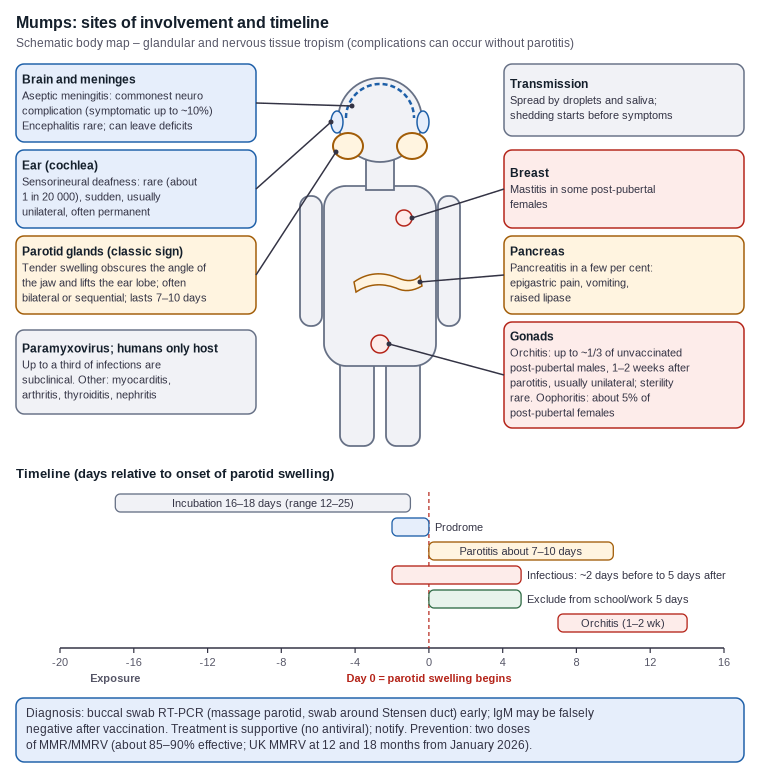
Mumps is an acute systemic infection by the mumps virus, an enveloped negative-sense RNA paramyxovirus spread by respiratory droplets and saliva. After an incubation of 16–18 days (range 12–25), a short prodrome of fever, malaise and headache is followed by painful swelling of one or both parotid glands, which obscures the angle of the jaw and pushes the ear lobe up and out. Up to a third of infections are subclinical. The virus has a tropism for glandular and nervous tissue: post-pubertal males may develop orchitis, and aseptic meningitis, oophoritis, mastitis, pancreatitis, encephalitis and sensorineural deafness also occur, sometimes without parotitis. Diagnosis is confirmed by RT-PCR of a buccal swab taken from around the parotid duct, or by IgM serology, which can be falsely negative in vaccinated people. Treatment is supportive; patients are excluded for 5 days after the onset of swelling and cases are notified. Two doses of MMR (or MMRV) vaccine prevent most disease, but waning immunity allows outbreaks among vaccinated young adults.
Patient case, mechanism, investigations, management, flashcards and exam-style questions.Open the lesson →
Key facts
- Mumps virus: paramyxovirus (Orthorubulavirus) with haemagglutinin–neuraminidase (HN) and fusion (F) proteins; one serotype; humans are the only host
- Incubation 16–18 days (12–25); infectious from about 2 days before to 5 days after parotid swelling begins
- Parotitis is the classic sign: swelling obscures the angle of the mandible and lifts the ear lobe; often bilateral, sometimes sequential
- Orchitis affects up to about a third of unvaccinated post-pubertal males, usually unilateral, 1–2 weeks after parotitis; sterility is rare
- Aseptic meningitis is the commonest neurological complication; sensorineural deafness is rare but may be permanent
- Buccal swab RT-PCR is the test of choice early; IgM may be negative in previously vaccinated people
- Treatment is supportive; exclude from school or work for 5 days after onset of swelling; mumps is notifiable
- Two MMR doses are about 85–90% effective; the UK moved to MMRV at 12 and 18 months from January 2026
Differential diagnosis
| Condition | Clues | Key test |
|---|---|---|
| Acute bacterial (suppurative) parotitis | Older, dehydrated or post-operative patient; pus from Stensen duct; very tender | Pus culture (S. aureus); ultrasound |
| Other viral parotitis | EBV, parainfluenza, influenza A, CMV, enteroviruses, HIV | Viral PCR and serology |
| Salivary stone (sialolithiasis) | Swelling and pain with meals; usually submandibular | Ultrasound or sialography |
| Cervical lymphadenitis | Swelling below the jaw, angle of mandible preserved | Examination; ultrasound |
| Sjögren syndrome or sarcoidosis | Chronic or recurrent bilateral swelling, dry eyes; uveitis and facial palsy in Heerfordt syndrome | Anti-Ro/La, ACE, biopsy |
| Parotid tumour | Slowly enlarging firm mass, facial nerve palsy if malignant | Ultrasound, fine-needle aspiration |
| Testicular torsion (for orchitis) | Sudden severe pain, high-riding testis, absent cremasteric reflex | Urgent surgical exploration; Doppler ultrasound |
Exam pearls
Guideline
UKHSA Green Book chapter 23 Mumps and UK childhood schedule change to MMRV (January 2026), WHO mumps virus vaccines position paper (2007), and CDC/ACIP MMR recommendations including a third dose in outbreaks (2017, published 2018)
References
- UK Health Security Agency. Immunisation against infectious disease (the Green Book), chapter 23: Mumps (online chapter, updated periodically). 2006.
- UK Health Security Agency. Changes to the routine childhood immunisation schedule from January 2026: introduction of MMRV vaccine. UKHSA 2025.
- World Health Organization. Mumps virus vaccines: WHO position paper. Wkly Epidemiol Rec 2007.
- Marin M, Marlow M, Moore KL, Patel M. Recommendation of the Advisory Committee on Immunization Practices for use of a third dose of mumps virus-containing vaccine in persons at increased risk for mumps during an outbreak. MMWR Morb Mortal Wkly Rep 2018.
- Hviid A, Rubin S, Mühlemann K. Mumps. Lancet 2008.
- Cardemil CV, Dahl RM, James L, et al.. Effectiveness of a third dose of MMR vaccine for mumps outbreak control. N Engl J Med 2017.
Related topics
By Dr Khalid Seidi (B.Sc., M.D.) · MedEd World Clinical Knowledge library. Original teaching content checked against current guidelines (November 2026); confirm the latest local guidance before clinical use. Not a substitute for clinical judgement.