Clinical Knowledge › Paediatrics › Renal and urological disorders
Nephrotic syndrome in children
Nephrotic syndrome (heavy proteinuria, hypoalbuminaemia, oedema) is the commonest childhood glomerular disease, peaking at 2–6 years, commoner in boys and South Asian children. Most cases are idiopathic, and in young children the underlying lesion is usually minimal change disease, so biopsy is not needed at onset. Children present with morning periorbital swelling, then leg, scrotal or labial oedema and ascites. Treatment is guided by response to glucocorticoids rather than histology: an 8-week course of prednisolone (60 mg/m2 daily for 4 weeks, then 40 mg/m2 on alternate days for 4 weeks) induces remission in about 85–90% (steroid-sensitive). Most children relapse and about half relapse frequently or become steroid dependent, needing steroid-sparing agents such as levamisole, mycophenolate, calcineurin inhibitors, cyclophosphamide or rituximab. Steroid resistance needs biopsy and genetic testing. Dangerous complications are hypovolaemia, thrombosis and infection, especially pneumococcal peritonitis. Most steroid-sensitive children outgrow the disease with normal kidney function.
Patient case, mechanism, investigations, management, flashcards and exam-style questions.Open the lesson →
Key facts
- Incidence about 2–17 per 100 000 children per year; peak 2–6 years; boys about 2:1 in young children; more common in South Asian children
- Definition (IPNA/KDIGO): urine protein:creatinine ratio 200 mg/mmol or more (or 3+ dipstick) with serum albumin under 30 g/L or oedema
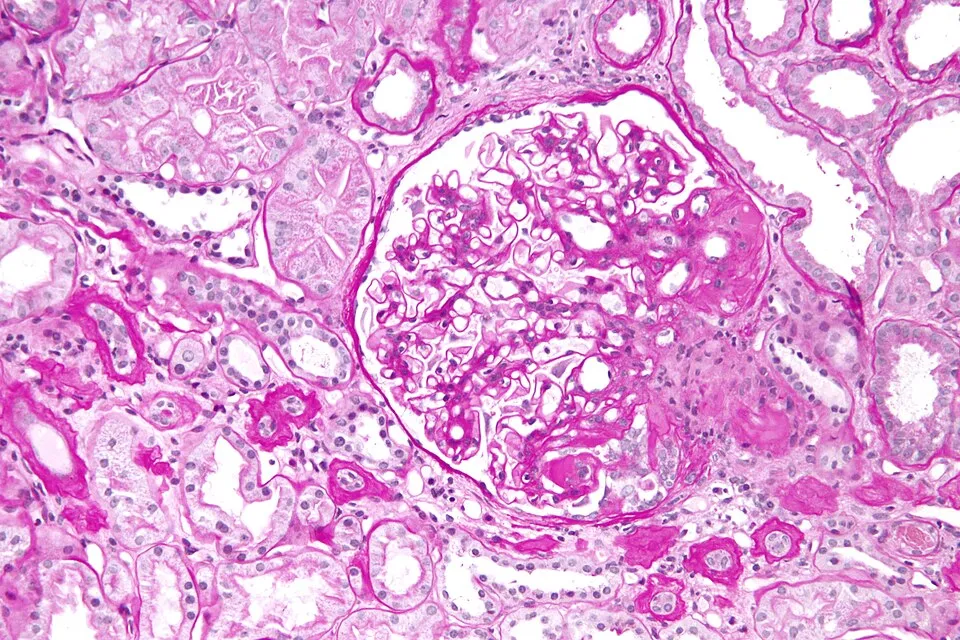
- Minimal change disease underlies most cases aged 1–10 years; biopsy not needed at presentation with typical features
- Initial prednisolone 60 mg/m2/day (max 60 mg) for 4 weeks, then 40 mg/m2 alternate days (max 40 mg) for 4 weeks
- About 85–90% are steroid sensitive; up to 80% relapse; about half become frequently relapsing or steroid dependent
- Steroid resistance (no remission after 4 weeks of daily prednisolone, confirmed over a further period) needs biopsy and genetic testing
- Complications: hypovolaemia, venous thrombosis, infection (pneumococcal peritonitis, cellulitis), AKI, hyperlipidaemia, steroid toxicity
- Remission: negative or trace dipstick (UPCR 20 mg/mmol or less) on 3 consecutive days; relapse: 3+ dipstick on 3 consecutive days
Differential diagnosis
| Condition | Clues | Key test |
|---|---|---|
| Acute post-streptococcal glomerulonephritis | Haematuria, hypertension, oliguria, recent sore throat or impetigo, low C3 | ASO/anti-DNase B, C3, urinalysis with red cell casts |
| IgA vasculitis nephritis | Purpura on legs, arthralgia, abdominal pain, haematuria | Clinical; urinalysis; biopsy if nephrotic |
| Lupus nephritis | Adolescent girl, rash, arthritis, cytopenias, low C3/C4 | ANA, anti-dsDNA, complement, biopsy |
| Congenital nephrotic syndrome | Onset before 3 months, large placenta, Finnish ancestry | Genetic testing (NPHS1, NPHS2) |
| Protein-losing enteropathy | Oedema and low albumin without proteinuria | Urine dipstick negative; stool alpha-1 antitrypsin |
| Liver disease or malnutrition (kwashiorkor) | Low albumin, oedema, liver signs or poor diet | Liver tests, urine protein negative |
| Heart failure | Oedema with hepatomegaly, gallop rhythm, tachypnoea | Echocardiography; urine protein negative |
| Allergic periorbital swelling | Itchy swelling after allergen, no proteinuria | Urine dipstick negative |
Exam pearls
Guideline
KDIGO 2025 Clinical Practice Guideline for the Management of Nephrotic Syndrome in Children; IPNA recommendations for steroid-sensitive (2023) and steroid-resistant (2020) nephrotic syndrome
References
- Kidney Disease: Improving Global Outcomes (KDIGO) Nephrotic Syndrome in Children Work Group. KDIGO 2025 Clinical Practice Guideline for the Management of Nephrotic Syndrome in Children. Kidney Int 2025.
- Trautmann A, Boyer O, Hodson E, et al.. IPNA clinical practice recommendations for the diagnosis and management of children with steroid-sensitive nephrotic syndrome. Pediatr Nephrol 2023.
- Trautmann A, Vivarelli M, Samuel S, et al.. IPNA clinical practice recommendations for the diagnosis and management of children with steroid-resistant nephrotic syndrome. Pediatr Nephrol 2020.
- Webb NJA, Woolley RL, Lambe T, et al.. Long term tapering versus standard prednisolone treatment for first episode of childhood nephrotic syndrome: phase III randomised controlled trial and economic evaluation. BMJ 2019.
- Christian MT, Webb NJA, Mehta S, et al.. Evaluation of daily low-dose prednisolone during upper respiratory tract infection to prevent relapse in children with relapsing steroid-sensitive nephrotic syndrome: the PREDNOS 2 randomized clinical trial. JAMA Pediatr 2022.
- Frangou E, Kronbichler A, Steiger S, et al.. The 2025 KDIGO guideline on the management of nephrotic syndrome in children: a comment of the European Renal Association Immunonephrology Working Group. Clin Kidney J 2025.
Related topics
By Dr Khalid Seidi (B.Sc., M.D.) · MedEd World Clinical Knowledge library. Original teaching content checked against current guidelines (November 2026); confirm the latest local guidance before clinical use. Not a substitute for clinical judgement.