Clinical Knowledge › Paediatrics › Renal and urological disorders
Vesicoureteric reflux
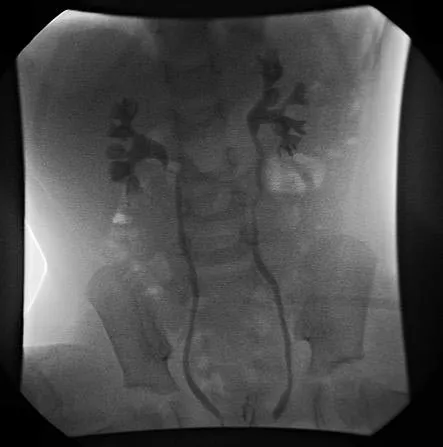
Vesicoureteric reflux (VUR) is retrograde flow of urine from the bladder into the ureter and kidney. Primary VUR results from a short intravesical ureteric tunnel; secondary VUR follows raised bladder pressure, as with posterior urethral valves or neurogenic bladder. VUR affects about 1% of children but 30–40% of children investigated after a febrile urinary tract infection, and it is strongly familial. It presents either after antenatal detection of urinary tract dilatation (mostly boys, often high grade) or after febrile UTI (mostly girls). Micturating cystourethrography (MCUG) grades reflux I to V; DMSA shows scarring. Low-grade reflux usually resolves as the child grows. Management is individualised: treat bladder and bowel dysfunction, treat febrile UTI promptly, and consider prophylaxis for high-grade reflux or recurrent infection, balancing fewer UTIs against resistance (RIVUR, PREDICT). Endoscopic injection or reimplantation is reserved for breakthrough infection, new scars or persistent high-grade reflux. The main long-term risk is reflux nephropathy.
Patient case, mechanism, investigations, management, flashcards and exam-style questions.Open the lesson →
Key facts
- VUR is present in about 1% of children and 30–40% of children with febrile UTI
- Primary VUR: short intravesical tunnel (normal tunnel length to ureteric diameter ratio about 5:1); secondary VUR: high bladder pressure (posterior urethral valves, neurogenic bladder)
- Familial: about a third of siblings and offspring of affected children have VUR
- International grading on MCUG: I ureter only, II to pelvis without dilatation, III mild dilatation, IV moderate dilatation with blunted fornices, V gross dilatation and tortuosity
- Spontaneous resolution is common in grades I–III and less likely in IV–V, bilateral reflux and bladder dysfunction
- RIVUR: prophylaxis halved recurrent UTI but did not reduce scarring and increased resistance
- PREDICT (2023): in infants with grade III–V VUR and no prior UTI, prophylaxis reduced first UTI (21% vs 36%) without changing scarring
- Surgery (endoscopic injection or reimplantation) for breakthrough febrile UTI, new scars or persistent high-grade VUR
Differential diagnosis
| Condition | Clues | Key test |
|---|---|---|
| Posterior urethral valves | Boy with poor stream, palpable bladder, bilateral hydroureteronephrosis | MCUG: dilated posterior urethra, thick trabeculated bladder |
| Pelviureteric junction obstruction | Pelvic dilatation without ureteric dilatation | Ultrasound; MAG3 diuretic renogram |
| Vesicoureteric junction obstruction (primary megaureter) | Dilated ureter down to the bladder without reflux | MCUG negative; MAG3 renogram |
| Duplex kidney with ureterocele | Upper-pole dilatation, cystic structure in bladder | Ultrasound; MCUG shows lower-pole reflux |
| Neurogenic bladder | Spina bifida, sacral agenesis, wetting, constipation | Spinal imaging; urodynamics |
| Multicystic dysplastic kidney | Non-functioning cystic kidney on antenatal scan | Ultrasound; DMSA no function |
Exam pearls
Guideline
EAU/ESPU Guidelines on Paediatric Urology – VUR chapter (latest annual edition, 2025), AUA guideline on primary VUR in children (2010, amended 2017), NICE NG224 UTI in under 16s (2022)
References
- European Association of Urology / European Society for Paediatric Urology. EAU Guidelines on Paediatric Urology: vesicoureteric reflux. EAU Guidelines Office, Arnhem 2025.
- Peters CA, Skoog SJ, Arant BS Jr, et al.. Management and screening of primary vesicoureteral reflux in children: AUA guideline. American Urological Association 2010.
- National Institute for Health and Care Excellence. Urinary tract infection in under 16s: diagnosis and management (NG224). NICE guideline 2022.
- RIVUR Trial Investigators; Hoberman A, Greenfield SP, Mattoo TK, et al.. Antimicrobial prophylaxis for children with vesicoureteral reflux. N Engl J Med 2014.
- Morello W, Baskin E, Jankauskiene A, et al.. Antibiotic prophylaxis in infants with grade III, IV, or V vesicoureteral reflux. N Engl J Med 2023.
- Lebowitz RL, Olbing H, Parkkulainen KV, Smellie JM, Tamminen-Möbius TE.. International system of radiographic grading of vesicoureteric reflux. International Reflux Study in Children. Pediatr Radiol 1985.
Related topics
By Dr Khalid Seidi (B.Sc., M.D.) · MedEd World Clinical Knowledge library. Original teaching content checked against current guidelines (November 2026); confirm the latest local guidance before clinical use. Not a substitute for clinical judgement.